
What if the numbers on your screen are actually costing you more than you realize? Most operators feel the daily pressure of watching competitor rates drop while their own fleet sits idle. It's frustrating to manage the constant flow of information from OTAs and GDS without a clear plan. When you're buried under raw numbers, rental car market data can feel like a burden rather than a strategic resource.
We believe that pricing shouldn't be a guessing game. In this article, you'll learn how to navigate complex market signals to optimize your fleet pricing and stay ahead of the competition. We'll provide a clear framework for categorizing your intelligence so you can distinguish between useless noise and actionable insights.
By the end of this guide, you'll understand how to use data-driven decisions to improve your fleet yield. We'll explore the synergy between high-tech automation and human intuition, helping you move from reactive pricing to strategic control. It's time to turn your data into your most powerful competitive advantage.
Key Takeaways
• Learn to distinguish between static historical reports and the real-time intelligence required for continuous, modern pricing.
• Balance fleet utilization with competitor movements to maximize your daily yield without sacrificing occupancy.
• Master a structured framework for filtering rental car market data to turn overwhelming numbers into actionable business decisions.
• See how Enhanced Intelligence® uses a synergy of automation and human intuition to keep your rates precise and profitable.
• Identify practical steps to aggregate and filter data across complex channels so you can react faster than the competition.
What is Rental Car Market Data and Why Does it Matter?
At its core, rental car market data is the pulse of your daily operations. It isn't just a collection of numbers on a spreadsheet; it's a strategic map that shows you exactly where your business stands in relation to the rest of the world. In a B2B context, this data includes competitor pricing, fleet availability, and shifting demand signals across Global Distribution Systems (GDS) and Online Travel Agencies (OTAs). Understanding these variables allows you to set the right price at the right time, rather than relying on guesswork.
There's a vital distinction between historical reports and real-time intelligence. Historical data is like a rearview mirror; it helps you understand long-term seasonal trends and past performance. However, you can't drive a car by only looking backward. Real-time intelligence acts as your radar. It tells you what's happening on the road ahead right now, allowing you to react to a competitor's sudden price drop or a surprise surge in local demand before the opportunity vanishes.
The Evolution of Market Visibility
The industry has come a long way from the days of physical logbooks and manual rate shopping. This car rental industry overview shows how the business model has expanded into a complex, digital ecosystem. With the "big data" explosion, the sheer volume of information available is staggering. In 2026, manual data collection is no longer a viable strategy. The market moves too fast for human eyes to track every change across every channel. Today, the speed of acquisition is your primary competitive advantage. If you don't have the data within minutes, you're already behind.
Data as a Defensive and Offensive Tool
Think of rental car market data as both a shield and a sword. Defensively, it's about protecting your market share. When an aggressive discounter enters your territory, you need to know immediately to decide if you should match their rate or hold your ground based on your current utilization. Offensively, data helps you identify "pockets" of high demand. If a local festival or flight delay causes a sudden spike in searches for SUVs, you can adjust your rates upward to capture that premium revenue.
Flying blind in a volatile market is a risk no modern operator should take. We've moved beyond periodic pricing where you set your rates once a week and hope for the best. Modern pricing is continuous. By using tools like RateIndex, you can see market shifts as they happen. This constant flow of information ensures that your fleet is always priced to move, balancing high utilization with the best possible yield.
The Four Pillars of Actionable Rental Car Intelligence
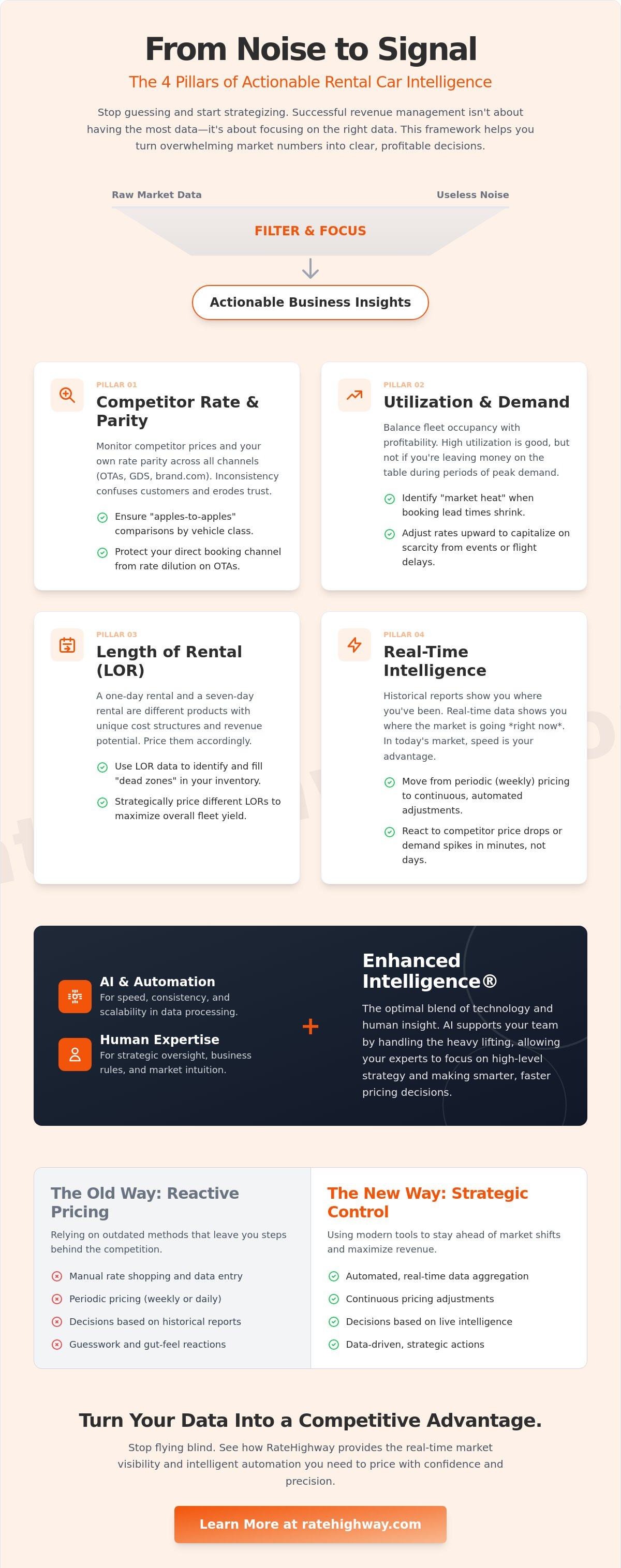
Data is only as good as the decisions it fuels. While macro trends give you a general sense of direction, four specific pillars of intelligence determine your daily success. These pillars transform raw rental car market data into a strategic playbook for your revenue manager. By focusing on these areas, you move from simply reacting to the market to actively shaping your fleet's performance. It's about seeing the whole field, not just the car in front of you.
Competitor Rate Shopping and Parity
Consistency is your best reputation builder. You must monitor rates across OTAs, brand sites, and Global Distribution Systems to ensure true rate parity. It isn't just about what the competitor across the street is doing; it's about making sure your own prices are consistent across every channel. If your brand site is more expensive than an OTA, you're essentially paying commissions for bookings you could've captured directly. Always ensure you're making "apples-to-apples" comparisons by vehicle class, as a midsize sedan and a small SUV serve very different customer needs and price points.
Utilization and Demand Forecasting
Utilization tells you how much of your engine is actually running. When you see booking lead times shrinking, it's a sign of "market heat." This is where price elasticity comes into play. If your fleet is at 90% utilization and demand is still climbing due to local market anomalies like festivals, weather events, or flight delays, your rates should reflect that scarcity. It's a delicate balance of volume and value. Just as Detroit Furnished Rentals monitors local cultural events and museum schedules to optimize occupancy, your car rental pricing should ensure you aren't leaving money on the table during peak demand periods.
The Critical Role of Length of Rental (LOR)
Length of rental is often the missing piece of the puzzle for many operators. A one-day rental and a seven-day rental are different products with different cost structures. Use LOR data to identify "dead zones" in your inventory where cars might sit idle. For example, if you have high demand for weekend trips but low utilization on Tuesdays and Wednesdays, you can use LOR-based pricing to bridge those shoulder days. This strategy helps you optimize your fleet schedule and ensures your assets are consistently generating revenue throughout the week.
Mastering these pillars requires a partner who understands the "tight turns" and complexities of the industry. If you want to see how these insights apply to your specific location and fleet mix, you can reach out to our team for a deeper discussion on your strategy. By refining your approach to rental car market data, you gain the strategic control needed to thrive in a fast-moving market.
Enhanced Intelligence®: Blending Data with Human Expertise
Data is a raw material. Without a framework to process it, rental car market data is just a flood of information that can paralyze your decision-making. Enhanced Intelligence® represents the synergy between advanced technology and human intuition. It's the philosophy that pricing shouldn't be a "black box" where numbers go in and a price comes out without explanation. Instead, it's a collaborative process where AI handles the heavy lifting of data analysis, allowing you to focus on high-level strategy.
Modern revenue management is about finding the right price at the right time based on current market conditions, demand, and utilization. This requires a continuous approach rather than periodic updates. When you use AI revenue management, you're not handing over the keys to your business. You're giving your revenue manager a high-performance tool that enhances their existing knowledge and local expertise.
AI as a Support Tool, Not a Replacement
Think of your revenue manager as a pilot and automation as the sophisticated flight computer. AI processes millions of data points across OTAs and GDS faster than any human team ever could. It identifies subtle patterns in booking velocity and competitor movement that might otherwise go unnoticed. However, human oversight remains essential for "black swan" events, such as sudden regulatory changes or unexpected local disruptions. Automation provides the speed and consistency needed to keep up with fast-moving markets, but your judgment provides the necessary context. It's about speed and precision, not total autonomy.
Setting Business Rules for Automated Pricing
Effective automation relies on clear business rules. These act as "guardrails" that prevent irrational price drops or spikes that don't align with your brand's value. For instance, you can set rules that trigger a human review if a competitor drops their rate by a certain percentage. This ensures that high-stakes decisions always have a pair of eyes on them. Tools like RateMonitor Elite allow you to configure these rules to match your specific fleet needs and risk tolerance. You define the strategy, and the technology executes the tactical maneuvers.
You shouldn't have to guess why your pricing changed. Understanding your pricing logic is vital for building trust in your systems and your team. When you combine the scalability of automation with the strategic oversight of an experienced manager, you create a system that is both fast-paced and methodical. This balanced approach ensures you stay ahead of the competition without losing control of your operational goals. By refining how you use rental car market data, you turn a source of noise into a clear signal for growth.
Turning Raw Market Data into a Pricing Strategy
Strategy is where the rubber meets the road. Having access to rental car market data is a strong start, but its true value lies in how you implement it. To move from raw information to a profitable rate, you need a repeatable process. This isn't about making one-off guesses; it's about building a system that reacts with the same precision as a high-performance engine. By following a structured framework, you ensure that every price change is backed by logic and aligned with your fleet goals.
A successful pricing workflow typically follows these five steps:
Step 1: Aggregate.
Gather data from multiple reliable sources, including GDS and major OTAs, to get a complete view of the landscape.
Step 2: Filter.
Narrow your focus to what matters. Filter by specific airport or off-airport locations, car classes, and Length of Rental (LOR).
Step 3: Compare.
Align market intelligence with your internal fleet utilization. If your lot is empty, a competitor's price drop might not require a response.
Step 4: Execute.
Use an automated engine like RateMonitor Elite to push price adjustments to your channels instantly.
Step 5: Monitor.
Track the results of your changes. If your booking velocity doesn't improve, it's time to refine your business rules.
Filtering Noise from Intelligence
Not all data points deserve your attention. In fact, some can be misleading. You'll often encounter "phantom" rates, which are prices displayed on certain sites that don't actually result in confirmed bookings. If you chase these ghost prices, you'll end up eroding your margins for no reason. Focus your energy on your true local competitors, not just the global brands. A local independent operator might have a different impact on your demand than a massive franchise. Weight your data sources based on their historical accuracy and how often they actually convert into customers in your specific market.
Continuous vs. Periodic Adjustments
The "set it and forget it" model is a relic of the past. In 2026, the market moves too quickly for weekly or even daily updates to be enough. Continuous pricing is the new standard. Intraday pricing movements allow you to capture revenue during sudden demand spikes that a periodic approach would miss entirely. However, you must also manage "rate fatigue." If your prices fluctuate too wildly without a clear strategy, you risk confusing your customers. The goal is steady, purposeful movement that keeps you at the front of the pack.
Modern pricing requires a balance of speed and strategic oversight. If you're ready to turn your raw data into a competitive advantage, contact us today to see how we can help you streamline your operations. By refining your approach to rental car market data, you gain the strategic control needed to thrive in any market condition.
Navigating the Market with RateIndex and RateMonitor Elite
Information is only powerful if you can act on it. While understanding the theory of rental car market data is essential, you need the right tools to put those insights into motion. RateHighway provides the infrastructure that bridges the gap between raw numbers and daily revenue growth. By centralizing your market intelligence, we help you move away from fragmented spreadsheets and toward a unified strategic vision. It's about having the right gear to handle the tight turns of a shifting industry.
The journey toward smarter pricing begins with visibility. Using RateIndex, you gain access to real-time rate shopping across multiple channels. This isn't just about seeing a list of prices; it's about understanding how your competitors are positioned right now. Once you have that clarity, RateMonitor Elite allows you to execute your pricing strategy with surgical precision. This combination ensures that your fleet is always priced optimally, reflecting the most current market conditions without the need for manual guesswork.
Visibility Meets Execution
Speed is the ultimate differentiator in revenue management. When a market shift occurs, the time it takes to see the change and update your rates can be the difference between a booked fleet and an empty lot. Our platform is designed to close this gap. By configuring the system to match your specific fleet goals, you reduce the need for manual entry. This shift allows your team to stop being data gatherers and start being master strategists. Through Enhanced Intelligence®, you get the benefit of high-speed automation while maintaining total control over your business rules.
Scaling Your Independent Brand
You don't need a massive corporate office to compete with the global brands. Small and independent operators can use the same high-level rental car market data tools to protect their margins. In a volatile market, having a co-pilot that monitors price elasticity and competitor movement continuously is invaluable. It levels the playing field, allowing you to react to demand surges or aggressive discounting with confidence. You can focus on providing excellent service while the technology handles the tactical pricing maneuvers in the background. To see how an independent provider presents a practical fleet to their customers, check out Drive NZ Rental Cars.
Taking the next step doesn't have to be complicated. We recommend requesting a custom market data audit to see exactly where your current strategy stands. By identifying leakage in your revenue or missed opportunities in your utilization, you can begin to refine your approach. The industry is moving toward continuous, data-driven pricing, and having the right partner makes all the difference. It's time to take strategic control and drive your business forward with precision.
Drive Your Revenue Forward with Precision
The transition from periodic rate updates to continuous, real-time pricing is no longer optional. It's the standard for staying competitive in a fast-moving market. By focusing on the four pillars of intelligence and filtering out market noise, you can protect your margins even during periods of high volatility. This strategy relies on the synergy of automation and your own professional judgment. It's about having the speed to react to a competitor's move and the wisdom to know when to hold your ground.
RateHighway has been a trusted partner for operators globally since 2008. Our proprietary Enhanced Intelligence® technology draws from over 50 global sources to provide a clear view of the competitive landscape. We don't just provide rental car market data; we provide the strategic framework you need to win. See how RateMonitor Elite turns data into revenue and start making faster, smarter decisions today. You have the local knowledge, and we have the tools to help you scale it.
Frequently Asked Questions
What is the most important data point in rental car market analysis?
The most important factor is the synergy between your current fleet utilization and competitor pricing. Neither number provides a complete picture on its own. If your lot is nearly empty, a competitor's price drop is less relevant than if you have high inventory. You must balance these two metrics to find the right price at the right time for your specific location.
How often should I check competitor rates in the current market?
You should monitor rates continuously to keep up with a market that moves in hours, not days. Intraday pricing shifts are now standard across major booking channels. Checking rates once a day or once a week leaves you vulnerable to sudden demand spikes. High-speed monitoring ensures you don't miss opportunities to adjust your rates when market conditions change rapidly.
Can I rely solely on AI to set my rental car prices?
No, you should position AI as a support tool that requires human guidance and oversight. We call this Enhanced Intelligence®. While AI processes rental car market data faster than any team, it lacks the intuition to handle "black swan" events or local nuances. The goal of automation is to help you make better decisions faster, not to remove you from the process entirely.
What is the difference between a rate scraper and a market intelligence tool?
A rate scraper only collects raw numbers, but a market intelligence tool like RateIndex provides context and actionable insights. Scraping often produces a flood of "noise" that can be overwhelming. Intelligence tools filter that data by car class, location, and length of rental. This allows you to focus on the intelligence that actually impacts your fleet yield and operational efficiency.
How does length of rental (LOR) affect my pricing data?
LOR changes the cost structure and profitability of every vehicle in your fleet. A one-day rental requires a different strategy than a seven-day rental because the operational overhead is higher for shorter turns. Analyzing rental car market data through the lens of LOR helps you identify "dead zones" in your schedule. You can then use targeted pricing to fill those gaps and improve your total yield.
Why is real-time data better than historical travel reports?
Real-time data acts as your live radar, while historical reports are more like a rearview mirror. Historical data is excellent for understanding long-term seasonal trends and past performance. However, you can't react to a sudden competitor price drop or a surprise demand surge using last month's report. You need live signals to navigate the "tight turns" of today's volatile travel market.
How can independent rental agencies compete with global brands using data?
Independent agencies can level the playing field by using professional-grade tools like RateMonitor Elite to gain the same visibility as global brands. You have the advantage of being more flexible and having deeper local knowledge. By using data to automate tactical pricing, you can focus on high-level strategy. This allows you to protect your margins and react faster than larger, more rigid competitors.
What are the risks of ignoring market volatility in my pricing strategy?
Ignoring volatility leads to lost revenue and poor fleet utilization. If you don't adjust for market shifts, you'll likely find your prices are either too high to attract bookings or too low to be profitable. This "flying blind" approach makes it impossible to maintain strategic control. Staying ahead of volatility ensures your business remains resilient and ready to capture demand as it happens.