

What if the "invisible" revenue leaks in your operation aren't just minor errors, but are actually the result of treating a high-speed, continuous market like a static spreadsheet? In an industry where online bookings now account for 71% of all sales, even a tiny delay in your response can mean the difference between a confirmed booking and an empty lot. Identifying common car rental pricing mistakes is the first step toward reclaiming control over your fleet's profitability and ensuring your rates reflect the reality of the road today.
You've likely felt the frustration of losing bookings to a competitor by mere cents or spending hours on manual updates only to find the market has already moved. It's an exhausting cycle that often leaves fleets underutilised during peak demand. We'll help you identify and fix the strategic pricing errors that lead to revenue leaks and stagnant growth. This guide provides a practical checklist to help you improve your Revenue Per Available Car (RevPAC) and move toward a model of Enhanced Intelligence, where automation handles the speed and you provide the strategic oversight. We'll explore how to tighten your pricing logic, sync rates across every channel, and build a faster response to competitor movements.
Key Takeaways
• Learn why ignoring Length of Rental (LOR) nuances in your base rates creates missed revenue opportunities during high-demand periods.
• Identify common car rental pricing mistakes such as failing to adjust rates in real-time based on actual fleet utilization thresholds.
• Discover how to maintain strict rate parity across OTAs and your direct website to prevent losing bookings over inconsistent price gaps.
• Understand the difference between reacting to temporary competitor noise and following genuine market trends that impact your bottom line.
• Explore how Enhanced Intelligence® combines automation with human expertise to keep your pricing fast, accurate, and strategically sound.
The High Cost of Invisible Pricing Errors
Pricing is the heartbeat of your rental operation. When it's steady and accurate, the business thrives. When it's off, even by a few cents, you aren't just losing a single transaction; you're leaking revenue across your entire fleet. Many operators fall into the trap of "good enough" pricing, believing that as long as cars are moving, the strategy is working. This is a dangerous misconception. In reality, "good enough" is often a mask for missed opportunities and underutilised assets.
A pricing error is a simple mistake, like a typo in a rate table. A failed strategy, however, is much more systemic. It's the result of using static tools to solve a dynamic problem. In a global market projected to reach $108.8 billion in 2026, these strategic gaps become visible revenue leaks. With 71% of bookings now happening online, customers see your rates side-by-side with competitors in real-time. If your pricing is inconsistent across channels, you don't just lose the booking; you lose the customer's trust in your brand's professional reliability. People value consistency; if they see three different prices for the same car on three different sites, they'll likely move to a competitor who looks more organized.
This demand for brand consistency and quality isn't limited to car rentals; it applies to every touchpoint of a traveler's journey, including where they choose to grab a meal, and you can find out more about how modern hospitality brands like Tacoverse are meeting these expectations.
Revenue Management vs. Simple Price Setting
Setting a price is a task, but revenue management is a strategy. True revenue management is about finding the right price for the right customer at the right time. It requires a balance between market conditions, current demand, and your specific fleet utilization. It's the difference between guessing what a car is worth and knowing what the market will pay at this exact moment.
Relying solely on historical data is no longer a viable path to growth. What happened last June doesn't account for a sudden local event, a competitor's fleet shortage, or shifting travel patterns in 2026. Modern pricing requires a broader view that includes:
Real-time utilization
Knowing exactly how many cars are on the lot at this moment.
Competitor movement
Seeing price shifts as they happen, not days later.
Market demand
Understanding the external factors driving rental needs in your specific city.
The 'Set-and-Forget' Trap
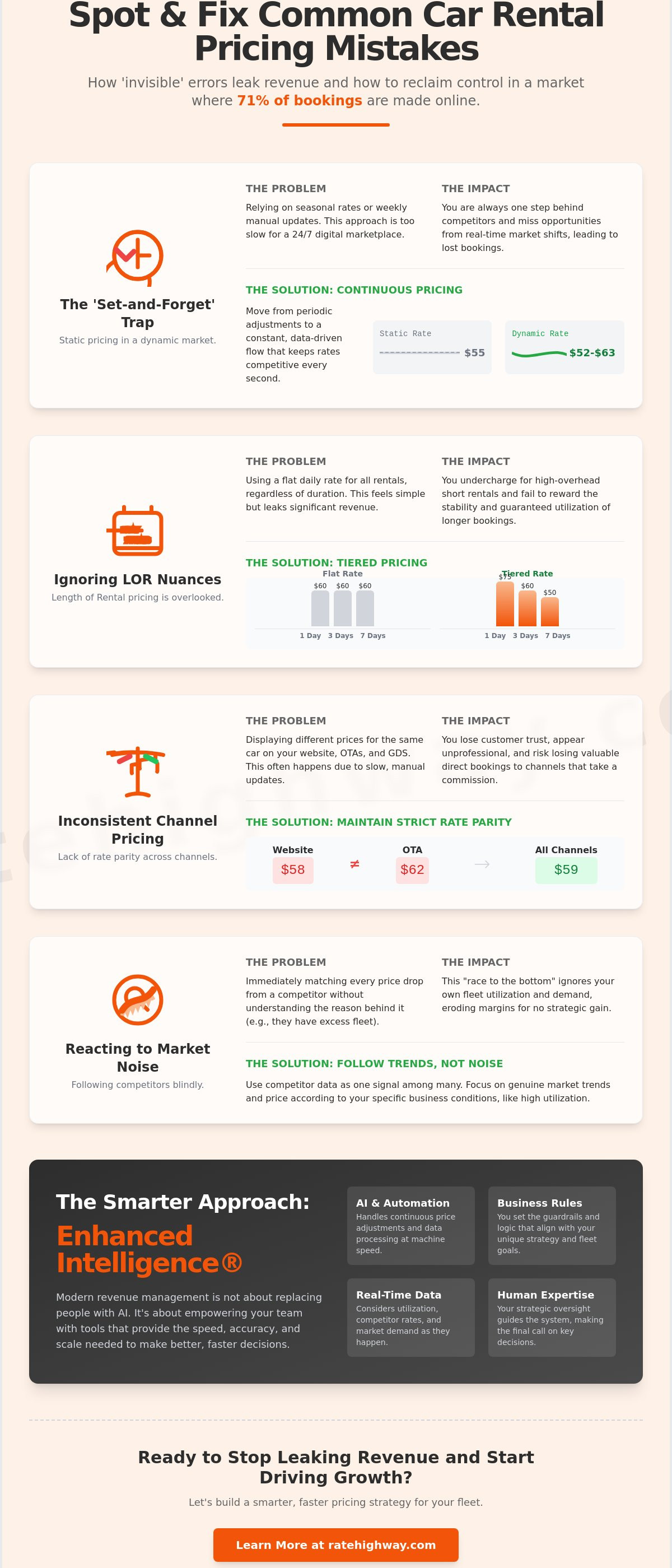
Static seasonal rates are a relic of the past. In a 24/7 digital marketplace, the "set-and-forget" approach is one of the most common car rental pricing mistakes an operator can make. Relying on weekly or even daily manual updates leaves you vulnerable to fast-moving market shifts that happen in minutes, not hours. If a competitor drops their price by a dollar at 2:00 PM, and you don't notice until the next morning, you've already lost a window of high-intent shoppers.
Manual updates are slow, prone to human error, and impossible to scale across multiple locations or car classes. If you're manually adjusting rates across OTAs, the GDS, and your website, you're always one step behind the curve. Continuous pricing is a necessity for modern fleet survival, representing a shift from periodic adjustments to a constant, data-driven flow that keeps your rates competitive every second of the day.
Strategic Mistakes in Revenue Management
Setting a price is easy. Building a strategy that protects your margins is hard. Many operators fall into the trap of looking at their competitors and assuming those companies have the "right" answer. This "follow the leader" approach is one of the most common car rental pricing mistakes because it ignores your unique fleet constraints and local demand. Your business isn't a mirror of the big brands; your pricing shouldn't be either. Strategic revenue management requires a co-pilot's eye for detail, looking at the road ahead rather than just the car in front of you.
True intelligence in pricing means understanding the "why" behind every rate change. It's about recognizing that a booking today is worth more than a potential booking tomorrow, but only if the price reflects the cost of losing that car for a different, higher-value customer. Balancing these trade-offs is where many businesses struggle, leading to underutilised fleets or, conversely, selling out too early at a discount. If you're looking to refine your approach, it may be time to speak with a pricing strategist about your current workflow.
The LOR (Length of Rental) Oversight
Flat daily rates feel simple. In practice, they often lead to missed opportunities. They fail to reward the stability of a weekly rental while often undercharging for the high-intensity overhead of a one-day booking. Tiered pricing is essential. It allows you to capture the premium from short-term urgency while securing the steady utilization that comes from longer contracts. Operators often make the error of setting "extra day" charges too low, which can cannibalize the profit of what should have been a higher-value, multi-day booking.
Utilization Blindness
Fleet utilization is your pulse. If 40% of your fleet is sitting idle, your prices are likely too high for the current market demand. However, dropping prices too early when utilization is high is equally damaging. This "utilization blindness" happens when operators don't have real-time visibility into their lot. Modern revenue management relies on Enhanced Intelligence® to spot these thresholds. By combining automated data with your own professional judgment, you can find the "goldilocks" zone where volume and margin meet, ensuring you don't leave money on the table during peak times or leave cars empty during the lulls.
Advance bookings provide a safety net for your fleet, but walk-ups are the high-stakes "tight turns" of the industry. Neglecting the value of the last-minute renter is a missed opportunity for high-margin revenue. A smart strategy accounts for both, using advance data to build a foundation and leaving room for the higher rates that walk-up demand can command.
Technical and Operational Pricing Errors
Your pricing strategy is only as strong as the technical infrastructure that supports it. Even the most brilliant revenue management plan will fail if your rates don't reach the customer accurately or on time. In a digital market where 71% of bookings happen online, technical glitches aren't just minor annoyances. They are significant revenue leaks. These common car rental pricing mistakes often stem from a lack of synchronization between your internal systems and the various channels where your cars are listed.
Operational excellence requires more than just picking a number. It involves ensuring that number is consistent, protected, and based on the freshest data available. When your technical "engine" is misfiring, you risk selling inventory at the wrong price or, worse, losing visibility entirely. Modern operators must move beyond basic tools to a more resilient, automated approach that protects their margins from technical friction.
The Rate Parity Problem
Rate parity is the practice of maintaining consistent prices across all distribution channels. When a customer sees a lower price on an OTA than on your direct website, it creates immediate confusion. It trains your most loyal customers to stop booking directly with you, increasing your dependency on high-commission third-party platforms. Beyond the lost profit, inconsistent pricing makes your brand look disorganized and untrustworthy.
The technical challenge of syncing rates across OTAs, the GDS, and your own site simultaneously is immense. Manual updates are too slow to keep up with the pace of the market. Without a centralized system to push updates instantly, you'll always have "ghost rates" lingering on some channels. High-performing operators focus on maintaining brand value with rate parity tools to ensure that every customer sees the right price, regardless of where they choose to shop.
Data Quality and Latency
Pricing based on 24-hour-old data is like driving a car by looking in the rearview mirror. By the time you see a competitor's price change from yesterday, the booking window has likely already closed. Many operators rely on basic web scrapers that are slow and often return "dirty" data—inaccurate numbers caused by caching issues or site errors. If your data is wrong, your pricing will be wrong, no matter how good your logic is.
A professional rate engine provides a clear advantage over basic scrapers. It delivers high-frequency, high-accuracy data that reflects the actual state of the market. This is where Enhanced Intelligence® becomes essential. It combines rapid data capture with human-defined business rules to ensure your pricing is both fast and strategically sound. This approach allows you to respond to micro-demand shifts, such as a sudden local event or a flight cancellation at the airport, before your competitors even realize the market has moved.
Finally, every operator needs a safety net. Automated "kill switches" are vital for preventing mistake fares from going live. Whether it's a typo in the backend or a logic error in a new rate plan, these safety rules catch anomalies before they drain your revenue. It's about having the speed of automation with the steady hand of human oversight.
Data Misinterpretation: Reading the Market Wrong
Data is the fuel for your pricing engine, but poor interpretation will lead you off course. One of the most common car rental pricing mistakes is reacting too quickly to competitor "noise" instead of identifying real market trends. If a single competitor drops their price for a specific car class on a Tuesday afternoon, it doesn't necessarily mean the whole market is shifting. It could just be a temporary move to clear a small surplus of cars. Panic-matching every price drop eats your margins without providing a long-term benefit.
Strategic control means knowing when to hold your ground. You must segment your pricing by car class correctly to avoid leaving money on the table. An economy car and a luxury SUV serve different customers with different price sensitivities. Similarly, ignoring the "halo effect" of airport pricing is a missed opportunity. Research shows airport rentals can be 15% to 30% higher than neighborhood pickups, and these high airport rates often push demand toward your local off-airport sites. If you don't benchmark your performance against your own historical data, you'll never know if your current strategy is actually driving higher RevPAC or just riding a wave of general market growth.
Competitor Tracking Fails
Matching the lowest price in the market is rarely a winning move. Often, those ultra-low rates represent "distressed inventory" where a competitor is desperate to move idle cars. If your fleet is already 85% utilized, there's no reason to match a price designed for someone who is 40% utilized. Using RateIndex allows you to see the full market picture, helping you distinguish between a broad market shift and a single competitor's localized problem.
The Local Demand Gap
Underpricing often happens when operators miss local micro-demand shifts. A major concert, a sports tournament, or even a large corporate conference can cause a sudden spike in demand that standard seasonal models might miss. Location-specific demand forecasting is vital for capturing these high-margin opportunities. This synergy between your local expertise and automated systems is the core of Enhanced Intelligence®, ensuring your pricing is as nuanced as the market itself. Local knowledge must be paired with automated data for best results, allowing you to capture the right price before the surge begins. If you want to see how a more data-driven approach can protect your fleet, contact our team for a strategy review today.
Moving Toward Enhanced Intelligence®
Technology should act as a force multiplier for your expertise, not a replacement for it. Moving beyond common car rental pricing mistakes requires a shift in how you view your revenue management tools. It's not about finding a machine to do your job; it's about finding a co-pilot that handles the repetitive, high-speed tasks while you focus on high-level strategy. This is the essence of Enhanced Intelligence®, where AI and automation are guided by human-defined business rules to ensure every rate change is both fast and logical.
Business rules serve as the guardrails for your automation. They prevent the system from making erratic moves during market volatility and ensure that your pricing stays aligned with your brand's goals. While a machine can process thousands of data points in seconds, it doesn't understand your specific relationship with local corporate accounts or the long-term value of a loyal customer. By combining automated speed with human oversight, you create a pricing engine that is both resilient and adaptable to the "tight turns" of the 2026 rental market.
Transitioning from manual entry to automated rate shopping is a fundamental step in protecting your margins. Manual entry is slow, subjective, and prone to the "set-and-forget" trap. Automated shopping is continuous and objective, providing the data you need to make informed decisions without the burnout of manual updates. This transition allows your team to move away from administrative tasks and toward proactive revenue optimization.
The Human-in-the-Loop Advantage
Your local expertise is the "secret sauce" that makes a pricing engine truly effective. You understand the nuances of your city, from the impact of a sudden airport construction project to the specific timing of local festivals. Automation handles the "heavy lifting"—the constant scanning of competitor rates and the syncing of prices across channels—so you can spend your time analyzing trends and refining your overall strategy. Using RateMonitor Elite allows you to scale these strategic decisions across your entire fleet, ensuring that your professional judgment is reflected in every booking.
Next Steps for Your Fleet
The path to higher RevPAC and better fleet utilization starts with a clear look at your current operations. You don't need to overhaul everything overnight. Instead, focus on incremental improvements that deliver immediate value.
Audit your workflow
Review your current pricing process for the mistakes we've discussed, such as broken rate parity or ignoring LOR nuances.
Pick one area to automate
Identify a single pain point, like syncing rates across OTAs or tracking competitor noise, and implement an automated solution first.
Focus on data quality
Ensure your decisions are based on fresh, accurate data rather than outdated scrapers or historical guesses.
Modern pricing is a continuous journey, not a destination. By embracing a human-centric approach to technology, you can protect your fleet from revenue leaks and position your business for sustainable growth. If you're ready to see how Enhanced Intelligence® can transform your daily operations, request a demo to see our tools in action.
Taking Strategic Control of Your Revenue
Success in today's market depends on your ability to move at the same speed as your data. We've discussed how shifting from static seasonal rates to continuous pricing and maintaining strict channel parity can stop invisible revenue leaks. Avoiding these common car rental pricing mistakes is about more than just fixing a spreadsheet; it's about reclaiming strategic control over your fleet. By focusing on real-time utilization and accurate market trends, you ensure your cars are always priced for maximum yield.
RateHighway provides the necessary tools to bridge the gap between human intuition and high-speed automation. Our proprietary Enhanced Intelligence® technology is trusted by global rental brands and independent operators alike to integrate real-time market data into their daily workflows. This approach ensures you remain the master strategist of your business while automation handles the heavy lifting. It's time to stop reacting to the market and start leading it.
Stop the revenue leaks and discover how RateMonitor Elite can optimize your fleet pricing today.
Frequently Asked Questions
What is the most common car rental pricing mistake for small fleets?
The most frequent of the common car rental pricing mistakes for small fleets is relying on static, seasonal rates. Many smaller operators set their rates once a month or once a season, failing to account for the real-time volatility of the digital market. This leads to missed revenue during sudden demand spikes and uncompetitive prices during lulls, as 71% of bookings are now made through fast-moving online channels.
How often should I update my car rental rates?
Modern car rental rates should be updated continuously rather than periodically. In a market where competitors can adjust prices in minutes, waiting for a daily or weekly manual update is too slow. Automated systems allow for constant adjustments based on demand, utilization, and competitor movement. This ensures your fleet remains competitive 24/7 without requiring manual intervention for every minor market shift.
Can AI completely replace a revenue manager in car rental?
AI cannot completely replace a revenue manager because it lacks local context and strategic judgment. AI excels at processing vast amounts of data and identifying patterns at speed, but it requires a human co-pilot to set the business rules and provide oversight. This human-centric approach ensures that automated decisions align with your brand's specific goals and local market knowledge.
What is rate parity and why does it matter for my rental brand?
Rate parity is the practice of maintaining the same price for the same vehicle across all distribution channels, including OTAs and your direct website. It matters because price inconsistencies confuse customers and erode brand trust. If a renter sees a lower price elsewhere, they are less likely to book directly with you. This increases your acquisition costs and reduces long-term customer loyalty.
How does fleet utilization affect my daily pricing strategy?
Fleet utilization serves as the primary indicator for when to push or hold your rates. If a large portion of your fleet is idle, your pricing strategy should focus on driving volume through more competitive rates. Conversely, when utilization is high, you should shift toward protecting your margins by raising prices. This ensures you don't sell out too early at a discount when demand is peaking.
Is it always a mistake to have the lowest price in the market?
It is often a mistake to have the lowest price if your fleet is already highly utilized. Matching a competitor's distressed inventory pricing when you only have a few vehicles left on the lot is a missed opportunity for high-margin revenue. Your price should reflect your specific inventory levels and local demand. You shouldn't simply participate in a race to the bottom that ignores your own fleet constraints.
What is Enhanced Intelligence® in the context of car rental software?
Enhanced Intelligence® is the strategic combination of AI, automation, and human expertise. It isn't just about autonomous software; it's about using technology to handle heavy data processing while keeping the revenue manager in control. This synergy allows for faster, more accurate decisions that are grounded in both global data and your specific local business rules.
How do I avoid 'mistake fares' when using automated pricing tools?
You avoid mistake fares by implementing automated business rules that act as guardrails for your pricing engine. These rules can include kill switches that flag or block any rate changes that fall outside of a pre-defined percentage or dollar range. This ensures that a typo or a logic error doesn't result in selling your fleet at an unsustainable price before a human can intervene.


