

What is Car Rental Revenue Optimization in 2026?
Revenue management isn't just a spreadsheet exercise. It's the strategic engine of your business. At its core, What is Revenue Management involves finding the right price for the right customer at the exact right moment. In 2026, car rental revenue optimization has evolved from a defensive posture into an offensive strategy. It's no longer about just filling the parking lot with cars; it's about maximizing the margin of every single vehicle in your fleet. Relying on "gut feel" or historical trends is a recipe for missed opportunities in a market where data moves at the speed of light. You need to know exactly how market conditions, demand, and competition are shifting in real-time.
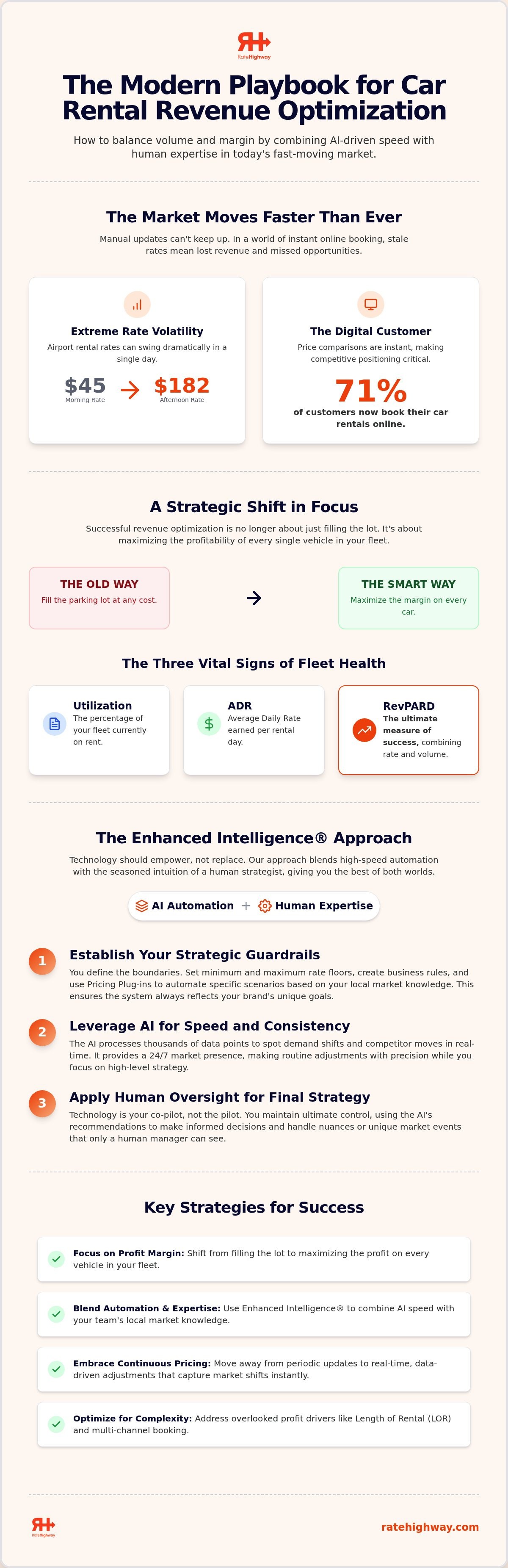
To master this environment, you must track three vital signs that determine your fleet's health:
- Utilization: This measures the percentage of your fleet currently on rent. High utilization is good, but not if it comes at the cost of your profit.
- Average Daily Rate (ADR): The average income earned per rental day across your active fleet.
- RevPARD (Revenue Per Available Rental Day): This is the ultimate measure of success. It combines volume and rate to show the true productivity of your assets, whether they are on the road or on the lot.
The Core Philosophy: Beyond Simple Discounts
Dropping your prices to move metal is a common but dangerous trap. While it might boost utilization in the short term, it often triggers a "race to the bottom" that erases your profits and devalues your brand. You must understand the complex relationship between supply, demand, and your competitors' positioning. It's about being the smartest player in the market, not necessarily the cheapest. Strategic car rental revenue optimization ensures that every car earns its keep without sacrificing long-term growth.
Revenue optimization is a strategic balance of volume and yield that ensures every vehicle earns its maximum potential based on current market conditions.
Why Timing is Everything in Modern Markets
Stale rates are expensive. In 2026, the industry has shifted away from periodic, once-a-day updates toward continuous, real-time pricing. Market volatility means that a rate set at 9:00 AM might be irrelevant by noon. If your competitors are updating their prices hourly and you're still on a weekly cycle, you're essentially flying blind. This speed is critical because 71% of bookings now happen online, where price comparisons are instantaneous. Faster decision-making cycles allow you to capture sudden spikes in demand or protect your utilization before the market shifts. This transition to AI-driven revenue management provides the speed you need to stay ahead while still allowing your team to apply their local expertise to the final strategy.
The Enhanced Intelligence® Approach to Pricing
Technology should empower, not replace. True car rental revenue optimization happens when you blend high-speed automation with the seasoned intuition of a human strategist. We call this Enhanced Intelligence®. It's the synergy of AI, configurable business rules, and your own professional judgment. While some systems offer "pure" AI that operates as a black box, this approach can be risky. Fully autonomous systems often miss local nuances or "black swan" events that only a human manager can see. By positioning technology as a co-pilot rather than a replacement, you maintain strategic control while the software handles the heavy lifting of data processing.
Step 1: Establishing Your Strategic Guardrails
Your brand has a unique market position that a generic algorithm won't fully grasp. You need to define the boundaries. Establishing business rules ensures that the system reflects your specific goals. This involves setting minimum and maximum rate floors to protect your brand value and prevent a race to the bottom. By using customizable Pricing Plug-Ins, you can automate specific scenarios based on your local knowledge. It's about setting the flight path so the automation knows exactly where to steer.
Step 2: Leveraging AI for Speed and Consistency
AI excels at identifying complex patterns that human analysts might overlook. It processes thousands of data points across multiple channels to spot shifts in demand as they happen. This is the core of effective AI-driven revenue management. The system provides a 24/7 market presence, making routine adjustments while you focus on high-level strategy. It ensures your rates stay competitive even when you aren't at your desk, reacting to competitor moves with millisecond precision.
Step 3: Human Oversight for Strategic Nuance
The revenue manager remains the master strategist. You provide the context that data alone cannot capture, such as a sudden fleet change or a local holiday. The The Enhanced Intelligence® Approach to Pricing thrives on this human review. You fine-tune the automated suggestions to ensure they align with the latest operational realities. This balance builds trust in the system and ensures car rental revenue optimization remains a tool for growth. If you're ready to see how this synergy works in practice, you can speak with our strategy team about your fleet's specific needs.
Benchmarking and Real-Time Market Intelligence
Data is the lifeblood of any modern strategy. In the fast-moving world of car rental revenue optimization, real-time data acts as the fuel for your pricing engine. Without it, you're essentially driving at night without headlights. You can't make informed decisions if you're relying on data that is even a few hours old. However, there's a significant difference between basic data collection and specialized market intelligence. A generic web scraper might pull raw numbers, but it often misses the nuances of the car rental industry, such as airport concession fees or specific length-of-rental rules. A specialized engine understands these "tight turns" and provides the accuracy you need to stay ahead.
Effective benchmarking allows you to identify which competitors actually influence your bookings. Not every operator at the airport is your direct rival. By filtering the noise, you can find "price gaps" in the market. These are specific windows where your competitors may have underpriced their fleet or run out of inventory, allowing you to increase your rates without losing booking volume. It's about finding the ceiling of what the market will pay at any given moment.
Rate Shopping with Precision
Visibility must be absolute. You need to track how your rates appear across every channel, from direct websites to major OTAs. Using a tool like RateIndex provides the granular visibility required to make these high-stakes moves. This isn't just about matching the lowest price. In fact, matching a competitor who is in a "race to the bottom" can destroy your profitability. By monitoring competitor inventory levels alongside their rates, you can determine if a low price is a threat or simply a sign that a rival is desperate to move a few remaining cars. If they are nearly sold out, you have the leverage to keep your rates higher.
Analyzing Market Trends vs. Noise
Raw numbers can be deceptive if you don't have the right context. A sudden price drop from a competitor might look like a market shift, but it could just be a temporary reaction to a single canceled flight or a small local event. You must distinguish between these temporary "dips" and actual long-term trends. By looking at historical data alongside real-time moves, you can forecast future demand with much higher precision. Your local knowledge is the final piece of the puzzle here. You understand the local festivals or seasonal shifts that an algorithm might see only as a random data spike. Data without context is just noise, and it takes a human strategist to turn that noise into a profitable decision.
Optimizing for Length of Rental and Channel Complexity
Many operators focus solely on the daily rate. This is a mistake. Length of Rental (LOR) is often the most under-optimized area in car rental revenue optimization. A one day rental and a seven day rental have very different cost structures and profit potentials. If you treat them the same, you're leaving money on the table. Effective revenue management requires you to look at the total value of the booking, not just the price per day. This means balancing your fleet across different car classes and locations to ensure you aren't sold out of SUVs for a high value weekly rental because you accepted too many one day economy bookings.
During peak demand periods, like summer holidays or major conventions, every car is a premium asset. Accepting a two day booking might prevent you from taking a more profitable ten day booking later. Strategic optimization involves setting minimum LOR requirements during these windows. This protects your inventory for the highest value customers. It isn't just about saying "yes" to every customer; it's about saying "yes" to the right customer for your current fleet goals. You need to prioritize high value bookings when demand is high and stay flexible when things slow down.
The LOR Profitability Framework
Daily and weekly rate structures serve different purposes. A high daily rate might maximize revenue during a short event, but a discounted weekly rate can secure utilization during off peak periods. Automation allows you to adjust these LOR based prices dynamically. For example, if your fleet utilization is low for the coming weekend, the system can automatically lower the threshold for weekly discounts to attract longer term travelers. It's about being flexible. You can use these strategies to incentivize the specific booking lengths that best fit your current fleet availability and market conditions.
Navigating Channel Complexity
Your rates live in many places at once. Managing OTAs, direct websites, and corporate contracts creates a web of complexity. Maintaining rate parity is essential to protect your brand integrity and avoid penalties from third party platforms. However, not all channels are created equal. Direct bookings usually have lower acquisition costs than OTA bookings. You should adjust your channel specific strategy based on these costs. Tools like DemandShift help you move inventory to the most profitable channels when demand is high. This ensures you aren't paying high commissions for bookings you could have secured directly. If you want to see how these strategies can apply to your specific fleet, contact our team for a strategy review.
Implementing Your Revenue Optimization Strategy
Execution is a journey, not a single event. Successful car rental revenue optimization doesn't require you to flip a switch and walk away. Instead, it's about starting with a focused approach and scaling as your confidence in the data grows. You don't need to automate your entire global operation on day one. By beginning with your most volatile locations or your most competitive car classes, you can prove the value of the system while keeping risk low. This methodical rollout ensures that your team stays in control while the technology handles the increasing speed of the market.
Measuring success in the early stages is vital for long-term buy-in. During the first 90 days, focus on core KPIs like RevPARD and utilization. These metrics provide a clear picture of how well your pricing strategy is balancing volume and margin. You'll likely see faster response times to competitor moves and fewer instances of "stale" rates. However, the human element is just as important as the numbers. Training your staff to interpret automated suggestions helps build a culture that values data-driven decisions. When your team sees the software as a visionary co-pilot rather than a replacement, they can focus their energy on high-level strategy instead of manual data entry.
Setting Up for Success
Before you introduce automation, audit your current pricing logic. You can't automate what you haven't defined. Identify the business rules that have served you well in the past and use them as the foundation for your new system. Look for "quick wins" in locations where manual updates have struggled to keep up with hourly price swings. It's also essential to collaborate closely with your fleet managers. Pricing and vehicle availability are two sides of the same coin. If your pricing strategy doesn't align with your actual fleet count, you'll end up with either empty lots or overbooked counters.
Continuous Improvement and Scaling
The best strategies are never static. Once your initial setup is running smoothly, use A/B testing to refine your results. You can test different pricing plug-ins or business rules to see which combinations drive the highest margins in specific market conditions. Regular strategy reviews allow you to adjust the "strategic guardrails" as the season changes or new competitors enter the market. This cycle of continuous improvement allows you to scale your success from a single airport location to a multi-national brand. Using a professional tool like RateMonitor Elite provides the specialized framework you need to manage this complexity with ease. It's the ultimate tool for the master strategist who wants to lead the market rather than follow it.
Driving Toward Sustainable Profitability
The future of the car rental industry belongs to those who move with precision and speed. You've seen how car rental revenue optimization has shifted from a manual task to a continuous, strategic process. By adopting Enhanced Intelligence®, you combine the processing power of AI with your own local market expertise. This balance allows you to navigate market volatility, manage complex booking channels, and drive higher RevPARD without losing strategic control. It's about having a visionary co-pilot that handles the data while you steer the strategy.
Leading independent and franchise operators worldwide already use these tools to maintain a competitive edge. With real-time market data from RateIndex and the configurable power of RateMonitor Elite, you can stop reacting to the market and start leading it. The road to maximized fleet profitability is built on data, but it's guided by your professional judgment. Take the next step toward a more efficient, profitable operation by putting these insights into action.
Discover how RateMonitor Elite can optimize your fleet's revenue today.
Success in 2026 requires a blend of high-tech speed and grounded, real-world experience. You have the knowledge; we provide the tools to amplify it.
Frequently Asked Questions
Is car rental revenue management only for large international brands?
No, revenue management is essential for operators of all sizes, including independent and franchise agencies. While large brands have massive departments, smaller operators can use automation to level the playing field. It's about maximizing the margin on every vehicle you own. Even a small fleet benefits from smarter pricing that reacts to local airport demand or competitor shifts without requiring a full-time analyst.
What is the difference between dynamic pricing and automated pricing?
Dynamic pricing is the strategy of changing rates based on demand, while automated pricing is the technology that executes those changes. You can have a dynamic strategy that you update manually once a week, but it will be slow. Automated pricing allows your strategy to happen in real-time. It ensures your car rental revenue optimization happens continuously, reacting to market moves while you focus on other operational tasks.
How does automation help with fleet utilization?
Automation balances your supply with current market demand to ensure your cars aren't sitting idle. If utilization is low, the system can automatically trigger lower rates or LOR incentives to attract bookings. Conversely, when your lot is nearly empty, it raises rates to protect your remaining inventory for high-value customers. This constant adjustment prevents you from being sold out too early at low prices.
Can I still manually override prices if I use an automated system?
Yes, you always maintain final strategic control over your pricing. Automation acts as a co-pilot that handles the repetitive data processing, but it follows the business rules you set. If you know about a local event or a sudden fleet issue that the data hasn't captured yet, you can step in and adjust rates manually. The software is a tool that enhances your expertise, not a replacement for it.
What is RevPARD and why is it more important than just ADR?
RevPARD stands for Revenue Per Available Rental Day. While Average Daily Rate (ADR) only tracks the price of cars that are actually rented, RevPARD looks at your entire fleet, including idle vehicles. It's a more accurate measure of car rental revenue optimization because it shows how effectively you're generating income from every asset you own. High ADR means little if half your fleet is sitting on the lot.
How often should a car rental company update its rates?
Rates should be updated as often as the market moves, which in 2026 is increasingly continuous. Periodic updates once a day or once a week are no longer enough when 71% of customers book online and see real-time price changes. Modern systems monitor the market 24/7 and make adjustments whenever a competitor moves or demand spikes. This ensures your rates are never stale or out of touch with current conditions.
Does automated pricing lead to a 'race to the bottom' with competitors?
Not if you use strategic guardrails. A race to the bottom happens when systems are set to always be the cheapest, but automated pricing should be used to find the right price, not the lowest one. By setting rate floors and using business rules, you ensure the system never drops prices below your profitable margin. It helps you stay competitive without sacrificing your brand value or your profit.
What is Enhanced Intelligence® in the context of car rental software?
Enhanced Intelligence® is the synergy between advanced AI, automated business rules, and human oversight. It's a human-centric approach to innovation that uses technology to process vast amounts of market data quickly. The AI identifies patterns and suggests moves, but the human manager provides the context and final approval. This ensures that your pricing is both fast enough for the modern market and smart enough to handle local nuances.
Curious to see RateMonitor in action? Reach out and book your demo now!