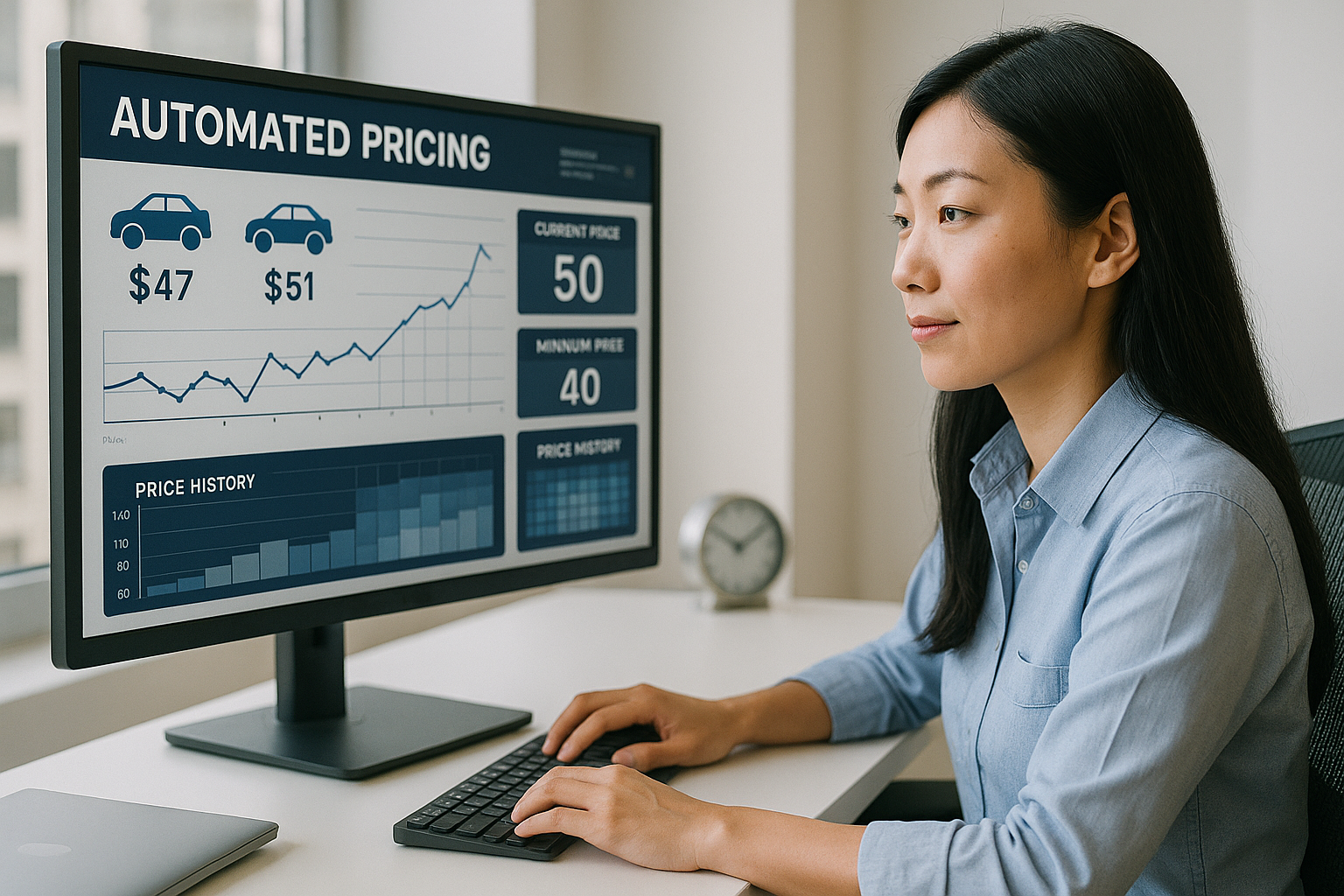

Your rental fleet is leaving money on the table, not because demand is weak, but because your prices are static while the market moves by the hour. AI can change that. In this analysis, we examine how surge pricing machine learning turns car rental pricing into a precise, real-time system that reacts to demand signals, inventory pressure, and competitive moves.
You will learn how modern models forecast demand at the branch and vehicle-class level, how they weight features like lead time, seasonality, events, weather, and competitor rates, and how to translate forecasts into optimized prices under business constraints. We will compare model choices and feature pipelines, outline guardrails for price floors and ceilings, and discuss elasticity estimation that prevents volume collapse. You will see how to validate uplift with backtesting and controlled experiments, how to monitor drift, and how to ship decisions through low-latency APIs without risking data leakage. By the end, you will have a clear blueprint for deploying AI-driven pricing that lifts revenue, stabilizes utilization, and preserves customer trust.
The Landscape of Car Rental Pricing
Market momentum
The car rental market is scaling fast, with forecasts calling for roughly 8 percent annual growth through 2033; published estimates range from 7.8 percent to 8.7 percent CAGR. Growth is fueled by flexible mobility preferences, digitized bookings, and the push toward greener fleets. That mix expands peak windows and creates micro surges across airports and urban hubs. Pricing that reacts in minutes, not weeks, captures this value. Surge pricing machine learning turns demand signals into executable rate moves at the speed your channels update. As inventory and trip purpose mix shift by hour and by location, precision determines margin.
From static to signal driven
Traditional pricing models stumble in volatility. Holidays, pop up events, storms, flight disruptions, and uneven fleet availability distort demand faster than manual rules can adapt. Repricing once or twice daily leaves hours of exposure, and spreadsheet ladders lag the actual booking curve. AI powered dynamic pricing analyzes historical bookings, local events, and even weather to optimize rates in real time. Integrating connected vehicle and fleet data further supports utilization and revenue. A practical playbook starts with guardrails, floors and ceilings, and maximum step sizes, then adds event sensitivity, pickup lead time bands, and channel level actions. The AI generates the pricing recommendations, and you retain full control to approve, edit, or tweak the strategy before it goes live. That workflow eliminates analysis paralysis while keeping you in the driver’s seat for risk and brand protection.
Why AI is Key to Dynamic Pricing
Integration of machine learning for real-time pricing adjustments
Dynamic pricing scales only when models read the market continuously and act instantly. Our Enhanced Intelligence engine ingests RateIndex signals, on-fleet counts, booking pace, event calendars, weather, and connected car telemetry, then recalculates elasticities and risk in real time. That pipeline turns noisy demand into precise price moves by pickup date, segment, and channel, so you capture yield when the market heats and protect conversion when it cools. Evidence from a microservices-oriented dynamic pricing study reported a 22 percent revenue lift and a 17 percent faster pricing response time when ML drove updates end to end, a result that mirrors what we see when execution is automated, not just reported. Industry trajectories point the same way, with pricing decisions moving to real time by 2026. This is surge pricing machine learning that learns continuously and pushes decisions to the edge without delay.
Advantages over static pricing methods
Static price sheets lose money because they lag demand and ignore fleet tightness. ML-driven dynamic pricing, informed by peer-reviewed evaluations that show high predictive accuracy for car rental price modeling, optimizes price bands by location, LOR, and lead time, then personalizes offers by customer segment. When utilization climbs to 85 percent seven days out, the system raises floors and constrains discounts; when pace softens at 55 percent three days out, it deploys targeted offers and length-of-rental incentives. Customers see fair, competitive, and timely prices, which preserves loyalty while extracting yield at peaks. Research confirms these mechanics, linking ML-driven pricing to improved revenue, faster decisions, and better customer experience.
Impact on operational cost and efficiency
We eliminate analysis paralysis. RateHighway unifies market monitoring and execution in a single workflow you can configure in under four minutes, then automate at scale. GMs and Revenue Managers recover hours each week once spreadsheets, manual comps, and nightly overrides disappear, backed by 100M+ corrections that keep decisions battle tested. The AI generates the insights and recommendations, but the user has full control to approve, edit, or tweak the strategy before it goes live. Guardrails enforce min and max rates, blackout dates, and segment rules, so there is no black box. With seamless integration to leading systems and no integration fees, changes propagate quickly, errors drop, and utilization rises, which lowers unit cost per rental and lifts contribution margin.
How RateHighway Revolutionizes Pricing with AI
RateMonitor Elite: automated precision, full control
RateMonitor Elite operationalizes dynamic pricing so GMs and Revenue Managers stop wrestling with spreadsheets and start scaling yield. The Position, Balance, and Precision modules form one automated workflow that monitors, decides, and executes, all with user oversight. Use the Pricing and Revenue Manager toolkit to set strategy and guardrails, then let RateMonitor Balance feed real-time fleet utilization into your price logic. RateMonitor Precision applies advanced AI to refine rate moves across segments, locations, and time bands. Users approve, edit, or tweak every recommendation before it goes live, so there is no black box. Setup is fast, typically under four minutes, and the system automates the daily grind while you stay in the driver’s seat.
Real-time market data collection and analysis
Elite ingests high-frequency market signals and RateIndex data, then aligns them with on-fleet supply and booking pace to generate right-now prices. The engine reads competitor rate movements, search demand, lead time, local events, weather, and seasonality, a pattern consistent with surge pricing machine learning in mobility markets. Studies show ML can predict rental prices with high accuracy, and industry trends point to real-time pricing becoming standard by 2026. Balance enriches this with connected vehicle and utilization inputs so the system can protect inventory for peak windows and fill softer periods without discounting too early. The result is instant detection of demand shocks and immediate, controlled corrections that keep you within target position bands.
The proof: outcomes and industry transformation
Elite is battle tested, with 100M plus corrections informing its guardrails and anomaly handling. Operators report moving from periodic, manual checks to continuous pricing that maintains market position during event spikes, then normalizes just as fast, preserving margin. Airport-heavy portfolios use Elite to protect high-value car classes during late booking surges, while city stations lean on Precision to micro-adjust by hour and lead time. The human ROI is clear, managers reclaim hours each week as monitoring and execution consolidate in one workflow. Action replaces analysis paralysis, and every action remains reviewable, editable, and reversible, which turns AI into a dependable copilot rather than an autopilot.
Understanding the Market Pulse with RateIndex
Powering precise pricing with RateIndex data
RateIndex reads the market like a heartbeat. With more than 15 years of rate history across vendors, classes, and geographies, it reveals the reference price for each pickup date and length of rental. Teams benchmark position, measure elasticity by segment, and spot demand shifts early. Example, if midsize SUVs in Phoenix run 12 percent above last year during spring training, RateIndex flags the gap so you lift SUV ADR while holding sedan pricing. The dataset updates continuously, aligning your logic to what shoppers actually see. Review the scope in the RateHighway RateIndex overview.
Anticipating future market trends with AI insights
AI then turns Market Pulse into foresight. Using surge pricing machine learning, our models learn lead-time curves, booking velocity, weather and event calendars, and inventory constraints, then project rate pressure by day and class. Through our integration of the AMPE Pricing Engine into RateMonitor, the system prepares individualized price strategies per location, anchored to your history and live market prices. Expect outputs like an 8 to 12 percent ADR lift window on premium classes for a holiday weekend, plus thresholds to capture it. The AI generates recommendations, and you approve, edit, or tweak every move before it goes live. Guardrails like min and max ADR, occupancy targets, and blackout periods stay enforced.
RateHighway’s unique approach to harnessing RateIndex
RateHighway operationalizes this intelligence inside RateMonitor Elite and Precision so managers stop tab diving and start scaling yield. Monitoring and execution live in one workflow that configures in under four minutes, eliminating analysis paralysis. With 100M plus automated corrections guiding the models, you get battle-tested rules, not theories. The result, fewer manual overrides, hours back each week, and sustained ADR growth from timely micro adjustments. See how RateMonitor Elite converts data into automated pricing actions in this overview of data driven car rental pricing.
Enhancing Efficiency: Saving Time for Managers
Reducing manual tasks through automation
Surge pricing machine learning takes the grunt work off your calendar by scanning demand signals continuously and executing within pre-set rules. Models read booking lead times, fleet utilization, airport schedules, local events, and weather, then propose price moves with proven accuracy as shown in peer reviewed evaluations of rental price prediction models. RateMonitor Elite consolidates that stream into a single workflow, so monitoring and execution stand up in under four minutes. You set thresholds and exceptions, the system auto publishes compliant prices, and flags edge cases for review. For support and configuration best practices, see the RateHighway client support resources for RateMonitor Elite.
Boosting revenue manager efficiency
Revenue managers reclaim hours every week because the platform eliminates spreadsheet triage. Instead of periodic checks, the engine evaluates rates in real time, a capability analysts expect to be the default by 2026, and executes when signals clear your guardrails. The Proof matters, our systems have learned from 100M plus pricing corrections and that volume sharpens recommendations across markets and classes. Managers still drive, the AI generates the insights and draft actions, and you approve, edit, or tweak before anything goes live. This cadence moves teams from data reporting to automated action, while preserving audit trails and version control.
Testimonials: experiences of using RateHighway
Operators echo the time savings and control. Emmanuel Scuto notes that the team delivers unparalleled expertise and support, which translates into faster onboarding and confident daily decisions. Ramzi Toukhli calls it the best pricing and revenue management software on the market, a sentiment we hear when peak weeks hit and automated rules stabilize margins without frantic after hours edits. A multi location GM recently described cutting a daily two hour rate review to about fifteen minutes by letting the system optimize most segments and surfacing only exceptions for human judgment. The pattern is consistent, fewer manual overrides, higher focus on strategy, and steadier outcomes across volatile demand spikes.
AI and User Oversight: Maintaining Control
Ensuring transparency and user control over AI decisions
Surge pricing machine learning must be visible, explainable, and auditable. RateMonitor Elite surfaces the exact drivers behind each recommendation, including booking velocity, fleet availability, RateIndex market movement, connected car utilization, and weather or event signals. You see feature-level attribution and a clear rationale, not a cryptic score. Every action writes to an audit trail with who approved it, when it executed, and what outcome it produced. Models that predict rental prices achieve high accuracy with big data, but accuracy alone does not earn trust. The AI generates the insights and proposed price changes, and the user has full control to approve, edit, or tweak the strategy before it goes live.
Balancing automation with human oversight
Automation scales only when it respects human judgment. Configure guardrails once, then let the system execute at speed: price floors and ceilings by class, caps on daily deltas, competitor sensitivity thresholds, and fairness policies for advance purchase windows. Set approval gates by location or segment so GMs can one-click accept, modify, or pause recommendations. Run controlled experiments with holdouts to validate uplift, then promote rules to full automation when results stabilize. With 100M+ corrections informing the engine, we cut false positives and keep rate moves aligned with your brand. The industry is shifting to real-time decisioning by 2026, so these controls future-proof your workflow without sacrificing speed.
Leveraging AI as a collaborative tool, not a black box
Treat the AI like a pricing co-pilot. Build playbooks that map scenarios to actions, for example, event surge, weather disruptions, airport irregular operations, or low-utilization weekdays. The system forecasts demand, proposes a 6 to 15 percent uplift with class-level nuance, shows which signals drove the change, and predicts revenue impact. You approve, adjust the cap, or launch a limited-time promo instead. Connected car data tightens the loop by revealing idle pockets and guiding both rate moves and fleet repositioning. Setup takes under 4 minutes, then monitoring and execution run in one screen, which gives managers hours back every week and eliminates analysis paralysis.
Conclusion: Empower Tomorrow's Pricing Today
AI has moved pricing from periodic guesses to precise, real-time decisions, and the car rental market rewards operators who automate. Surge pricing machine learning reads market signals like booking pace, on-airport arrivals, weather shifts, and event calendars, then adjusts rates within policy to capture demand without eroding margin. Peer-reviewed studies show models predict rental prices with high accuracy, and industry trendlines point to real-time decisioning becoming standard by 2026. Add connected car data and you strengthen signals on utilization, mileage, and return timing, which sharpen short-window pricing. The playbook is clear: feature engineering around lead time, fleet availability, and market density, continuous retraining on RateIndex history, and guardrails that enforce your brand's price bands.
Winning teams will not add more dashboards, they will compress sensing, decision, and execution into one workflow. RateHighway operationalizes this shift with Enhanced Intelligence, 100M+ pricing corrections, and a setup that takes under four minutes from rule design to automated execution. Managers reclaim hours because actions publish automatically when signals trip thresholds, and every change is logged and explainable. The AI generates the insights and proposed price changes, and the user has full control to approve, edit, or tweak the strategy before it goes live. If you want sustained advantage in a faster market, start automating with RateHighway today and turn market volatility into predictable yield.
Curious to see RateMonitor in action? Reach out and book your demo now!