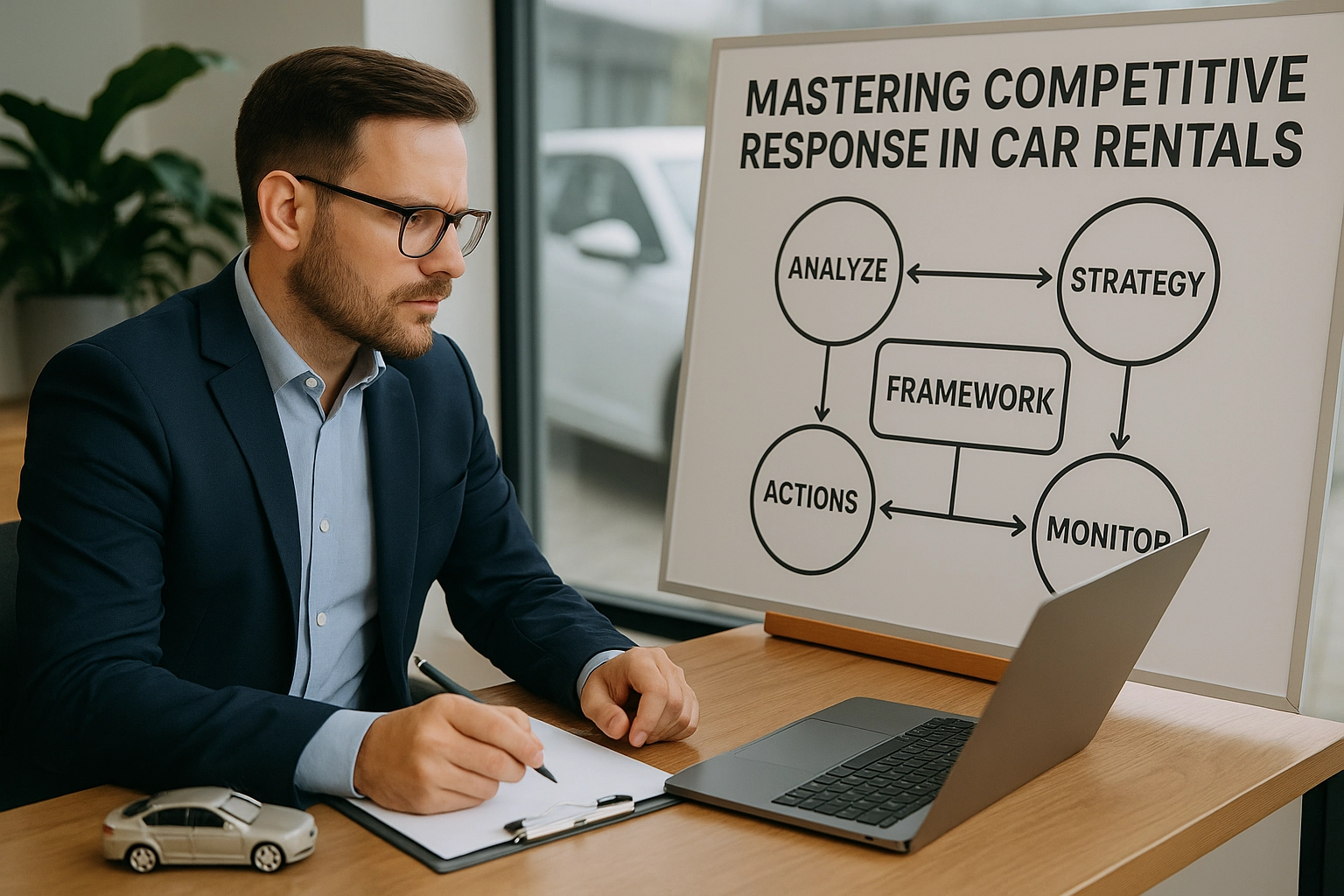
Defining Car Rental Profit Optimization in a Modern Market
Profit isn't accidental. It's the result of precise timing. In the car rental world, profit optimization means finding the right price at the right time for the right customer. It's no longer enough to just look at what the guy across the street is charging. True success requires a shift toward Yield Management, where you adjust rates based on the real-time availability of your fleet and the intensity of local demand. This approach treats your fleet as a finite resource that gains or loses value by the hour.
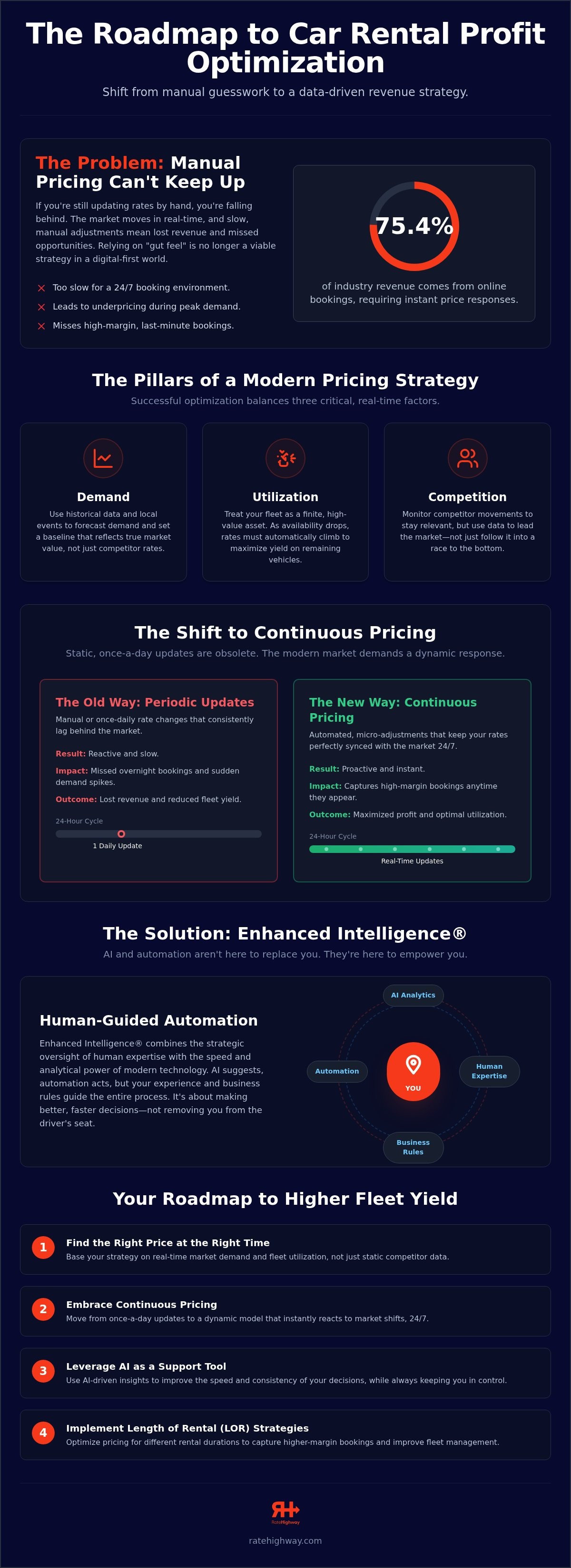
The market in 2026 moves faster than ever. With online bookings accounting for 75.4% of the industry's revenue, pricing has become a live event that requires an immediate response. You need to react in seconds, not hours. High fleet utilization is a goal, but it's only profitable if you aren't leaving money on the table by underpricing during peak windows. Conversely, empty cars are a constant drain on your margins. Balancing these factors is the heart of car rental profit optimization.
The Core Pillars: Demand, Utilization, and Competition
Base rates shouldn't be static. They start with demand forecasting that informs your entire strategy. By looking at historical data and upcoming events, you can set a foundation that reflects true market value. Your fleet utilization then acts as a lever for pricing elasticity. Competition matters, but it shouldn't dictate your entire strategy. Consider these three pillars:
- Demand: Use historical data and local events to set a foundation that reflects true market value.
- Utilization: Treat your fleet as a lever for pricing elasticity; as cars become scarce, your rates must climb to protect your yield.
- Competition: Monitor movements to stay relevant, but avoid price matches that lead to a race to the bottom.
Why "Gut Feel" is a Profit Killer
Relying on intuition is risky in a multi-channel market. Humans can't track hundreds of price points across dozens of booking sites simultaneously. The gut feel trap is the delta between perceived and actual market demand. When you guess, you miss the subtle shifts that happen at 2:00 AM or the sudden surge from a delayed flight. In a 24/7 booking environment, even a two-hour delay in updating your rates can result in dozens of lost high-margin bookings. Modern operators use AI-driven revenue management to bridge this gap, ensuring that human strategy is backed by digital speed.
Moving Beyond Manual Adjustments: The Shift to Continuous Pricing
Speed is the new currency in the rental industry. If your team is still updating rates once a day, you're effectively driving a high-performance vehicle while looking only at the rearview mirror. Static rate sheets have become obsolete because market volatility is no longer seasonal; it's hourly. To achieve true car rental profit optimization, you must shift from periodic adjustments to a continuous pricing model. This isn't about letting a machine take over; it's about giving your strategy the wheels it needs to keep up with a 24/7 market.
Continuous pricing allows you to navigate the industry's "tight turns." These are the specific moments when a sudden flight delay, a weather event, or a local surge changes demand in minutes. While your competitors are stuck with yesterday's rates, a continuous model lets you capture high-margin bookings that appear during these narrow windows. It's the difference between being a passenger in your market and being the driver.
Periodic vs. Continuous Pricing Models
Waiting until the morning to adjust your rates means you've already missed the peak-demand bookings that happened overnight. Periodic pricing relies on large, sweeping changes that can alienate customers or leave significant revenue on the table. In contrast, continuous pricing focuses on micro-adjustments. These small, frequent tweaks keep your rates in sync with the market without triggering drastic shifts that confuse the consumer. This approach also ensures rate parity across all your distribution channels, so you don't accidentally undercut yourself on one OTA while trying to stay competitive on another.
Automating the Rate Shopping Process
You can't have continuous pricing without a foundation of speed. Manually checking competitor sites is a slow, error-prone process that keeps you in a reactive state. Many operators try to use simple web scrapers, but these often provide "dirty" data that doesn't account for hidden fees or specific rental terms. You need a cleaner stream of intelligence to make informed decisions.
Professional market intelligence, like RateIndex, provides the clean, real-time data needed for a data-driven dynamic pricing framework. This level of intelligence allows you to be proactive. Instead of reacting to a competitor's price drop after you've already lost bookings, you can see the trend forming and adjust your logic instantly. Integrating this data directly into your pricing rules means your strategy evolves as fast as the market does. If you're ready to see how these real-time insights can change your daily operations, reach out to our team for a strategy session.
The Power of Enhanced Intelligence®: Blending AI with Human Expertise
Technology works best as a partner. While some providers push for fully autonomous systems, we champion the concept of Enhanced Intelligence®. This is the strategic synergy of AI, automation, and human oversight. It ensures your pricing is fast enough to beat the market but smart enough to follow your specific business goals. Think of it as a high-tech co-pilot that handles the heavy lifting while you stay in command of the flight path. The goal is speed and consistency, not the removal of professional judgment.
This approach is about better decisions, not just faster ones. It's about combining the analytical power of a machine with the localized expertise of a rental operator. When you use Enhanced Intelligence®, you don't just set a price; you set a strategy. This ensures that every rate update reflects both the current market data and your long-term operational needs.
Why "Black Box" AI Fails in Car Rental
Pure AI can be irrational when left to its own devices. Without human-defined guardrails, a "black box" system might chase a competitor's price drop into territory that destroys your minimum margins. It simply can't see the local street fair, the sudden weather shift, or the construction project that's about to surge demand for specific vehicle classes. Business rules act as the essential logic layer that protects your brand value. They prevent the software from making moves that don't make sense for your specific location or fleet mix. You get the speed of a machine without sacrificing the judgment that built your business.
Customizable Pricing Plug-Ins and Logic
Effective car rental profit optimization relies on flexible, rule-based logic. Using customizable Pricing Plug-Ins, you can create specific triggers based on your real-time fleet utilization. For example, you might set a rule that automatically raises rates by a specific percentage once your SUV fleet reaches 80% utilization for a holiday weekend. This ensures you're always protecting your yield when supply is low. By leveraging AI Revenue Management strategies, you can automate these repetitive calculations. This allows your team to focus on high-level strategy rather than getting bogged down in manual entry. Automation is a support tool designed to scale your expertise across every location and channel you manage.
5 Practical Steps to Increase Your Fleet Revenue Yield
Theory only goes so far. To achieve consistent car rental profit optimization, you need a clear, tactical plan. Start by auditing your current pricing frequency. If you discover a significant delay between a competitor’s price move and your own response, you have a revenue gap. Identifying these gaps is the first step toward reclaiming lost margins. Once you understand where your process is slow, you can apply these five practical steps to sharpen your strategy.
- Audit Frequency: Track how often you update rates compared to actual market movement.
- Apply LOR Rules: Use length-of-rental logic to capture high-value bookings.
- Location Sensitivity: Price differently for high-traffic airport hubs versus neighborhood offices.
- Benchmark Daily: Use real-time data to stay ahead of local competitors.
- Channel Oversight: Adjust rates per distribution point to account for specific channel costs.
Optimizing for Length of Rental (LOR)
Pricing should reflect the value of the booking, not just the number of days. A 7-day rental shouldn't always be calculated as 7x the daily rate. Long-term rentals offer lower operational costs and guaranteed utilization, but they also tie up inventory that could be sold at a premium during a weekend surge. Strategic LOR-based rules allow you to increase total fleet yield by favoring high-margin durations when demand is high and offering incentives to fill inventory gaps during low-demand mid-week periods. This ensures your fleet stays moving without sacrificing your average daily rate.
Location-Based Demand Management
Your rates must reflect the specific reality of each branch. Airport locations face higher volatility and different customer profiles than local city offices. Managing one-way rental pricing is also essential to balance your fleet distribution across multiple locations. If one branch is overstocked, you can use DemandShift to move inventory where profit is highest. This prevents "dead" inventory and ensures your cars are always positioned where they can earn the most. By aligning your pricing with physical location needs, you turn your fleet into a flexible asset rather than a fixed cost.
Executing these steps requires the right tools and a focused approach. If you want to see how your current strategy stacks up against the latest industry benchmarks, contact our specialists today for a personalized fleet analysis.
Scaling Your Growth with RateHighway Solutions
Scaling your business requires tools that understand your specific hurdles. Many generic pricing platforms try to solve revenue management for every industry at once, but car rental has unique "tight turns" that require a specialized approach. Our B2B focus means we build solutions specifically for fleet operators who need to balance utilization with yield across multiple locations. By choosing a partner that understands the industry, you achieve car rental profit optimization without the trial and error of non-specialized software. You gain a strategic ally that values your local knowledge and professional judgment.
The transition to a data-driven strategy doesn't have to be overwhelming. It's about moving logically from high-level concepts to granular operational benefits. With the right technology, you can replace slow, manual processes with a system that works as fast as the market does. This shift allows you to focus on the bigger picture of fleet growth while the software handles the constant fluctuations of daily rates.
RateMonitor Elite: Automation with Oversight
This is where Enhanced Intelligence® comes to life in your daily operations. RateMonitor Elite acts as your strategic co-pilot, automating the repetitive tasks of rate entry while keeping you in full control. You don't just set a price; you implement a bespoke revenue strategy using customizable Pricing Plug-Ins. These rules ensure that the software reacts to market shifts exactly how you would, but at a speed that humans simply can't match. It's about enhancing your expertise and giving you the tools to make better, faster decisions across your entire fleet.
RateIndex: Deep Market Visibility
You can't lead a market you can't see. RateIndex provides deep market visibility through real-time rate shopping. This isn't just about knowing what your competitors are doing right now; it's about analyzing trends to forecast future demand shifts. When you have clear, professional-grade data, you can move from reactive price-matching to proactive yield management. This visibility allows you to spot opportunities in the market before they disappear, ensuring your vehicles are always priced for maximum profit based on real-time intelligence.
The result of this partnership is a more efficient, profitable operation. You spend less time on manual data entry and more time on high-level growth. You gain more revenue through smarter pricing and maintain total control over your brand's position in the market. It's a steady, methodical path toward sustainable growth, supported by technology that was built for the specific way you do business.
Take the Wheel of Your Revenue Strategy
The roadmap to car rental profit optimization starts with a shift in mindset. You've seen how moving from manual, periodic updates to a continuous, data-driven strategy protects your margins and keeps you ahead of the curve. By embracing Enhanced Intelligence®, you combine the speed of automation with the essential "guardrails" of your own industry expertise. This balance ensures that your fleet is always priced right for the moment, whether you're managing airport surges or mid-week inventory gaps.
RateHighway has been a trusted partner for operators worldwide since 2008. We provide specialized technology that delivers real-world results for both local and global brands. Our tools are designed to enhance your existing judgment, not replace it. It's time to stop reacting to the market and start driving it with confidence. You have the local knowledge; we provide the high-tech co-pilot to help you scale.
Discover how RateMonitor Elite can automate your profit growth and help you secure higher margins today. We look forward to helping you navigate the road ahead and achieve total control over your fleet yield.
Frequently Asked Questions
What is car rental profit optimization?
It's the strategic process of finding the right price at the right time based on market conditions, demand, and fleet utilization. It moves beyond simple cost-plus pricing to maximize the yield of every vehicle. By using data-driven insights, operators can ensure they aren't underpricing during high demand or leaving cars empty during slow periods. It's about balancing volume with margin to grow your bottom line through smarter, faster decisions.
How is revenue management different from just changing prices?
Pricing is a single action, while revenue management is a comprehensive strategy. It involves analyzing competitor movement, forecasting demand, and monitoring fleet utilization to make informed decisions. Changing prices might be reactive, but revenue management is proactive. It looks at the reasoning behind market shifts to ensure every rate update serves a specific goal, such as filling mid-week inventory or protecting margins during a high-demand local event.
Can I still control my prices if I use automation?
Yes, you maintain total control through human-defined business rules and Pricing Plug-Ins. Automation acts as a support tool that executes your strategy at scale, not as a replacement for your judgment. You set the guardrails, such as minimum margins or specific triggers for utilization levels. The system then carries out those instructions instantly across all channels, ensuring consistency while you remain the master strategist behind every move your software makes.
How often should a car rental company update its rates?
Modern pricing should be continuous rather than periodic to keep up with fast-moving markets. Updating rates once a day is no longer enough when competitors shift prices in real-time. Continuous car rental profit optimization ensures you capture high-margin bookings that appear during narrow windows, such as sudden flight delays. Frequent, micro-adjustments maintain rate parity and prevent you from losing ground to more agile competitors who monitor the market 24/7.
What is Enhanced Intelligence® in the context of car rentals?
Enhanced Intelligence® is the combination of AI-driven automation, human-defined business rules, and professional expertise. It positions AI as a high-tech co-pilot that improves speed and scalability while requiring human guidance. This approach avoids the risks of black box AI by ensuring the technology stays aligned with your specific brand values and local market knowledge. It's about empowering people to make better decisions faster, not removing them from the process entirely.
Does profit optimization only work for large fleets?
Car rental profit optimization is essential for operators of all sizes. Smaller fleets often have tighter margins and less room for error, making every booking critical. Automation allows local and regional brands to compete on a level playing field with international giants by providing the same level of market visibility and reaction speed. It scales your existing expertise, allowing you to manage multiple locations and channels without adding significant manual labor to your daily routine.
How does Length of Rental (LOR) affect my profitability?
LOR pricing strategies help you balance utilization with average daily rates. A 7-day rental has lower operational costs than seven 1-day rentals, but it might tie up a car during a high-demand weekend. By using LOR-based logic, you can favor high-margin durations when supply is low or offer incentives to fill inventory gaps during slow periods. This ensures you are maximizing the total revenue yield for every vehicle in your fleet.
What are the risks of using a simple rate scraper?
Simple scrapers often provide dirty data that doesn't account for hidden fees, specific terms, or real-time availability. Relying on inaccurate information can lead to irrational pricing moves that hurt your margins or brand reputation. Professional market intelligence tools like RateIndex provide clean, reliable data that is integrated directly into your pricing logic. This ensures your strategy is built on a foundation of facts rather than flawed observations from basic, non-specialized web tools.
Curious to see RateMonitor in action? Reach out and book your demo now!