
The Anatomy of a Car Rental Price War
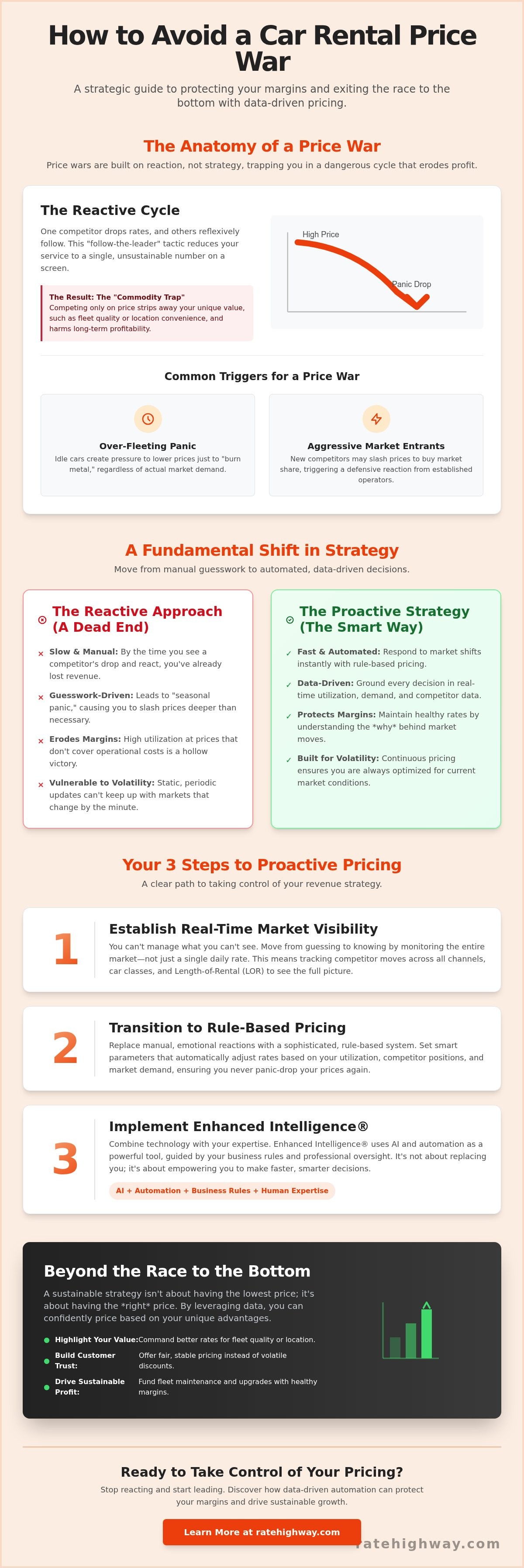
Price wars aren't built on strategy. They're built on reaction. In the car rental industry, this often manifests as a "follow-the-leader" cycle where one operator slashes rates and competitors reflexively match them to protect their booking volume. This defensive posture is a primary reason why many struggle with how to avoid a car rental price war. Understanding The Anatomy of a Car Rental Price War reveals that these conflicts are usually triggered by specific operational pressures rather than actual shifts in consumer value. Common triggers include over-fleeting, where idle cars create a "burn metal" panic, or the arrival of aggressive new market entrants looking to buy market share at any cost.
When you compete only on the base rate, you fall into the "Commodity Trap." This is a dangerous place to be. It strips away your brand's unique value, such as your location convenience or fleet quality, and reduces your service to a single number on a screen. This is a battle of cost, not a battle of value. The long-term damage is real. It drains the budgets you need for fleet maintenance and vehicle upgrades, ultimately hurting the customer experience you worked so hard to build. Using tools like RateIndex can provide the market intelligence needed to see these cycles forming before they consume your profits.
Why Reactive Pricing is a Dead End
Manual price matching is a slow game. By the time you see a competitor's drop and manually adjust your own rates, you've already lost valuable revenue. The psychological pressure is intense. Watching a screen as rates fall in real-time can lead to "seasonal panic," causing you to slash prices far deeper than necessary. Winning a price war is often a hollow victory. It leads to high utilization but unsustainable margins that don't cover your rising operational costs, like the 11.9% rental tax in Washington state or increased airport concession fees. It's about strategic control, not just survival.
The Role of Market Volatility
Modern markets move too fast for periodic updates. In 2026, we see rates fluctuate by as much as 13% year-over-year, and digital transparency means customers see every change instantly. This volatility makes traditional, static pricing obsolete. There's a critical difference between a healthy, data-driven price adjustment and a panic-driven slash. While a healthy adjustment responds to actual demand and utilization levels, a panic slash is a blind guess. To stay profitable, your pricing must be continuous and grounded in real-world data rather than just matching a competitor's move. This approach ensures you're responding to the market's speed with precision instead of haste.
Step 1: Establish Real-Time Market Visibility
Visibility dictates victory. You cannot manage what you cannot see, and in a fast-moving market, blind spots are expensive. To truly understand how to avoid a car rental price war, you must move beyond the surface level of daily rates and embrace total market intelligence. This means transitioning from guessing to knowing. Using a professional tool like RateIndex allows you to monitor competitor movements across every distribution channel and car category in real-time. This isn't just about watching a number fall; it's about discerning if a rate drop is a temporary "fake" move by a single discounter or a genuine market shift that requires a strategic response.
Real-time visibility provides the strategic control needed to resist the urge to match every downward tick. When you have a clear view of the entire landscape, you can see the difference between a competitor who is desperate for volume and one who is simply adjusting for a specific timeframe. This clarity is the foundation of Enhanced Intelligence®. It combines high-quality data with your own human expertise to ensure you aren't just reacting to noise. If you're ready to see how this visibility can protect your specific location, you can connect with our team for a deeper analysis of your market.
Beyond Simple Rate Scraping
Basic rate scraping is often a liability. It provides data without context, and poor data leads to poor decisions. You need to track Length-of-Rental (LOR) and car class specific trends to see the full picture. For example, a competitor might slash their rate for a 1-day rental while keeping their weekly rates steady. If you only see the daily rate, you might panic and lower your 7-day rates unnecessarily, leaving money on the table. Historical data is equally vital. It helps you identify recurring seasonal patterns, allowing you to predict when a price war is likely to start before the first discount is even posted. This foresight is a key component in how to avoid a car rental price war.
Monitoring Competitor Utilization Signals
You can often infer a competitor's fleet health by analyzing their price volatility. Frequent, erratic price drops usually signal a "burn metal" panic caused by low utilization. Conversely, when a competitor stops dropping rates or their prices suddenly spike, it's a strong signal they are nearing "sold out" status and their prices are about to rebound. This level of market visibility gives you the confidence to stay firm on your rates while others are panicking. Building a Sustainable Strategy requires this depth of insight. It allows you to maintain your margins and catch the high-value bookings that remain after your competitors have exhausted their inventory at lower, unsustainable prices.
Step 2: Transition from Reactive to Rule-Based Pricing
Stop reacting. Start dictating. Rule-based pricing replaces emotional impulses with logical, pre-defined parameters. It's a system of "if-this-then-that" instructions that govern your fleet's rates without requiring constant manual intervention. For example, you might set a rule that states: "if utilization for standard SUVs exceeds 85% for next weekend, then increase the base rate by 5%." This transition is a critical step in how to avoid a car rental price war because it removes the "seasonal panic" that leads to unnecessary discounting. You're no longer chasing a competitor's tail; you're following a strategic roadmap that prioritizes your specific business goals.
Automation without oversight is a risk that few operators can afford. This is why we focus on Enhanced Intelligence®. It's the synergy between advanced technology and human intuition. AI handles the heavy lifting of processing millions of market data points in real-time, but you provide the essential context of your local market knowledge. By using AI-driven revenue management, you can scale this strategy across multiple locations and car classes with precision. The goal of automation is to improve speed and consistency, acting as a visionary co-pilot that helps you make better decisions rather than removing you from the process entirely.
Setting Intelligent Price Floors
Every vehicle in your fleet has a "walk-away" price. This is the absolute minimum rate you must charge to cover your operational costs, including fleet depreciation, maintenance, and location-specific taxes like the 11.5% sales tax and 3.5% excise tax in Maryland. Setting an intelligent price floor protects your margins by refusing to drop below this threshold, regardless of what aggressive discounters are doing. There's a significant psychological benefit here. When the market dips, you won't feel the pressure to slash rates because your strategy is already locked in. You understand that letting a car sit for a day is often more profitable than renting it at a rate that doesn't cover your overhead.
Using Pricing Plug-Ins for Flexibility
Modern markets require more than just a single base rate. Configurable pricing plug-ins allow for nuanced adjustments based on specific demand shifts, such as length-of-rental (LOR) or booking window variations, rather than just competitor movements. If your data shows a surge in weekly bookings for the summer of 2026, your system can automatically optimize those rates even if daily rates are falling elsewhere. This flexibility also helps you maintain rate parity. Parity ensures your prices stay consistent across all booking channels, from your direct website to major travel platforms. This consistency prevents you from accidentally competing against yourself and is a proactive way to manage how to avoid a car rental price war.
Step 3: Implementing Enhanced Intelligence® to Protect Margins
Execution is where strategy meets the road. Once you've established your visibility and rules, you must implement them with surgical precision. Enhanced Intelligence® thrives on specificity. Instead of trying to monitor every operator at the airport, configure your automation to focus only on "key" competitors. These are the specific brands that directly impact your booking volume in certain car classes. By ignoring the noise of irrelevant discounters, you gain a clearer understanding of how to avoid a car rental price war that isn't actually yours to fight.
Continuous optimization is the standard in 2026. Markets like Anchorage, Alaska, where summer daily rates can reach $182, require a 24/7 watchful eye that manual adjustments simply can't provide. By utilizing RateMonitor Elite, you ensure your rates are always optimized based on real-time market movements and your internal utilization levels. This isn't a "set and forget" system. You should establish a regular review cadence where your team audits the AI’s performance. This ensures the automation remains aligned with your local expertise and any sudden shifts in the business environment. If you want to see how these triggers work in your specific market, you can schedule a strategy session with our experts.
Defining Your Strategic Goals
Your pricing settings must reflect your current business objectives. Are you chasing high yield during a peak holiday weekend or looking for volume during a shoulder season? Your automation should behave differently in each scenario. For instance, a location near a major hub might prioritize high utilization, while a boutique off-airport site might focus on premium yield. Aligning your automation triggers, such as adjusting rates when utilization drops below 70%, is a proactive way to manage how to avoid a car rental price war while maintaining your desired profitability.
Automating the Mundane, Focusing on the Strategic
Speed is a competitive advantage. In the car rental world, being the second to adjust to a significant demand shift is often too late. Automation handles the repetitive, time-consuming tasks of data entry and periodic rate updates, freeing your revenue managers to focus on high-level strategy. Instead of spending hours in spreadsheets, they can analyze long-term trends, plan fleet expansions, or evaluate vehicle valuations. This shift from reactive labor to proactive planning is a cornerstone of a sustainable business model. It allows your human experts to do what they do best: provide the strategic vision that guides the technology.
Beyond the Race to the Bottom: Building a Sustainable Strategy
Price is a signal, but it isn't the only one. To master how to avoid a car rental price war, you must shift the conversation from the base rate to the total value you provide. High-quality fleets and superior location convenience create price elasticity, allowing you to maintain higher rates even when competitors are slashing theirs. For example, a business traveler in 2026 is often willing to pay a premium for a low-emission vehicle or a seamless, app-based pickup experience. By focusing on these value-added services, you justify your margins and build a brand that stands for more than just the lowest number on a search results page.
Consistency builds trust. Professional pricing logic ensures that your rates make sense to the customer and the market. When your pricing is erratic, you train customers to wait for the next discount; when it's logical and steady, you reinforce your brand's value. You can further diversify your income by looking toward DemandShift strategies. This approach helps you identify and capture new revenue pools that aren't tied to the same aggressive discounting cycles as the broader market. It's about finding the right demand for your specific inventory at the right time.
The Long-Term ROI of Intelligent Pricing
Success isn't measured by how many cars you have on the road, but by the profit each vehicle generates. Understanding how to avoid a car rental price war leads to more stable, predictable revenue streams that allow for better long-term planning. Technology plays a vital role here. It allows you to scale your operations across multiple locations without significantly increasing your headcount. By automating the repetitive elements of revenue management, your team can focus on the high-level decisions that drive growth. This is the real return on investment: a business that is both more profitable and more resilient.
Preparing for the Next Market Shift
The market never stands still. Revenue management is a continuous process of observation, adjustment, and refinement rather than a one-time setup. In an industry where "normal" is constantly changing, agility is your greatest asset. Whether it's a sudden spike in fuel costs or a shift in travel demand, your system must be ready to respond with precision. Staying ahead of these turns requires the right combination of data intelligence and human judgment. If you are ready to see this in action, schedule a demo to see RateMonitor Elite in action and discover how to protect your margins in any market condition.
Take Control of Your Pricing Strategy
Strategic control is the difference between a business that survives a price war and one that thrives despite it. We've established that visibility and rule-based parameters form the essential bedrock of a healthy operation. By integrating real-time market analytics and customizable pricing plug-ins, you ensure your rates always reflect your actual fleet utilization and current local demand. This proactive shift is the definitive answer to how to avoid a car rental price war. It moves your team away from the exhaustion of manual data entry and toward the clarity of high-level strategy.
Our Enhanced Intelligence® technology acts as your visionary co-pilot. It provides the speed and consistency required in today's fast-moving market while keeping your professional judgment at the center of every decision. You don't have to choose between advanced automation and human intuition; you can have the synergy of both. Ready to protect your margins and exit the race to the bottom? Master your market with RateMonitor Elite today. You have the local expertise. We provide the tools to make it scale with precision and confidence.
Frequently Asked Questions
What exactly is a car rental price war?
A car rental price war is a reactive cycle of "follow-the-leader" discounting that erodes profit margins across the board. It's a race to the bottom where operators abandon their strategic pricing to match a competitor's lowest rate. Instead of focusing on yield or profit per vehicle, businesses focus on booking volume at any cost, often leading to unsustainable operational losses.
How do I know if a competitor is starting a price war?
You can spot a price war by monitoring for erratic, high-frequency rate drops that aren't justified by actual market demand. When a competitor slashes rates despite high seasonal volume, they're often panicking about idle fleet utilization. Tracking these signals with precision is the first step in learning how to avoid a car rental price war before it consumes your margins.
Can AI really help me avoid dropping my prices?
AI provides the market visibility needed to see if a competitor's rate drop is a genuine market shift or just temporary noise. By analyzing total market data, AI helps you stay firm on your rates when the intelligence shows that demand still supports your current price point. It acts as a sophisticated co-pilot that reinforces your existing expertise with data-driven confidence.
Is it ever okay to participate in a price war?
Participation should be rare and highly tactical. It might be necessary to protect a specific location or car class for a very short window, but only if you have a pre-defined exit strategy and a clear "walk-away" price. Long-term participation almost always leads to a "Commodity Trap" that damages your brand equity and drains your maintenance budgets.
What is the difference between dynamic pricing and a price war?
Dynamic pricing is a data-driven strategy that adjusts rates based on real-time utilization and demand; a price war is an emotional reaction to a competitor's move. Dynamic pricing is about optimization and finding the right price for the right time. Understanding this distinction is key to mastering how to avoid a car rental price war while staying competitive.
How often should I be updating my car rental rates?
Pricing updates should be continuous to keep pace with the modern digital market. Periodic updates, such as once a day or once a week, are often too slow to capture revenue during sudden demand spikes or to respond to rapid competitor movements. Continuous pricing allows for small, precise adjustments that maintain your competitive edge without requiring constant manual labor.
Will automated pricing tools take away my control over my fleet?
Automation actually enhances your control by executing your specific business rules with perfect consistency. You define the "if-this-then-that" parameters, such as price floors or utilization triggers, based on your local knowledge. The technology handles the repetitive, high-speed tasks, while you maintain final oversight and strategic direction over the entire process.
How can I justify higher rates when competitors are cheaper?
You can justify higher rates by highlighting value-added services like airport convenience, premium vehicle models, or flexible cancellation policies. Many customers, particularly business travelers, value reliability and speed over the absolute lowest base rate. Your pricing logic should reflect the superior experience you provide, ensuring you attract the right customers at the right price.
Curious to see RateMonitor in action? Reach out and book your demo now!