

Defining Dynamic Pricing in the Car Rental Landscape
Success in the modern car rental market isn't about having the most cars; it's about having the most intelligent prices. Dynamic pricing is a strategy of continuous rate adjustment based on real-time data. It's the engine that powers yield management. This isn't a "set it and forget it" approach. Instead, it's a fluid process of finding the right price for the right car at the right time. By 2026, the industry moved past the era of simple surge pricing. Today, we focus on maximizing the revenue potential of every single unit in your fleet through precision and timing.
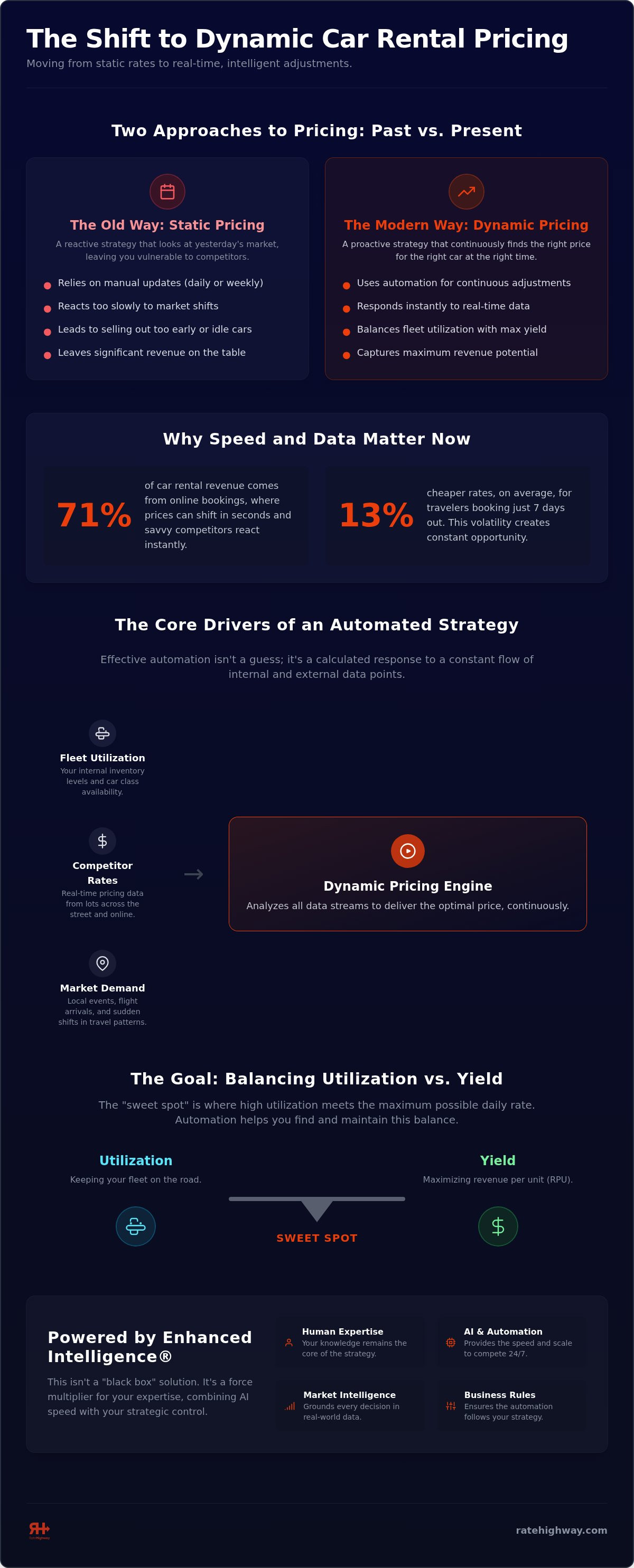
Traditional "static" or "seasonal" rate sheets often feel safe, but they're essentially frozen in time. They don't account for a competitor dropping rates on a Tuesday afternoon or a sudden spike in demand due to a local event. Dynamic pricing for car rentals replaces these rigid structures with a responsive system. It balances what's happening inside your lot with what's happening on the street. This strategy ensures you aren't leaving money on the table during peak demand or sitting on idle inventory when the market cools.
Beyond Static Rate Sheets: Why Speed Matters
Manual entry creates a "latency gap" that savvy competitors can exploit. If your team only updates rates once a week or even once a day, you're reacting to yesterday's news. Research from 2026 shows that over 71% of car rental revenue now comes from online bookings, where prices can shift in seconds. Travelers have also learned that booking just seven days out can be 13% cheaper than booking three months in advance. To stay competitive, you must close that gap. Continuous pricing is the ability to update rates every time market conditions shift.
The Core Drivers: Supply, Demand, and Competition
Effective pricing relies on a balance between internal and external data points. Your internal factors are the foundation. These include your current fleet utilization and inventory levels. If your lot is 90% empty, your pricing should reflect that scarcity. Conversely, external factors like competitor movement and local event triggers act as the weather conditions for your "flight."
- Inventory Levels: Your remaining stock of specific car classes.
- Competitor Rates: Real-time data on what the lot across the street is charging.
- Market Volatility: Sudden shifts in travel patterns or local demand.
These factors intersect to create a "price ceiling" and a "price floor." The ceiling is the maximum the market will bear before customers look elsewhere. The floor is the minimum you can charge while still maintaining a healthy margin. High-precision tools like RateIndex help you identify these boundaries instantly. You're not just guessing; you're using data to navigate the tight turns of the 2026 market.
The Anatomy of an Automated Fleet Pricing Strategy
Automation isn't a replacement for your expertise; it's a force multiplier. To work effectively, a dynamic pricing for car rentals strategy needs a steady stream of high-quality data. If you feed your pricing engine outdated information, you'll likely end up with irrational rates that alienate customers or drain your margins. A successful strategy connects market intelligence directly to your operational rules, ensuring that every price shift is grounded in the current reality of your lot and the local market.
Integrating Real-Time Market Intelligence
Data from 24 hours ago is practically ancient history in the 2026 market. If you're relying on daily reports, you're missing the intra-day swings that define modern travel. Tools like RateIndex provide the foundational intelligence you need by shopping rates across multiple booking channels in real-time. This allows you to see exactly how competitors are moving in response to local demand shifts. Whether it's a sudden surge at Anchorage (ANC) or a price war in Tampa (TPA), you need to see the move as it happens. By tracking these shifts across OTAs and direct sites, you eliminate the guesswork and ensure your automation is grounded in reality.
Balancing Utilization vs. Yield
Utilization is the percentage of your fleet currently on rent. It's a vital metric, but it's only half the story. The goal isn't just to have every car off the lot; it's to find the "sweet spot" where high utilization meets the maximum possible daily rate. Automation helps you avoid the common trap of selling out your inventory too early at a lower price point. If you book 100% of your economy cars three weeks in advance, you've lost the ability to capture high-yield, last-minute bookings. A sophisticated system uses business rules to slow down bookings as inventory tightens, effectively raising the price floor as you approach capacity.
While you push for yield, you must also stay mindful of the evolving landscape regarding consumer protections in dynamic pricing. Transparency ensures that your smarter pricing builds long-term loyalty rather than short-term friction. Balancing these factors requires a blend of speed and strategy. If you're ready to see how these data points can work for your specific fleet, you can reach out to our team for a deeper look at the technology behind these decisions.
Developing Your Pricing Rules and Tactics
Building a pricing strategy is about translating your professional intuition into a set of executable rules. Dynamic pricing for car rentals often triggers a fear of a "race to the bottom," where algorithms slash rates until margins disappear. This only happens when automation lacks strategic guardrails. By using modular Pricing Plug-Ins, you can layer specific tactics like occupancy-based surcharges onto your baseline rates. This approach allows you to scale your local knowledge across thousands of daily transactions without losing tactical control.
Strategic logic is well-supported by academic research. A recent literature-based assessment of dynamic pricing highlights how structured models outperform ad-hoc adjustments by reducing human error and increasing response speed. In practice, this means your automation works for you, not instead of you. It's about combining the speed of a machine with the strategic vision of a manager.
Establishing Safety Guardrails
You wouldn't drive a car without brakes; you shouldn't run automation without limits. Price floors are your primary defense. They ensure your rates never drop below your operational costs or brand standards. On the other end, price ceilings prevent price gouging during extreme demand, which protects long-term customer trust. You should also set maximum percentage jumps. If a competitor doubles their rate in an hour, your system can be programmed to follow only by a set amount. This prevents erratic behavior that might confuse your customers or trigger regulatory scrutiny.
Designing Competitive Response Logic
Your competitive stance isn't one-size-fits-all. You might choose to "Match" a major player for economy cars but maintain a "Premium" position for luxury SUVs. This logic should be flexible. If utilization for a specific class is low, you can use DemandShift to move inventory by adjusting the price gap between classes. This encourages customers to book into the classes you need to move most.
Targeting the right Length of Rental (LOR) is another powerful tactic. You can set rules that offer more aggressive rates for seven-day rentals while keeping one-day rates high. This preserves inventory for more profitable long-term bookings rather than filling the lot with low-margin, short-term stays. This level of nuance ensures your automation is always chasing the highest yield, not just the highest volume.
Steps to Implementing Dynamic Pricing for Your Fleet
Transitioning to dynamic pricing for car rentals is a strategic evolution, not just a software installation. It marks the move from reactive manual entry to a proactive model of Enhanced Intelligence®. To succeed, you must build a foundation that supports both speed and accuracy. You wouldn't launch a high-performance vehicle without a pre-flight check; your pricing strategy requires the same level of preparation. This process is about building a system that acts as a visionary co-pilot for your management team.
Auditing Your Current Data Foundation
Automation only works if your data is clean. Start by auditing your fleet inventory and utilization reporting to ensure the numbers in your system match the reality on your lot. If your software thinks you have five minivans available when you're actually sold out, your pricing will be dangerously low. You also need to identify your true market peers. Tracking every operator in the city creates noise; focus on the four or five competitors who actually influence your bookings. Finally, verify that your booking engine can ingest rate updates instantly. A delay in this connection creates a latency gap that competitors will exploit.
Configuring and Testing Your Logic
Trust in technology is earned through performance, not promises. We recommend starting your implementation in "Shadow Mode." In this phase, a tool like RateMonitor Elite suggests price changes based on your business rules, but it doesn't push them live to the OTAs. This allows your team to compare automated suggestions against their own manual decisions in real-time. It's a side-by-side test that identifies logic gaps before they can affect your revenue.
Once you're confident in the system's accuracy, you can gradually increase the automation "leash." You might start by allowing the system to auto-update economy cars within a tight price range, then expand to other car classes as the results prove out. This phased approach builds team confidence and ensures that human intuition remains the guiding force behind the machine's speed. It's about moving from periodic updates to a continuous pricing model at a pace your operation can handle.
The implementation process is a continuous loop of improvement. Every week, you should review your performance data to see where the automation excelled and where it hit a ceiling. This "Review and Refine" stage is where you sharpen your strategy to handle market volatility or local demand shifts. If you're ready to build a customized roadmap for your fleet, schedule a strategic consultation with our team to see how we can help you scale.
Navigating the Future with Enhanced Intelligence®
The future of revenue management isn't a competition between humans and machines. It's a partnership. Enhanced Intelligence® represents the fusion of high-speed automation and professional human judgment. This approach ensures that your pricing is always fast enough to capture demand but grounded enough to make sense in the real world. By 2026, adopting AI Revenue Management became more than an upgrade; it’s a competitive necessity for any fleet looking to protect its margins in a volatile market.
Using RateMonitor Elite facilitates this human-in-the-loop strategy. It treats the revenue manager as a master strategist rather than a data entry clerk. Instead of spending hours manually typing rates into a portal, you spend your time designing the rules that govern the machine. This shift allows you to focus on the "tight turns" of your business while the technology handles the repetitive execution of your vision. You're not just managing a spreadsheet; you're directing a high-performance system.
The Synergy of AI and Human Oversight
AI is incredibly effective at the heavy lifting. It can process thousands of daily rate changes across every car class and location without fatigue. However, AI lacks local context. It doesn't know if a sudden storm is grounding flights or if a local festival is drawing a different demographic of traveler. That's where your expertise comes in. The best systems provide total transparency and allow for manual overrides at any time. You remain the pilot, while the automation serves as your high-precision co-pilot, alerting you to opportunities and executing your commands with perfect consistency.
Continuous Pricing in a Volatile Market
Relying on periodic updates is a reactive stance that leaves you vulnerable. In contrast, dynamic pricing for car rentals allows you to be proactive. By implementing fleet pricing automation, you create a more resilient business that can withstand sudden market shifts or competitor price wars. You aren't just following the market; you're anticipating it based on real-time utilization and demand data. This strategy ensures that your fleet is always priced for maximum yield, regardless of how fast conditions change.
The transition to smarter pricing starts with a single step toward automation. If you're ready to move beyond manual rate sheets and take full strategic control of your revenue, we're here to help. Schedule a demo to see Enhanced Intelligence in action and discover how to maximize your fleet's potential throughout 2026 and beyond.
Mastering the Future of Revenue Management
The road to revenue optimization in 2026 is paved with data and precision. You've seen how moving away from static rate sheets allows you to capture yield that manual entry simply misses. By implementing dynamic pricing for car rentals through the lens of Enhanced Intelligence, you position your business to thrive despite market volatility. It's about combining the tireless speed of automation with your own deep industry expertise to stay ahead of the competition.
Success requires the right tools to execute your vision. RateHighway provides the foundation you need with real-time market intelligence via RateIndex and the strategic flexibility of configurable Pricing Plug-Ins. Trusted by global car rental brands, our technology ensures you stay in total control of every rate change. You're no longer just reacting to the market; you're actively steering your fleet toward higher utilization and better margins. The transition to a proactive pricing model is a journey we take with you as your strategic partner.
If you're ready to close the latency gap and reclaim your time for higher-level strategy, it's time to take the next step. Optimize your fleet revenue with RateMonitor Elite today. The future of your business is waiting, and we're ready to help you drive toward it with confidence.
Frequently Asked Questions
What is the difference between dynamic pricing and yield management?
Dynamic pricing refers to the tactical movement of rates based on real-time data. Yield management is the broader strategic goal of maximizing revenue from a fixed inventory. Think of yield management as the destination and dynamic pricing as the engine that gets you there. In car rentals, this means adjusting prices to ensure the most profitable car classes are rented at the peak value for every available day.
Does fleet pricing automation mean I lose control of my rates?
You maintain total strategic control through configurable business rules. Automation doesn't replace your judgment. Instead, it executes your specific vision at a speed humans can't match. You set the guardrails, such as price floors and competitive logic, ensuring the system never makes a move you haven't authorized. Tools like RateMonitor Elite are designed to be your co-pilot, not an autonomous replacement for your expertise.
How often does dynamic pricing software update my car rental rates?
Modern systems focus on continuous pricing rather than periodic updates. This means the software can monitor the market and adjust your rates every time conditions shift. You close the latency gap. By using real-time market intelligence from RateIndex, you ensure your fleet remains competitive as demand spikes or competitors drop their prices. The software handles thousands of updates daily while you focus on high-level strategy.
Can I set a minimum price to ensure I never rent at a loss?
Setting "Price Floors" is a standard part of any sophisticated strategy for dynamic pricing for car rentals. These guardrails protect your brand value and cover your operational costs by ensuring rates never dip below a specific threshold. You can customize these floors by car class, location, or length of rental. This safety net prevents the system from entering a "race to the bottom" during periods of low demand.
Do I need a large fleet to benefit from dynamic pricing for car rentals?
Operators of all sizes benefit from the speed and accuracy of dynamic pricing for car rentals. While larger fleets gain from scalability, smaller operators often find that automation allows them to compete with international brands on a level playing field. Even with a small fleet, missing a single high-demand window hurts your bottom line. Automation ensures you capture every yield opportunity without needing a dedicated revenue management team.
How does dynamic pricing handle local events like concerts or festivals?
The system monitors market intelligence to detect sudden surges in competitor pricing or inventory scarcity caused by local events. Your local knowledge is vital. While AI handles the data processing, you provide the strategic context. For example, if you know a major festival is coming to town, you can adjust your rules to increase your price floor or target specific lengths of rental that are more profitable during high-traffic weekends.
What is Enhanced Intelligence® in the context of car rental software?
Enhanced Intelligence® is the synergy between advanced technology and human intuition. It's a human-centric approach to innovation where AI handles the heavy lifting of data analysis while humans provide strategic oversight. You remain the pilot. In our software, this means using AI to identify trends and suggest rate changes, but keeping you in the loop to approve or override decisions based on your unique understanding of the local environment.
How long does it take to implement a dynamic pricing system?
Implementation follows a chronological roadmap designed to build team confidence. You start with an audit of your current data and inventory reporting to ensure a clean foundation. Many operators begin in "Shadow Mode," letting the system suggest rates for a few weeks without pushing them live. This allows you to refine your business rules and test the logic before fully automating your pricing across your entire fleet inventory.
Curious to see RateMonitor in action? Reach out and book your demo now!