The most expensive seat in your office isn't the one behind the desk; it's the one spent manually chasing competitors across a dozen browser tabs. It is a common frustration for operators who feel they're constantly a step behind, watching fleet utilization drop while rivals snap up bookings with lightning speed. You know your market better than anyone, but the sheer volume of data in 2026 makes it impossible to manage a modern car rental pricing algorithm by hand without a clear strategic framework.
We understand that losing bookings to faster competitors or seeing low utilization during off-peak hours can feel like a loss of control. This article demystifies the core variables and logic behind modern pricing to help you move from manual adjustments to intelligent automation. You will learn how to improve your revenue per available car (RevPAC) using Enhanced Intelligence®, a balance of technology and human oversight that ensures you remain the master strategist of your fleet.
Key Takeaways
• Understand how modern pricing logic balances maximum profit with high fleet utilization to keep your business moving.
• Identify the internal and external data points a car rental pricing algorithm uses to see market opportunities that human eyes might miss.
• Learn why top-tier operators have moved from static rates to continuous pricing to stay competitive in the 2026 market.
• Discover the concept of Enhanced Intelligence® and how it pairs automation with human oversight for more precise control.
• See how using professional platforms like RateMonitor Elite can help you increase RevPAC while maintaining your strategic authority.
What is Car Rental Pricing Logic?
Pricing logic is the invisible engine that drives your business forward. It's the set of specific rules and data inputs used to determine the optimal rate for every vehicle in your fleet. In the past, many operators relied on "rack rates," which were fixed prices that rarely changed regardless of what was happening in the street. Today, that approach is a liability. Modern revenue management relies on a car rental pricing algorithm to process thousands of variables in real time, ensuring your rates are both competitive and profitable.
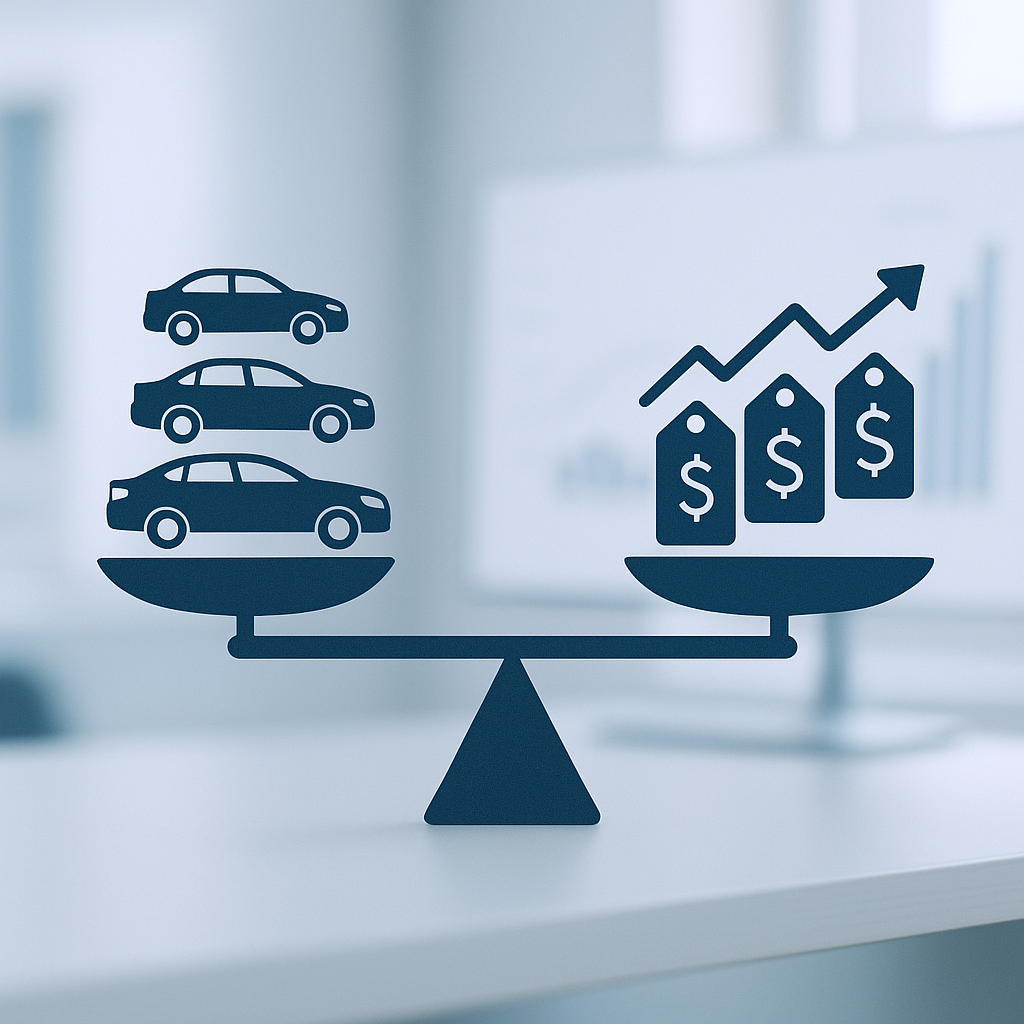
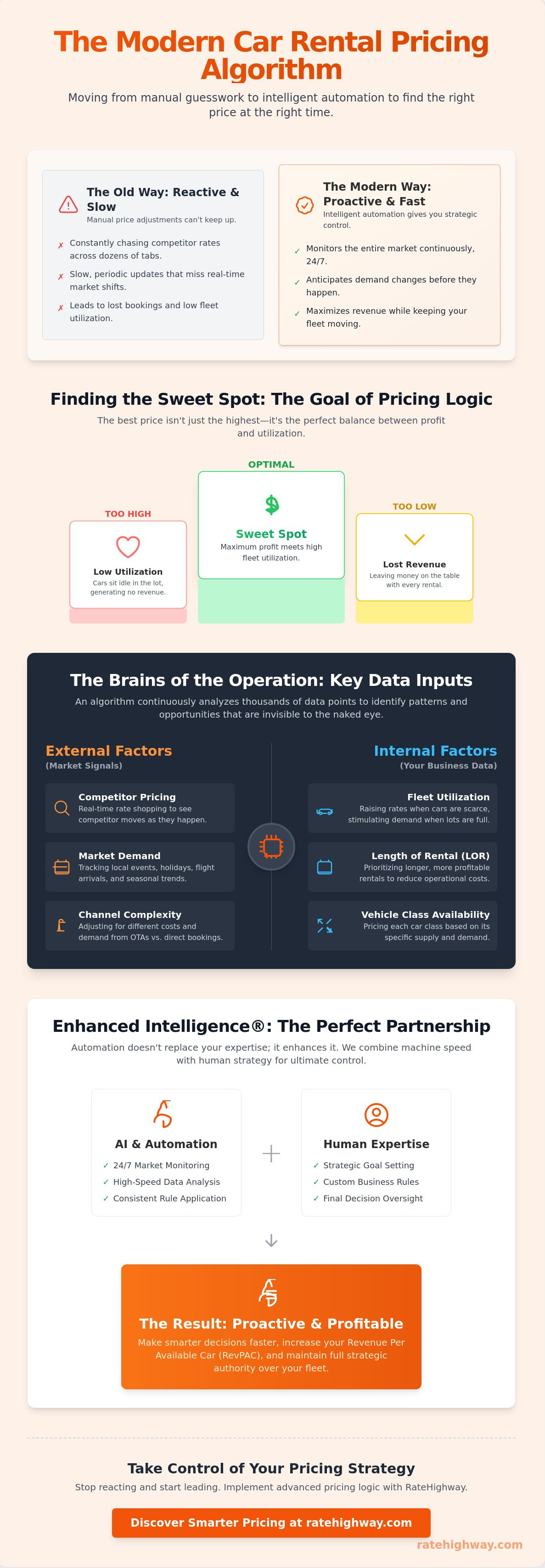
An "optimal" price isn't just the highest number you can get away with. Instead, it's a careful balance between maximum profit per transaction and high fleet utilization. If your prices are too high, your cars sit idle in the lot. If they're too low, you leave money on the table and wear out your fleet for minimal gain. Algorithmic pricing helps you find the "sweet spot" where supply meets demand. This logic must remain consistent across every distribution channel, from your own website to global OTAs, to maintain your brand's integrity and prevent customers from "rate shopping" your own business.
The Shift from Static to Strategic Pricing
Weekly or monthly rate updates don't work in a 24/7 digital market. By the time you've manually adjusted your prices for a weekend event, your faster competitors have already captured the bookings. We believe in Enhanced Intelligence®, which is the synergy between advanced automation and human expertise. This isn't about letting a machine take the wheel; it's about giving you a high-tech navigation system. This technology makes sense of massive data sets so you can stay proactive. You aren't just reacting to a competitor's price drop after it happens. You're anticipating market movements before they impact your bottom line.
The Goal: Finding the Right Price at the Right Time
Understanding the relationship between demand, supply, and price elasticity is key to staying profitable in 2026. A car rental pricing algorithm looks at how sensitive customers are to price changes at different times. For example, a business traveler might prioritize convenience over a $5 difference, while a vacationing family might be more price-sensitive. The highest price isn't always the most profitable if it results in a 40% utilization rate. You want your fleet moving, but you want it moving at a rate that reflects its true value in the current market. Pricing logic is a strategic framework for revenue optimization.
The Core Variables: What Drives the Algorithm?
A human manager might check competitor rates once or twice a day. In contrast, a car rental pricing algorithm monitors the market continuously. It doesn't just look at a single price point. It analyzes the relationship between thousands of data points to identify patterns that are invisible to the naked eye. This high-definition view allows for more precise adjustments, especially in high-volatility environments where conditions change by the hour. Data freshness is the lifeblood of this process; using day-old information in a fast-moving market is like driving with a dirty windshield.
External Variables: Competition and Market Demand
External variables act as the environmental sensors for your pricing logic. Real-time rate shopping is essential because it identifies competitor movements the moment they happen. According to research from Harvard Business School, the widespread adoption of these algorithms has fundamentally changed how firms interact with market signals. For a rental operator, this means tracking local events, holidays, and seasonal trends automatically. You also have to account for channel complexity. A booking on an OTA often carries different costs and demand profiles than a direct booking, and your logic must adjust to protect your margins across all platforms.
Internal Variables: Utilization and Length of Rental (LOR)
Internal variables are just as critical to the equation. Fleet utilization is the pulse of your business, often monitored through advanced GPS and IoT solutions like Letstrack to ensure data accuracy. When your lot is full, your logic should push rates higher to maximize revenue per available car. When utilization is low, the system finds the price floor that stimulates demand without sacrificing value. Length of Rental (LOR) plays a massive role here. A single seven-day rental is often more valuable than seven one-day rentals because it reduces "tight turns" and lowers operational overhead. The algorithm recognizes this and prices accordingly to fill inventory gaps and keep your fleet moving efficiently.
To make these insights actionable, we use "Pricing Plug-Ins" that allow you to customize how a car rental pricing algorithm balances these inputs for your specific location. This ensures the technology respects your local expertise while providing the speed of automation. If you want to explore how these variables can be tuned for your specific fleet, you can reach out to our strategy experts for a deeper look at your data.
From Static to Continuous: The Evolution of Pricing Models
Pricing strategy isn't a "set it and forget it" task anymore. It has matured from a seasonal chore into a high-speed, real-time discipline. For top-tier operators in 2026, the goal isn't just to have a price; it's to have the right price for that specific second. Moving from manual adjustments to a car rental pricing algorithm allows independent brands to scale their expertise without losing sleep over every competitor's move.
Static vs. Dynamic vs. Continuous Pricing
The industry has moved through three main stages of sophistication. Static pricing is the most basic, relying on fixed rates for "peak" and "off-peak" seasons. It's risky because it ignores the daily fluctuations of a modern market. Dynamic pricing introduced trigger-based adjustments, where rates move based on specific events or utilization levels. A data-driven dynamic pricing framework helps bridge the gap between human intuition and cold numbers. However, the current gold standard is continuous pricing. This model uses a constant flow of data to make micro-adjustments in real time, ensuring your fleet is always positioned for maximum revenue.
The Role of Real-Time Market Intelligence
You can't have continuous pricing without a solid foundation of data. Professional intelligence tools like RateIndex provide the high-frequency market visibility needed to fuel these decisions. Relying on simple web scrapers is a dangerous gamble; they often provide delayed or inaccurate data that can lead to costly pricing errors. In 2026, speed is the ultimate competitive advantage. If your car rental pricing algorithm sees a supply drop ten minutes before the rest of the street, you can capture those high-value bookings while others are still catching up.
There's a common myth that automation leads to a "race to the bottom" where everyone just cuts prices. In reality, intelligent logic does the opposite. It identifies when demand is high and supply is low, allowing you to raise rates aggressively. It protects your brand value by ensuring you aren't discounting when you don't have to. Automation improves consistency and scalability, giving you the power of a global brand while maintaining the local judgment that makes your business unique.
Enhanced Intelligence®: Balancing Automation and Human Expertise
Technology should never be a black box that makes decisions in the dark. It should be a lens that clarifies your vision and a tool that amplifies your expertise. Many operators fear that a car rental pricing algorithm will take over their business and make cold, irrational moves that ignore local reality. We address this through Enhanced Intelligence®. This is the strategic combination of AI, automated business rules, and human oversight. It is designed to keep you in the driver’s seat while the technology handles the complex calculations happening under the hood.
This approach ensures that AI acts as a support tool rather than a replacement for experienced revenue managers. You understand your market’s "tight turns" and unique local quirks better than any machine ever could. Enhanced Intelligence® respects that knowledge. It provides the data intelligence to make faster decisions, but it relies on your professional judgment to set the ultimate direction. It is a partnership of speed and strategy.
AI as Your Visionary Co-Pilot
Think of AI as a co-pilot that handles the heavy lifting of data processing. While you focus on high-level growth, the car rental pricing algorithm monitors thousands of market signals every minute. It identifies trends in fleet utilization and competitor movement that would take a human hours to find. However, a machine might not know about a last-minute local festival or a construction project that changes demand at a specific location. Your intuition fills these gaps. By combining your local insights with automated data processing, you can stay proactive rather than just reacting to the market. You can learn more about AI in Revenue Management to see how this balance protects your bottom line.
Setting the Guardrails: Business Rules and Plug-Ins
Automation requires "rules of the road" to remain effective and safe for your brand. We use Pricing Plug-Ins to create these guardrails. These rules allow you to enforce brand standards, maintain minimum profit margins, and prevent the system from making irrational price drops during market glitches. These "sanity checks" are vital for maintaining long-term brand value. They ensure that your pricing logic remains consistent even when the market becomes volatile. Automation provides the speed, but humans provide the strategy. By setting these parameters, you ensure the technology works for you, not the other way around.
If you want to see how configurable logic can be tailored to your specific fleet and location, contact our team for a strategy session. We can help you build the right guardrails to optimize your revenue with confidence.
Implementing Advanced Pricing Logic with RateMonitor Elite
Strategy is only as effective as your ability to execute it. You can have a deep understanding of market dynamics, but without a platform to translate that knowledge into action, your revenue potential remains locked. RateMonitor Elite is the command center where your strategic vision meets the street. It allows you to move beyond the exhausting grind of "managing rates" and instead focus on steering the broader strategy of your business. This shift is what separates the market leaders from those who are simply trying to keep up.
The benefits of this transition are tangible and immediate. Operators see a measurable increase in Revenue per Available Car (RevPAC) because the system identifies and captures high-value opportunities that manual checks miss. You gain total market visibility, allowing you to see exactly where you stand against the competition at any moment. Whether you are managing a local independent fleet or a multi-location international franchise, the platform scales to fit your operational complexity without adding to your workload.
Automating the Rate Lifecycle
RateMonitor Elite handles the entire rate lifecycle with precision and speed. It begins with high-frequency market shopping to gather the freshest data. From there, your custom car rental pricing algorithm applies your specific business rules to determine the optimal price. The system then automatically distributes these rates across all your booking channels. This process accounts for location-based demand and real-time fleet utilization, ensuring you never overbook at a low rate or sit empty during a surge. It closes the loop by analyzing performance data to refine your logic over time, turning every rental into a lesson for the next price adjustment.
Your Next Steps Toward Revenue Optimization
Waiting to automate is a choice, but it's a costly one. Every hour spent on manual data entry is an hour where your competitors might be capturing your most profitable bookings. In the fast-moving market of 2026, the cost of hesitation is high. You need a partner who understands the "tight turns" and specialized challenges of the car rental industry. We provide the technology and the expertise to help you navigate these complexities with confidence.
It's time to take control of your revenue. You can schedule a demo of RateMonitor Elite today to see how intelligent automation can transform your operations. Let us show you how to turn your data into a powerful competitive advantage that keeps your fleet moving and your margins growing.
Master the Curve of Modern Revenue Management
The shift from manual rate management to continuous, automated logic is no longer optional for brands that want to lead the market. By leveraging a car rental pricing algorithm, you gain the speed to react to competitors instantly while keeping your fleet moving at optimal rates. This isn't about surrendering control to a machine; it's about using Enhanced Intelligence® to support your local expertise with real-time market data from RateIndex.
You maintain total authority over your brand through configurable Pricing Plug-Ins that act as your strategic guardrails. This combination of high-tech precision and human judgment ensures you're always finding the right price at the right time. Your fleet is an asset that deserves proactive management rather than reactive adjustments. The complexity of the 2026 market requires a co-pilot that can handle the data while you handle the vision.
Ready to take the wheel? Optimize your revenue with RateMonitor Elite and start steering your strategy with confidence. The future of pricing is here, and it's built to empower you.
Frequently Asked Questions
What is the difference between dynamic pricing and a pricing algorithm?
Dynamic pricing is the broad strategy of adjusting rates based on market demand, while a car rental pricing algorithm is the specific set of rules and calculations that executes that strategy. Think of dynamic pricing as the "what" and the algorithm as the "how." The algorithm takes in data like competitor movement and fleet utilization to find the exact price point that meets your revenue goals for that moment.
Can I still manually override the pricing algorithm if I see a market change?
You can always manually override the system, as human expertise is a core part of Enhanced Intelligence®. If you know about a local event or a unique market anomaly that the data hasn't captured yet, you can step in and adjust your rates. The technology is designed to be your co-pilot, providing the speed of automation without taking away your strategic authority.
How often should a car rental pricing algorithm update my rates?
Modern rates should update continuously to keep pace with the fast-moving 2026 market. Periodic or daily updates are no longer enough because travel demand and competitor prices can shift in minutes. Continuous updates ensure that your fleet is always priced correctly for the current second, protecting your margins and preventing you from losing bookings to faster competitors.
Do I need a large fleet to benefit from car rental pricing software?
You don't need a large fleet to see the benefits of automation. In fact, smaller independent brands often gain the most from a car rental pricing algorithm because it allows them to compete with global franchises without hiring a massive revenue team. Automation provides the scalability and speed you need to manage your fleet efficiently, regardless of how many vehicles you have.
How does fleet utilization affect my pricing logic?
Fleet utilization is the primary internal driver for your pricing logic. When your lot is nearly empty, the system identifies high demand and pushes rates up to maximize revenue per available car (RevPAC). Conversely, when utilization is low, the algorithm may lower rates to attract more customers and keep your vehicles moving, ensuring you don't have idle assets costing you money.
Will an algorithm always lower my prices to beat competitors?
An algorithm's goal is optimization, not just price cutting. While it will lower rates to stay competitive during slow periods, it's just as likely to raise them when it detects a supply shortage in the market. It protects your brand value by ensuring you only discount when it's strategically necessary to fill inventory gaps and keep your fleet moving.
What data sources do car rental pricing algorithms use?
These systems pull from a wide variety of internal and external data points. This includes real-time competitor rates from sources like RateIndex, your current fleet utilization levels, and historical booking trends. It also factors in external signals like regional holidays, major local events, and even fuel prices to ensure your rates reflect the true market conditions.
How does length of rental (LOR) impact the rates generated by the software?
Length of Rental (LOR) significantly impacts pricing because longer bookings reduce your operational overhead. A seven-day rental typically has a lower daily rate than a one-day rental because it ensures the vehicle is earning revenue for a longer period with less cleaning and administrative work. The software calculates these discounts to encourage longer, more profitable bookings that fill inventory gaps.