
The Hidden Costs of Manual Rate Management in a Volatile Market
Manual rate management isn't just a slow process; it's a financial liability. In a global market projected to reach nearly $73 billion by 2030, the sheer volume of data makes traditional spreadsheets obsolete. Relying on a team member to manually check competitor websites and type in new rates is like trying to win a high-stakes race on a bicycle. You might be pedaling as hard as you can, but the competition has already finished the lap while you were still checking the first turn. The benefits of AI in car rental revenue management start with the simple realization that human eyes cannot monitor every price shift across every channel at once.
Market volatility in 2026 is relentless. With shifting insurance regulations and the rapid integration of electric vehicles into fleets, prices change by the minute. When your team leaves for the day, your pricing effectively freezes. This creates a "Coverage Gap." While your office is dark, competitors are using dynamic pricing to capture early bird bookings and late-night travelers. By the time you sit down at your desk the next morning, the most profitable opportunities have already passed you by. This gap doesn't just cost you a few bookings; it erodes your overall margins over time.
The Speed Gap: Losing the Race to the First Booking
Speed defines your visibility in the modern marketplace. Online Travel Agencies (OTAs) prioritize active, competitive pricing when determining search rankings. If your rates are stale, your listings slide to the second or third page where they're rarely seen. Consider these common operational hurdles:
- Competitor Agility: Rivals using automation can undercut your rates within minutes of a market shift.
- Intra-day Spikes: Periodic daily updates fail to capture sudden demand spikes caused by flight delays or local events.
- Conversion Decay: Stale pricing leads to lower click-through rates, signaling to booking platforms that your inventory is less relevant.
One of the primary benefits of AI in car rental revenue management is the ability to close this speed gap. Automation allows you to respond to market movements in real time, ensuring you're always in the running for the next booking.
Data Fatigue and the Risk of Human Error
Managing thousands of rate combinations across different car groups and rental lengths is mentally exhausting. It's not just about the time spent; it's about the inevitable risk of fatigue. A single typo in a manual rate upload can drop a daily rate from $59 to $5.90. These errors can lead to thousands in lost revenue before anyone even notices the mistake. This constant pressure leads to burnout and keeps your best people trapped in a cycle of reactive firefighting.
Transitioning to a more strategic rate management approach allows your team to focus on high-level goals rather than repetitive data entry. By leveraging automation, you empower your staff to act as master strategists who oversee the system. They provide the local nuance and business rules, while the technology handles the heavy lifting of data processing. This synergy ensures your fleet utilization remains high without the mental fatigue that leads to costly operational mistakes.
Enhanced Intelligence®: Why AI Needs a Human Co-Pilot
Automation provides the engine; you provide the steering. While the benefits of AI in car rental revenue management include incredible speed and 24/7 monitoring, technology should never be a "black box" that makes decisions in the dark. Many generic AI systems fail because they lack the context of your specific market. An algorithm might see a sudden drop in competitor rates and follow them down, unaware that those competitors are nearly sold out or that a major local festival is about to drive demand back up. Without human intuition, an autonomous system can inadvertently trigger a "race to the bottom" that destroys your margins.
We solve this by focusing on Enhanced Intelligence®. This approach treats technology as a tool for scalability rather than a replacement for your staff. By setting clear business rules and guardrails, you ensure the system acts as a visionary co-pilot. It handles the repetitive data processing while you maintain strategic control. This balance is particularly important when considering broader market implications like consumer protections and brand reputation, which require a level of nuance that code alone cannot provide.
Automation as the Scalable Foundation
AI excels at processing massive datasets that would overwhelm a human manager. It monitors market movements every minute of every day, identifying subtle trends in fleet utilization and competitor shifts across multiple booking channels. This ensures your pricing remains consistent whether a customer finds you on an OTA or your direct website. Enhanced Intelligence® is the combination of AI speed and human strategic oversight. By building on this foundation, your team can manage complex, multi-location operations without increasing their daily workload. If you are curious about how these tools fit into your current workflow, you can speak with a strategist to explore the possibilities.
The Human Element: Strategy and Brand Identity
An algorithm cannot decide if your brand should be a premium service or a budget-friendly alternative. These are strategic choices that require human judgment. You understand the "tight turns" of your local market, such as which car groups are in high demand for weekend getaways versus weekday business travel. When black swan events occur, like unexpected vehicle recalls or sudden weather shifts, a human manager can adjust the logic instantly. This level of oversight maintains accountability in the AI revenue management process. You aren't just letting a machine run your business; you are using a powerful tool to execute your specific vision more effectively than ever before.
Configurable Pricing Plug-Ins: Solving the Black Box Problem
Generic algorithms treat car rentals like any other retail product. This is a mistake. A rental car is a perishable asset with unique constraints like Length of Rental (LOR) and fleet utilization. One of the core benefits of AI in car rental revenue management is the ability to use configurable pricing plug-ins. These aren't rigid, "black box" systems that hide their logic. Instead, they're modular sets of rules that you can adjust to match your specific business goals. This transparency is vital because it allows you to see exactly why the system recommended a price change before it goes live.
Configurability bridges the gap between your high-level fleet valuation and daily rate adjustments. If your goal is to maximize the value of every vehicle in your yard, your pricing must reflect the current state of your inventory. Plug-ins allow you to automate this connection. You can set the system to prioritize high-margin weekly rentals or to focus on quick turns during peak holiday periods. You remain the strategist, while the plug-ins serve as the precise tools that execute your plan across thousands of daily transactions.
Industry-Specific Logic: LOR and Utilization
Successful revenue management depends on more than just matching a competitor's price. You must account for how long a customer intends to keep the car. Pricing plug-ins allow you to set specific rules for Length of Rental (LOR) to ensure you aren't filling your fleet with low-value, short-term bookings during a high-demand week. By integrating RateIndex, the system gains real-time market intelligence, allowing it to adjust rates based on actual supply and demand. If your utilization hits a certain threshold, the system can automatically nudge rates up to protect your remaining inventory.
- Utilization Triggers: Automatically increase rates as your fleet availability drops to avoid "selling out" too early at a low price.
- LOR Protection: Incentivize longer bookings during busy periods to maximize the total revenue per vehicle.
- Market Alignment: Use real-time data to stay competitive without sacrificing your target margins.
-
Flexibility for Franchise and Independent Operators
Every location has its own "tight turns." An airport location faces different competitive pressures than a local city branch. Configurable plug-ins give you the flexibility to set floor and ceiling prices that protect your brand value. You can ensure the system never drops a rate below your operational cost, regardless of what a competitor does. This creates a "set it and monitor it" workflow. Over time, this consistency builds trust. You can feel confident that the automation is working within your guardrails, allowing you to focus on growing your business rather than micro-managing every car group.
Case Study: Achieving Millions in Additional Revenue
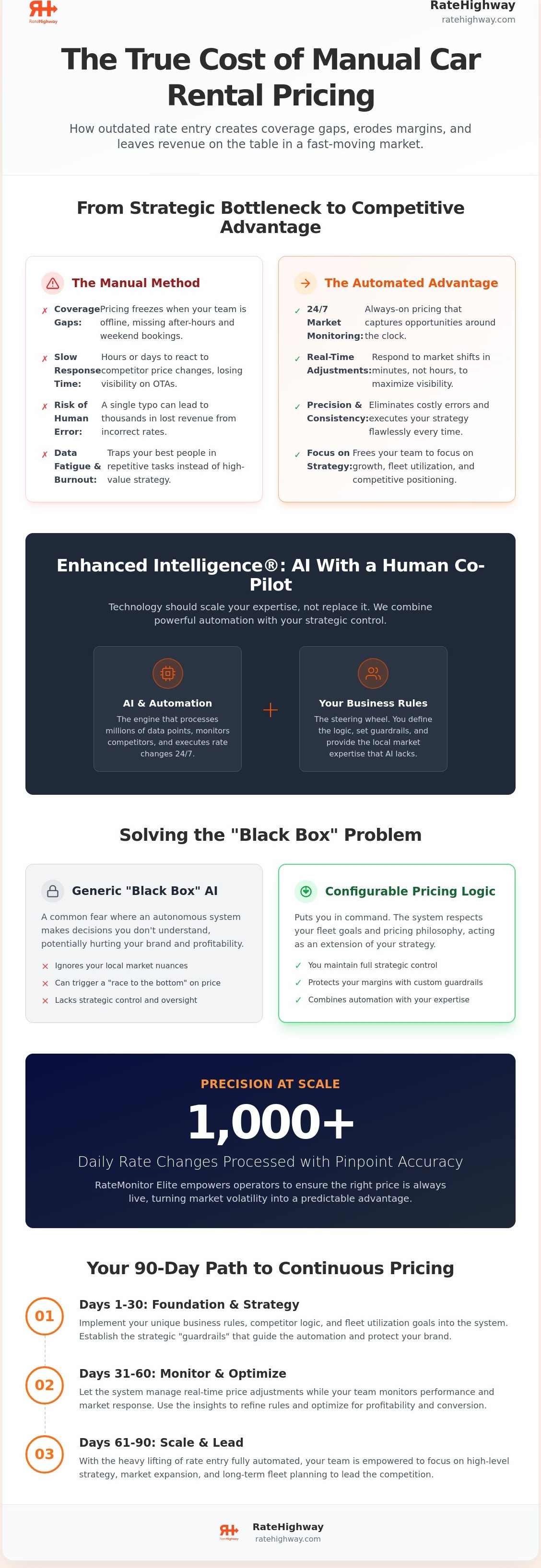
A mid-sized fleet operator faced a relentless daily grind. With multiple locations and various car groups, they struggled to manage over 1,000 daily rate changes across their booking channels. Their team was trapped in a cycle of manual rate entry, often finishing yesterday's updates while today's market had already moved. They needed a way to reclaim their time and protect their margins without losing strategic control. By implementing RateMonitor Elite, they transitioned from chasing the market to leading it.
One of the primary benefits of AI in car rental revenue management is the ability to execute complex strategies at a speed no human can match. This operator didn't just turn on a machine and walk away. Instead, they used the implementation phase to set specific guardrails that reflected their local market knowledge. They defined floor prices, utilization triggers, and competitor sets. This ensured the automation acted as an extension of their expertise, following their unique business rules while processing data 24/7.
From Manual Entry to Strategic Oversight
The impact on daily operations was immediate. The team reduced the time spent on manual rate shopping by 90%. This massive time savings allowed them to shift their focus from repetitive data entry to high-level fleet strategy. Instead of typing numbers into a portal, they spent their time analyzing market trends and optimizing their fleet mix. They discovered that managing car rental rates with a structured approach is about more than just speed; it's about having the mental space to make better decisions. The software handled the "tight turns" of the market, while the staff focused on the finish line.
Revenue and Utilization Growth Metrics
The financial results validated the move to Enhanced Intelligence®. By using automated rate shopping, the operator could visualize and capture increases in average daily rate (ADR) during sudden peak demand periods that they previously missed. They also maintained high utilization during traditionally slow periods by allowing the system to make micro-adjustments to stay competitive. The operator achieved a 15% revenue lift while reducing manual labor hours by 30 hours per week. This ROI demonstrates that automation is a tool for strategic growth, not just operational efficiency.
If you are ready to see how automation can reclaim your team's time and boost your bottom line, schedule a strategy session today.
Implementing Car Rental Revenue Automation: Your Next 90 Days
Moving from manual entry to automated pricing is a strategic transition, not a single event. You don't need to overhaul your entire operation overnight to see results. The primary benefits of AI in car rental revenue management come from a phased approach that builds trust in the data before scaling the automation. By following a structured 90-day roadmap, you can move from reactive firefighting to a proactive Enhanced Intelligence® workflow that respects your local expertise while maximizing your fleet's potential.
Your first step is assessing your current revenue management maturity. If your team is still spending hours every morning cross-referencing OTA rates against your reservation system, your maturity level is "manual-heavy." Transitioning to a car-rental-specific system is vital because generic retail software doesn't understand the "tight turns" of our industry. You need a tool that accounts for fleet utilization, length-of-rental (LOR) patterns, and the perishable nature of your inventory.
Phase 1: Data Integration and Rate Shopping
The first 45 days focus on visibility. You cannot manage what you cannot measure. During this phase, you'll connect your reservation system to a dedicated car rental revenue management platform to ensure a seamless flow of data. This allows you to establish a baseline for competitor tracking and market movement. Key objectives include:
- System Connection: Integrating your live fleet data to ensure pricing recommendations are based on actual utilization.
- Baseline Establishment: Identifying your core competitor sets across all active locations.
- Channel Parity: Ensuring your rates are consistent across your direct website and all distribution channels to protect your brand integrity.
Phase 2: Strategy and Continuous Pricing
Once your data is flowing, you can begin deploying automated business rules. This is where your strategic vision takes the wheel. You'll start by setting your first automated pricing rules in RateMonitor Elite, defining the floor and ceiling prices that act as your safety guardrails. This phase is about moving from periodic updates to continuous pricing that responds to the market in real time.
You can also begin using DemandShift to move inventory into higher-yield car groups during peak periods. This ensures you aren't just selling out, but selling at the highest possible margin. As you measure success, look beyond just top-line revenue. Evaluate your RevPAR (Revenue Per Available Rental) and the total labor hours saved. By the end of 90 days, your team should be acting as master strategists, overseeing a system that works for them. Contact our team to start your automation journey today.
Take the Wheel of Your Revenue Strategy
Success in today's car rental market isn't about working harder; it's about scaling your expertise through smarter technology. We've seen how manual rate management creates coverage gaps that rivals are eager to exploit. By embracing Enhanced Intelligence®, you combine the lightning speed of automation with the strategic nuance of your own local knowledge. This synergy ensures your fleet remains utilized and your margins protected, even in the most volatile conditions. You don't have to choose between automation and control; you can have both.
The benefits of AI in car rental revenue management are most powerful when the system respects your specific business rules. With configurable pricing plug-ins and a platform trusted by operators since 2008, you can finally move away from the "black box" and toward transparent, data-driven growth. It's time to stop chasing the market and start leading it with precision and confidence. Your fleet is ready for the next level of performance, and we're here to help you reach it.
Ready to see these tools in action? Request a demo and start your journey toward Enhanced Intelligence®. We look forward to helping you navigate the tight turns of the industry.
Frequently Asked Questions
What is car rental revenue automation?
Car rental revenue automation is the use of software to monitor market data and adjust rental rates automatically based on your specific business rules. Instead of manual entry, the system uses real-time signals like competitor moves and fleet availability to keep prices aligned with demand. This ensures your fleet stays competitive every hour of the day without requiring constant human intervention or manual spreadsheet updates.
Does car rental pricing automation replace the revenue manager?
No, automation is a tool that enhances the revenue manager's capabilities rather than replacing them. We call this Enhanced Intelligence®. The software handles the repetitive data processing and 24/7 monitoring, while the manager focuses on high-level strategy and brand positioning. The manager remains the strategist who sets the course and makes final decisions on complex market shifts or local exceptions.
How much does it cost to implement car rental revenue automation?
Implementation costs depend on your fleet size, number of locations, and specific data integration needs. While we don't provide flat pricing, most operators find the investment is offset by the revenue growth and labor savings achieved within the first few months. It's best to consult with a specialist to get a tailored quote that reflects your specific operational requirements and fleet complexity.
Can I still manually override prices if I use automation?
Yes, you maintain full control and can manually override any price at any time. Automation works within the guardrails you set, but it never locks you out of your own system. One of the key benefits of AI in car rental revenue management is that it provides data-driven recommendations while always leaving room for human intuition during unique local events or fleet changes.
How fast does the system react to competitor price changes?
The system reacts to competitor price movements in near real-time, often within minutes of a change appearing online. Unlike manual rate shopping which might only happen once or twice a day, automated systems like RateMonitor Elite scan the market continuously. This speed ensures you never miss a booking opportunity because your rates were stale for a few hours while your team was away.
What is the difference between a rate scraper and a revenue management system?
A rate scraper only collects data, whereas a revenue management system analyzes that data and takes action. Scrapers give you a spreadsheet of what others are doing, but you still have to manually decide how to respond. A true revenue management system integrates with your own fleet data to apply logic and push live rate updates to your booking channels automatically based on market conditions.
Is automation suitable for small, independent car rental fleets?
Yes, automation is often even more critical for smaller operators who don't have large teams to monitor rates all day. Small fleets face the same market volatility as global brands but have fewer resources to combat it. Using automation levels the playing field, allowing independent operators to capture every profitable booking and manage their fleet with the same precision as a major franchise.
How does automation help with fleet utilization?
Automation improves utilization by adjusting rates to match current supply and demand levels throughout the day. When the system detects that your yard is full, it can lower rates slightly to stimulate bookings and keep vehicles moving. Conversely, as your fleet thins out, it nudges rates up to maximize the yield on your remaining inventory. This balanced approach ensures you aren't leaving cars idle or selling out too cheaply.
Curious to see RateMonitor in action? Reach out and book your demo now!