

The Hidden Cost of Rate Disparity in Car Rental Markets
Revenue management in the car rental sector is about finding the right price at the right time based on live market conditions, fleet utilization, and competitor moves. Unlike hotels, which manage static rooms in fixed physical buildings, vehicle rental operators juggle movable assets across airport counters and downtown branches. Rate parity is the strategic alignment of prices across all public sales channels. When this alignment breaks down, margins quickly evaporate.
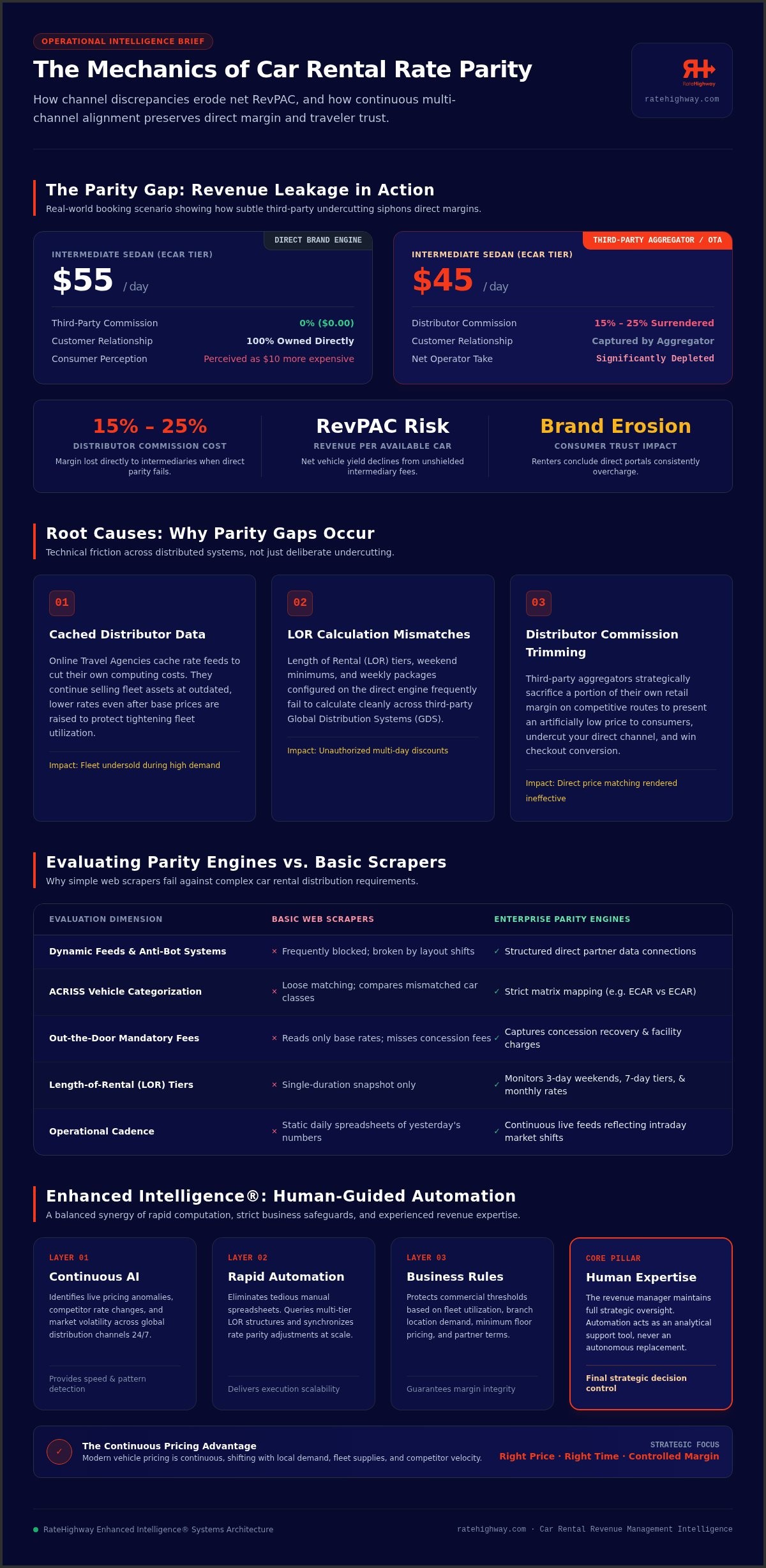
Price discrepancies create severe revenue leakage. If an online travel agency (OTA) sells an intermediate sedan for $45 per day while your direct booking engine lists it at $55, price-conscious renters will take the third-party deal every time. Beyond losing that direct relationship, you surrender 15% to 25% of that booking to distributor commissions. Worse still, inconsistent pricing breeds buyer hesitation. When travelers discover cheaper rates on secondary aggregators, trust in your brand erodes, making them assume your direct website overcharges them.
Checking hundreds of rate combinations manually across multiple platforms cannot keep pace with today's fast-moving market. Rental rates change continuously throughout the day as competitor fleet supplies shift and local demand surges. Modern car rental rate parity tools give operators the speed and visibility needed to monitor these movements without wasting hours on manual spreadsheets.
Understanding the Parity Gap
Parity gaps in vehicle rentals rarely stem from bad intentions alone. They often emerge from technical friction across distributed channels, such as:
- Cached distributor data: OTAs cache rate feeds to cut computing costs, continuing to sell vehicles at outdated, lower rates even after you raise your base price to protect tightening fleet utilization.
- Length of rental (LOR) mismatches: Multi-day discounts, weekend minimums, and weekly tiers applied on your direct engine often fail to calculate cleanly across third-party global distribution systems.
- Commission trimming: Aggregators sometimes trim their own margin on competitive routes to present an artificially low retail price to the consumer.
These operational breakdowns prove that rate integrity is not just an administrative checkbox. It is a foundational commercial pillar that protects your bottom-line profitability.
The ROI of Parity Alignment
Protecting rate parity directly improves direct booking ratios. When consumers realize your direct portal consistently offers the best rate alongside clear, transparent terms, they stop browsing comparison aggregators. This lowers your customer acquisition costs and shields net revenue per available car (RevPAC) from unnecessary intermediary fees. Deploying specialized car rental rate parity tools ensures your brand commands consistent value across every channel while keeping pricing strategy under your team's control.
How Modern Parity Tools Monitor the Multi-Channel Landscape
Tracking rate alignment across dozens of online brokers, global distribution systems (GDS), and metasearch engines requires precision. A static daily spreadsheet provides only a snapshot of yesterday's numbers. In contrast, modern car rental rate parity tools deliver continuous visibility, querying live partner feeds to reflect current market realities.
These platforms evaluate data far beyond simple base rates. A true parity engine maps rates down to the standardized ACRISS vehicle category, such as comparing an economy four-door (ECAR) directly against matching competitor tiers. It tracks rates across specific length of rental (LOR) tiers, catching subtle discrepancies where a three-day weekend package displays correctly, but a seven-day rental defaults to an unauthorized discount. Connecting this real-time visibility into an automated revenue management system lets you bridge the gap between spotting a rate imbalance and correcting it across all channels.
Data Accuracy and the Rate Shopping Process
Clean data makes the difference between sound commercial strategy and costly false alarms. Basic scrapers often fail when booking portals change page layouts or apply anti-bot protections. Purpose-built parity engines use direct data connections to extract true out-the-door prices, including mandatory airport concession recovery fees and local customer facility charges.
Actionable intelligence also requires monitoring market context. When you observe how nearby competitors price their fleets across identical pickup dates, you see whether a partner site is undercutting you intentionally or reacting to localized demand shifts.
Automated Alerting and Reporting
Revenue managers cannot stare at dashboards around the clock. Automated notifications flag violations the moment third-party rates deviate outside your pre-set tolerances. You can set granular parameters, such as receiving an instant alert only when an OTA undercuts your direct price by more than 3% on high-demand vehicle classes.
Long-term parity reporting helps you track distributor reliability over weeks and months. By monitoring these historical trends through market intelligence platforms like RateIndex, you can identify which channels consistently publish cached rates or breach contract pricing terms. If you want to evaluate where your distribution network might be experiencing unnoticed price slippage, you can reach out to our pricing specialists for practical guidance on setting up active monitoring.
Evaluating Enterprise Parity Engines vs. Basic Scrapers
Basic data scraping collects raw numbers; enterprise rate parity delivers strategic execution. In car rental, relying on an off-the-shelf script to check competitor or broker pricing is a liability. Cheap scraping bots treat car rental rate gathering like simple e-commerce price checks. They pull disconnected figures without understanding the operational logic behind them, leaving your revenue team vulnerable to bad data.
Specialized car rental rate parity tools do not simply harvest rates from public screens. They parse the entire distribution architecture to reveal how your inventory is packaged, displayed, and sold across global travel channels.
The Limitations of Basic Scraping
Low-end scrapers run into severe technical barriers immediately. Modern online travel agencies actively defend their sites with bot-detection platforms and IP throttling. When a generic scraper gets blocked, it either fails outright or pulls stale cached numbers, masking genuine rate leakage.
There are serious dangers of relying on a simple car rental rate scraper when evaluating total price transparency. Car rental pricing is not just a base daily rate. It includes customer facility charges, airport concession recovery fees, and localized taxes. Basic tools routinely miss these mandatory add-ons, giving you a distorted picture of what consumers actually pay at checkout.
The Enterprise Advantage
Enterprise parity engines provide the speed, depth, and resilience required to protect your brand across high-volume distribution networks. They deliver distinct advantages across three critical areas:
- Multi-fleet scalability: Enterprise systems monitor thousands of pickup locations and standardized ACRISS vehicle categories simultaneously, eliminating blind spots across regional operations.
- Direct reservation integration: Rather than trapping data inside a static report, enterprise tools connect directly with your central reservation system (CRS) to support immediate operational adjustments.
- Configurable pricing plug-ins: Built-in business rules let revenue managers define exact tolerance thresholds, accounting for fleet utilization limits and location-specific demand surges.
By shifting from primitive scraping tools to enterprise car rental rate parity tools, operators replace guesswork with verified, audit-ready market intelligence. This technical stability gives your revenue team the confidence to protect profit margins without constantly chasing phantom discrepancies.
How to Implement an Automated Rate Parity Strategy
Putting a parity strategy into action requires a disciplined framework. Turning on software without clear operational guidelines creates confusion across your branch network. To build a reliable defense against revenue leakage, high-performing operators follow five practical implementation steps:
- Audit your distribution channels: Identify every broker, OTA, and corporate portal selling your vehicles, pinpointing where margins leak most frequently.
- Establish utilization-based rules: Define pricing tolerances based on fleet supply, seasonal demand, and booking lead time.
- Automate repetitive checks: Use car rental rate parity tools to handle high-frequency, low-risk data monitoring and routine rate syncing.
- Apply strategic human review: Keep experienced revenue managers in control of high-impact pricing decisions and market anomalies.
- Refine logic continuously: Regularly update your pricing rules as flight schedules shift, competitor fleets expand, and travel patterns evolve.
-
Setting Intelligent Pricing Rules
Not every pricing mismatch demands an immediate reaction. Minor discrepancies caused by currency rounding differ significantly from an aggressive broker discount that undercuts your direct rate by $15 per day. Intelligent rules distinguish between acceptable variance and actionable violations.
Your parity rules must also connect directly to fleet utilization. If your downtown lot sits at 92% occupancy for an upcoming holiday weekend, matching a lower OTA rate makes little commercial sense. Instead, your rule should trigger a channel restriction or push higher rates across external portals. Modern pricing is continuous, requiring real-time rate updates that reflect inventory changes as they occur rather than waiting for nightly batches.
The Role of Human Oversight
Some software providers promote a "set-and-forget" approach, but hands-off algorithms carry severe risks. An automated system cannot anticipate sudden flight cancellations, local sporting events, or unexpected regional weather disruptions. In these moments, human intuition and local market knowledge remain irreplaceable.
True operational resilience relies on Enhanced Intelligence®. Automation improves speed while humans provide the strategic compass. Advanced car rental rate parity tools act as an experienced co-pilot, surfacing pricing discrepancies and suggesting corrections while leaving final control with your revenue team. If you want to audit your current distribution workflow and build tailored parity safeguards, contact our rate strategy team to start aligning your channels.
Strategic Control with RateHighway’s Enhanced Intelligence®
Autonomous algorithms can calculate numbers quickly, but they lack the operational wisdom of an experienced revenue manager. Pure automation without human guidance can easily spark destructive local price wars or cut rates right before an unpredicted demand surge. RateHighway approaches car rental rate parity tools through our Enhanced Intelligence® philosophy: pairing algorithmic speed and automated data aggregation with human oversight and custom business rules.
Through RateMonitor Elite, operators gain automated rate monitoring and multi-channel synchronization without surrendering strategic control. Rather than relying on a rigid, opaque system, managers use Configurable Pricing Plug-Ins to shape how the platform responds to market shifts. You decide how your rates behave across specific pickup locations, lead times, and vehicle categories, ensuring every automated adjustment reflects your broader commercial strategy.
Advanced Automation for Modern Fleets
Managing rental inventory means handling constant volatility. Tight turns in fleet availability, sudden competitor sellouts, and localized travel spikes require immediate adjustments. RateHighway leverages over two decades of dedicated car rental pricing data architecture to process complex channel data smoothly.
The platform eliminates the repetitive burden of manual rate checks, freeing your analysts to focus on high-yield commercial planning. When a partner channel triggers a disparity violation, the system flags the issue instantly, applies your predefined rules, or requests human review when market conditions exceed normal parameters. This balance keeps your pricing responsive, accurate, and aligned with your operational targets.
Getting Started with Smarter Rates
Transitioning from reactive parity firefighting to proactive rate management protects your brand integrity across every customer touchpoint. By unifying market intelligence with disciplined pricing controls, independent operators and multi-location franchises can compete effectively against national conglomerates while preserving healthy direct booking margins.
Protecting your brand value requires both speed and precision. Discover how to optimize your revenue with RateMonitor Elite and maintain full command over your multi-channel distribution network.
Take Command of Your Distribution and Protect Your Margins
Maintaining rate consistency across external channels isn't just about defending prices. It's about protecting direct revenue, preserving customer trust, and ensuring third-party intermediaries don't undermine your fleet strategy. By replacing error-prone manual rate checks with specialized car rental rate parity tools, operators eliminate costly distribution blind spots while securing fair returns across every vehicle class.
As car rental dynamic pricing specialists since 2008, RateHighway understands that real strategic control requires both speed and context. Through our Enhanced Intelligence® framework, you get continuous access to real-time market data alongside configurable business rules that keep your revenue team in the driver's seat. You don't have to surrender margin to distribution complexity or let cached rates dictate your profitability.
Ready to safeguard your brand across every booking channel? Master your market with RateMonitor Elite and build a pricing strategy that drives lasting business growth.
Frequently Asked Questions
What is the difference between rate parity and price matching?
Rate parity is about maintaining consistent pricing across all your public distribution channels for your own brand's inventory. Price matching, on the other hand, is a reactive tactic where you match a competitor's rate. Parity protects your direct brand equity and prevents third-party aggregators from undercutting your direct website. Price matching looks outward at competing companies; rate parity looks inward to ensure your channel distribution remains disciplined and profitable.
How do car rental rate parity tools handle taxes and fees?
Advanced car rental rate parity tools extract out-the-door totals rather than just base rates. In vehicle rentals, customer facility charges, concession recovery fees, and localized taxes significantly alter the final checkout price. Dedicated parity engines normalize these fees across channels. This ensures you compare true consumer prices across online travel agencies and direct booking engines, preventing false disparity alerts caused by different fee display rules.
Can these tools monitor rates on mobile apps as well as websites?
Yes, modern enterprise parity engines monitor rates across both desktop websites and mobile channels. With over half of global car rental reservations booked through mobile apps or mobile browsers, aggregators often show app-only promotions. Effective parity tools simulate mobile traffic or connect directly to API distribution feeds. This process captures closed-user-group discounts and mobile rates that desktop web browsers might miss.
Will using a parity tool lead to a "race to the bottom" in pricing?
No, because parity tools enforce price consistency across your own sales channels rather than blindly lowering rates against competitors. A proper parity engine alerts you when an OTA sells your inventory too cheaply, helping you raise external rates back to your intended baseline. When paired with customizable business rules and human strategy, parity management protects your profit margins instead of triggering unnecessary price reductions.
How often should a car rental operator check for rate parity?
High-performing operators monitor parity continuously rather than relying on batch updates once a day. Rental markets move fast, and competitor sellouts or surge periods can shift inventory demands in minutes. Modern car rental rate parity tools run frequent, continuous checks throughout the day. This schedule catches cached OTA rates and unauthorized distributor discounts before they siphon off high-demand bookings.
Do I need a separate tool for rate shopping and parity monitoring?
Not if you deploy an enterprise solution like RateMonitor Elite. Dedicated rate shopping software often includes integrated parity tracking alongside competitor market analysis. Combining both functions into one platform gives your team complete visibility. You can monitor what competitors charge while simultaneously verifying that your third-party distributors respect your established rate structure across all car classes and rental lengths.
How does fleet utilization affect my rate parity strategy?
Fleet utilization dictates how aggressively you enforce channel rules. When fleet capacity runs high, such as 90% utilization ahead of peak travel weekends, your goal is to push high-margin direct bookings. If an external channel undercuts your website during tight utilization, you may choose to restrict inventory or raise third-party rates. Utilization data tells your team whether to adjust external distribution or prioritize direct reservations.
Is AI-driven parity management safe for independent car rental brands?
Yes, provided the technology follows an Enhanced Intelligence® model that keeps human oversight in place. Independent operators cannot afford the risks of fully autonomous "black-box" pricing algorithms that act without context. When AI works as a supportive co-pilot, it rapidly flags parity violations and automates routine adjustments. Meanwhile, your revenue managers retain full authority to set strategic rules, override suggestions, and maintain control.
Curious to see RateMonitor in action? Reach out and book your demo now!