
What if your busiest booking day was actually your biggest missed opportunity? It's a scenario many new operators know well. You celebrate a sold-out fleet only to realize you left significant revenue on the table because your rates didn't rise with the demand. Understanding how to build a car rental rate matrix is the first step toward solving this. It's about moving away from static pricing and toward a framework that balances occupancy with maximum yield.
We understand that pricing shouldn't feel like a shot in the dark. This guide provides a clear framework to help you stop the guesswork and start pricing with the precision of a seasoned pro. You'll gain a deep understanding of time-based price bands and vehicle hierarchy, ensuring you don't leave money on the table during peak dates or face high vacancy during quiet weeks.
We'll show you how to construct a system that supports your professional judgment with data. This creates a foundation for Enhanced Intelligence® that allows your business to scale without losing the human touch that defines your local expertise. You'll walk away with a practical roadmap for vehicle pricing that keeps your fleet moving and your margins healthy.
Key Takeaways
• Learn why a rate matrix acts as the strategic "DNA" of your operation, ensuring you price for utilization rather than just following a static list.
• Master the core steps of how to build a car rental rate matrix by mapping vehicle classes against specific time-based booking windows.
• Discover how to calculate your floor rate and benchmark local competitors to find the right balance between occupancy and yield.
• Understand the transition from manual spreadsheets to dynamic pricing rules that react to market volatility as it happens.
• Explore how tools like RateMonitor Elite use Enhanced Intelligence® to support your expertise with automated data and real-time insights.
What is a Car Rental Rate Matrix and Why Does it Matter?
A rate matrix is the structural DNA of your pricing strategy. It's the engine that powers your ability to stay competitive in a market that never stops moving. Unlike a static price list that sits on a desk, a matrix is a dynamic map. It aligns your vehicle classes with specific time and demand variables to ensure you aren't just renting cars, but maximizing the value of every mile. Learning how to build a car rental rate matrix is what separates a hobbyist from a professional operator.
Static pricing is a trap. It ignores the perishable nature of your inventory. If a car sits on your lot for 24 hours without a renter, that revenue is gone forever. You can't sell "yesterday" today. A professional matrix uses Yield Management principles to balance your Average Daily Rate (ADR) with utilization. It’s about finding the sweet spot where your fleet is moving and your margins are protected. This matrix serves as the critical interface between your fleet management and your booking engine, translating operational reality into market-facing prices. For many, tools like RateMonitor Elite provide the necessary data to bridge this gap.
The Core Components: Rows and Columns
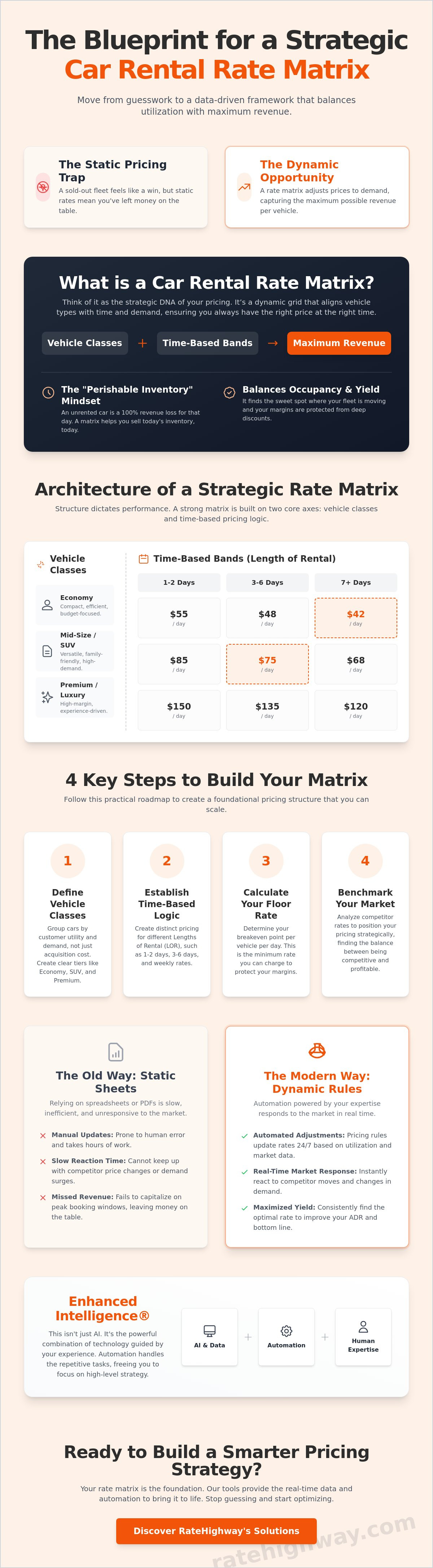
Think of your matrix as a grid. The vertical axis defines your vehicle categories, segmenting them by size, utility, and luxury level. You don't price an Economy hatch the same as a Premium SUV because their overhead and demand patterns differ. The horizontal axis handles duration bands, outlining how logic shifts from a 1-day rental to a 7-day or 30-day booking. This structure allows you to apply seasonal multipliers, ensuring your base grid adapts to holiday surges or off-peak lulls without manual recalculations every morning.
The "Perishable Inventory" Mindset
In the car rental world, time is your most expensive cost. An unrented car today is a 100% loss. You can't recover that specific day's earning potential. A well-constructed matrix prevents you from leaving money on the table during high-demand events like local festivals or airport surges. It also uses price anchoring to guide customer behavior. By showing clear value differences between tiers, you encourage upgrades and longer rental durations, turning a simple transaction into a strategic revenue opportunity. Understanding how to build a car rental rate matrix ensures you have a framework that reacts to these shifts automatically.
The Architecture of a Strategic Rate Matrix
Structure dictates performance. When you learn how to build a car rental rate matrix, you start with the vertical axis. This isn't just a list of cars you bought; it's a classification of utility. You might use standard ACRISS codes or simplified fleet categories, but the goal remains the same. You need to group vehicles that serve the same purpose for the customer. A compact car and a small hybrid might have different purchase prices, but in the eyes of a budget traveler, they occupy the same space in your matrix.
The horizontal axis maps out your time-based segmentation. You need distinct bands for 1-day, 3-day, 7-day, and 30-day rentals. A common mistake is treating a 5-day rental as just five times the daily rate. In reality, the 4-6 day "middle ground" is where yield often drops because operators fail to adjust for the overhead of short-term stays versus the stability of longer ones. Implementing a Dynamic Pricing Framework helps you move away from static multiples and toward rates that reflect the actual market velocity. You should also build in "Blackout Dates" and "Event Premiums" directly into this structure to account for local surges without redesigning your grid every week.
Defining Your Vehicle Classes
Price based on utility, not just your acquisition cost. A minivan and a large SUV might have similar monthly payments, but their utility for a family of seven is vastly different during peak summer months. We recommend a "Hero Vehicle" strategy. Pick one high-demand model to anchor a category, such as a Jeep Wrangler for your 4x4 tier. This creates a clear value proposition and makes it easier to manage brand parity across your fleet. If you're unsure how to group your specific fleet, you can consult with one of our specialists to refine your categories.
Time-Based Pricing Logic
Length of Rental (LOR) is the heartbeat of your utilization. The old "Saturday Night Stay" requirement is largely a myth in modern car rentals; what matters now is the breakeven point of your operational turns. Every time a car returns, you incur costs for cleaning, inspection, and administrative labor. A 14-day rental at a lower daily rate is often more profitable than four separate 2-day rentals with gaps in between. Use your matrix to create incentives for those "sweet spot" durations that keep your cars on the road and out of the wash bay. How to build a car rental rate matrix that balances these turns is the key to long-term scalability.
How to Set Rental Car Rates for the First Time
Setting your initial rates is a pivotal moment for any new operation. It's the point where your business plan meets market reality. If you're wondering how to build a car rental rate matrix that actually works, you have to start with a logical, step-by-step process. This isn't about picking numbers that feel right; it's about building a framework that protects your margins while remaining attractive to your customers.
First, you must benchmark the market. Analyze your local competitors across a 30-day rolling window to understand their pricing patterns. Once you have that data, calculate your floor rate. This is your "do not cross" line. From there, establish your retail or "rack" rate for peak demand periods and create step-down logic for longer durations. Remember that your first matrix is a hypothesis. You'll need to test and iterate as you see how the market reacts to your presence.
Benchmarking Without Getting Overwhelmed
Precision matters more than volume when you look at competitors. Don't try to price your local boutique agency against a global giant like Hertz or Enterprise. Instead, identify your "True Competitors"—those with similar fleet sizes and locations. Using RateIndex allows you to see real-time market movement without the soul-crushing task of manual searching. Focus on the price leaders in your specific geographic territory, especially those at the airport versus off-airport locations, where fees can vary by nearly 20%.
Finding Your Pricing Floor
Your pricing floor is the absolute minimum daily revenue required to cover all variable operating costs and vehicle depreciation while maintaining a healthy fleet. You have to account for hidden costs like cleaning, wear-and-tear, and the opportunity cost of a vehicle sitting idle. Pricing below this floor is a race to the bottom that kills long-term growth. While the projected global average daily rate in 2026 is approximately $48, your specific floor will depend on your local overhead and fleet type. To better manage these acquisition and maintenance costs, you can learn more about Alliance Fleet Solutions. If you ignore these fundamentals, you aren't running a business; you're subsidizing your customers' travel. Use this floor as a hard barrier in your matrix to ensure every rental contributes to your bottom line.
Establishing these boundaries early gives you the strategic control needed to navigate market volatility. You can then layer on additional fees, such as the typical $25 per day young driver fee or optional insurance costs that range from $10 to $30 daily. This structured approach ensures that your base rate stays competitive while your total yield remains high.
From Static PDF to Dynamic Automation
A static matrix is a snapshot of a market that has already moved. When you learn how to build a car rental rate matrix, you might start with a spreadsheet, but staying there is a liability. In a market where competitors adjust prices continuously, a fixed PDF is an invitation for others to capture your margins while you sleep. Manual updates are the primary cause of rate leakage in independent agencies. You leave money on the table because you simply can't react fast enough to a sudden surge in airport demand or a competitor's aggressive price drop.
Moving to dynamic automation means transitioning from fixed numbers to intelligent "If/Then" logic. This is the core philosophy of Enhanced Intelligence®. It isn't about replacing your professional judgment; it's about giving your expertise the speed of automation. You provide the strategic direction, and the technology handles the granular execution across your entire fleet. This ensures your pricing is always active, even when you aren't at your desk.
The Limitations of Manual Management
Human error is a constant operational risk. A "fat finger" mistake during data entry can set a premium vehicle at an economy price, leading to significant revenue loss before the error is even noticed. Beyond simple mistakes, you face the latency problem. By the time you manually identify a market shift, the most profitable bookings are often gone. Manual managers also tend to default to "safe" or low prices to ensure cars are moving, rather than finding the optimal price that balances occupancy with maximum yield.
Introducing Dynamic Pricing Plug-ins
Automation allows your matrix to breathe with the market. Instead of a static grid, you use configurable rules that respond to real-time fleet utilization. For example, you can program a rule: "If fleet utilization for SUVs exceeds 85% for next weekend, increase the daily rate by 10%." This keeps your pricing competitive whether you are operating in Miami, where weekly rates average $400, or Chicago, where they can exceed $640. It also ensures rate parity across OTAs and your own booking engine, protecting your brand's credibility. To see how these rules can be tailored to your specific fleet goals, get in touch with our team for a personalized walkthrough.
Scaling Your Strategy with RateMonitor Elite
Once you understand how to build a car rental rate matrix, the next step is moving from manual oversight to strategic automation. RateMonitor Elite takes the structural logic of your matrix and applies it across the market in real-time. This isn't just about changing numbers. It's about executing a high-level strategy with precision. By using configurable pricing plug-ins, you can tailor your automation to fit specific fleet goals, whether you're focusing on high utilization for economy cars or maximizing yield on premium SUVs.
We believe in Enhanced Intelligence®. This means our platform acts as your visionary co-pilot. You provide the local expertise and professional judgment, while the software handles the high-speed data processing. You stay in control of the tight turns of the industry while the system manages the heavy lifting of 24/7 market monitoring. This synergy ensures that your rates are always optimized for current demand without requiring you to be tied to a computer screen.
With your business running efficiently on autopilot, you may find more time to focus on personal milestones, such as international relocation. For those exploring residency options abroad, CanadaPathway provides a self-service digital platform for permanent residence applications.
Why Automation is the Modern "Must-Have"
Timing is everything in a volatile market. Research shows that booking a car seven days in advance often costs around $513 weekly, compared to $589 when booking 91 days out. These shifts happen constantly. Automation provides the competitive advantage of 24/7 rate shopping, allowing you to capture these revenue opportunities as they appear. It also frees up your staff to focus on customer service and fleet maintenance. Many operators find that even a 5% increase in ADR through smarter automation can significantly impact the bottom line, often doubling net profit by stopping rate leakage.
Getting Started with RateHighway
Getting started follows a "set and monitor" approach. You integrate the logic you developed when learning how to build a car rental rate matrix into the RateMonitor Elite engine. This allows you to build trust in the system as you see it respond to competitor movements and utilization shifts. You'll see the real-time ROI as the system adjusts for airport fees, which can add nearly 20% to a rental cost, or young driver fees that average $25 daily. If you're ready to see how your new matrix performs under real-world pressure, schedule a demo to see your strategy in action.
Master Your Market Velocity
Success in this industry isn't about having the lowest price. It's about having the right price at the exact moment a customer is ready to book. You now understand how to structure vehicle classes and duration bands to protect your margins. Transitioning from a static framework to an active, automated system is what allows you to scale without losing control. Mastering how to build a car rental rate matrix provides the strategic foundation you need to navigate market volatility with confidence.
We're here to help you move beyond spreadsheets and into a future of strategic growth. Our platform combines real-time market intelligence from RateIndex with AI-driven automation that respects your human-centric oversight. It's a system trusted by global brands and independent operators alike to keep fleets moving and yields rising. By combining your local expertise with our high-speed data intelligence, you'll always stay a few turns ahead of the competition.
Stop manual entry and start maximizing yield with RateMonitor Elite. You have the vision to lead your business, and we have the tools to help you get there faster.
Frequently Asked Questions
How often should I update my car rental rate matrix?
You should update your pricing continuously to keep pace with modern market volatility. While some legacy operators update weekly, a professional strategy requires at least daily adjustments to catch sudden demand shifts. If you are learning how to build a car rental rate matrix, start with daily checks. Automation tools can handle this hourly, ensuring you never miss a revenue opportunity while you sleep.
What is the difference between a rack rate and a floor rate?
A rack rate is the maximum price you charge during peak demand, while a floor rate is the absolute minimum required to cover costs. Think of the floor as your safety net; it ensures you don't lose money on a rental. The rack rate acts as your ceiling during high-traffic events. Balancing these two extremes within your matrix allows you to maximize yield without sacrificing fleet health.
Can I build a rate matrix in Excel or do I need specialized software?
You can build a basic matrix in Excel, but specialized software is essential for scaling a competitive business. Spreadsheets are static and prone to "fat finger" errors that can cost thousands in lost revenue. As you master how to build a car rental rate matrix, you'll find that automation provides the speed and consistency needed to manage complex pricing rules across multiple channels simultaneously.
How do I handle pricing for one-way rentals within my matrix?
One-way rentals are typically handled through specific drop-off fees rather than changing the base matrix rate. These fees cover the cost of relocating the vehicle back to its home base. You can build these into your booking engine as a surcharge that triggers automatically. This keeps your core matrix clean while ensuring you don't lose money on the logistical challenges of vehicle recovery.
What is ACRISS and do I need to use it for my fleet categories?
ACRISS is an industry-standard four-letter coding system used to classify vehicles by category, type, transmission, and fuel or air conditioning. Using these codes helps maintain parity across global booking channels. It provides a common language for travel agents and customers alike. Implementing ACRISS in your matrix ensures your fleet is compared accurately against competitors in the same tier during the booking process.
How do I price my rentals if a competitor suddenly drops their prices to zero?
Don't follow a competitor into a "race to the bottom" if they drop prices below your calculated floor rate. If a competitor prices at near-zero, they are likely facing a liquidation crisis or a technical error. Stick to your strategy and focus on the value of your service. Pricing below your floor kills long-term growth and damages the perceived value of your fleet in the market.
Should my rate matrix include insurance and add-ons or just the base rate?
Your rate matrix should focus on the base rental rate, with insurance and extras handled as separate line items. Add-ons like child seats, which typically cost $10 to $15 per day, should be added on top of the base price. This keeps your market-facing rates competitive while allowing you to capture high-margin revenue through optional amenities during the final checkout process.
How does fleet utilization affect my matrix pricing rules?
Fleet utilization is the primary driver of your dynamic pricing rules. When your occupancy increases, your rates should rise to protect your remaining inventory for high-value, last-minute bookings. Conversely, if utilization is low, your matrix should trigger "step-down" logic to attract more volume. This balance ensures you maximize total revenue rather than just filling cars at low margins during quiet periods.