

What Are Car Rental Pricing Rules in Revenue Management?
Strategic control requires more than just intuition. It demands a framework that reacts as fast as the market moves. Car rental pricing rules are the logic-based instructions that govern how your rates fluctuate in response to the world around them. For decades, operators relied on manual rate loading. This was a slow, grueling process of typing numbers into a system and hoping they stayed relevant for a week. We've moved beyond that. The industry has shifted to rule-based rate automation, a move that turns the revenue manager into a visionary co-pilot. You set the flight path; the technology handles the turbulence.
This automation doesn't just save time. It eliminates the latency that leads to revenue leakage. When a competitor shifts their strategy on a Global Distribution System (GDS) or an Online Travel Agency (OTA), your rules detect the change and respond instantly. This ensures your direct booking channel remains the most attractive option while keeping your presence on third-party sites optimized for volume. By mastering car rental pricing rules, you're not just setting prices. You're architecting a system that defends your market share while you focus on high-level growth.
The Difference Between Base Rates and Rule-Based Pricing
Base rates are your foundation. They represent your starting point, often dictated by historical data and broad seasonal trends. They are the "ground floor" of your revenue strategy. However, rules provide the agility needed to navigate the tight turns of a modern market. While seasonality helps you establish baseline rule sets for peak summer or holiday periods, static pricing has become a dangerous liability. In the 2026 rental landscape, a price that stays the same for forty-eight hours is likely a price that is losing money. Rules take your base rate and breathe life into it, allowing it to expand and contract based on real-world conditions.
The Three Pillars of Effective Pricing Logic
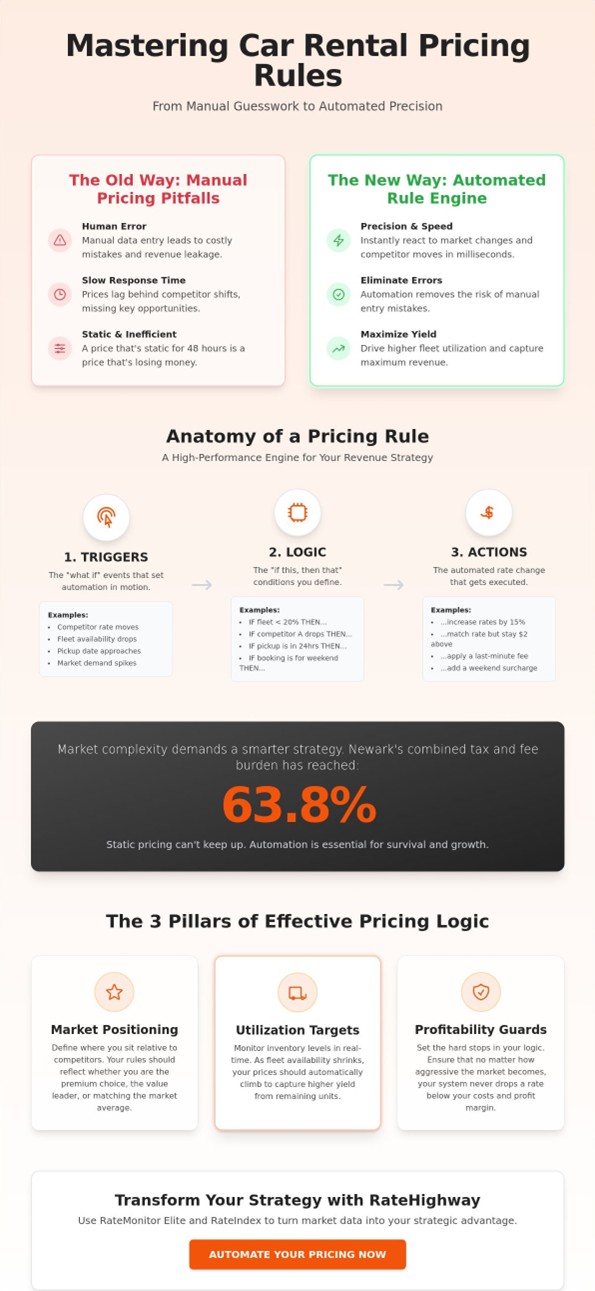
Success in revenue management rests on three distinct pillars of logic. First is market positioning. You must define exactly where you want to sit relative to the "Big Three" and other local players. Your rules should reflect whether you are the premium choice or the value leader. Second is utilization targets. These rules monitor your inventory levels in real-time. As your fleet availability shrinks, your prices should automatically climb to capture the higher yield of the remaining units. Understanding various car rental business models can help you decide which pillar to prioritize. Finally, profitability guards are essential. These are the hard stops in your logic. They ensure that no matter how aggressive the market becomes, your automated system never drops a rate below the cost of fleet maintenance, insurance, and depreciation. Platforms like RateMonitor Elite and RateIndex are designed to manage these pillars, giving you the strategic control to win the race without risking the vehicle.
The Anatomy of a Pricing Rule: Triggers, Logic, and Actions
Think of a pricing rule as a high-performance engine. It doesn't just run; it reacts to the track conditions in real-time. Every rule consists of three core components that work in unison to protect your yield and maintain your competitive edge. Without a clear structure, your car rental pricing rules are merely guesses. When built correctly, they become strategic weapons that allow you to navigate market volatility with the precision of a seasoned pilot.
The process begins with triggers. These are the sensors that detect shifts in the external environment or your internal operations. Once a trigger is activated, the data flows into the logic gate. This is where the "If-This-Then-That" (IFTTT) structure evaluates the situation against your specific goals. Finally, the action parameter executes the change. This entire sequence happens in milliseconds, ensuring you never miss a window of opportunity. Understanding the complexities of car rental revenue management is vital here, as variable supply and demand forecasting require rules that are both rigid in their goals and flexible in their execution.
Trigger Events: What Starts the Change?
Triggers are the market events that set your automation in motion. You can't watch the screen every second, but your software can. Common triggers include:
- Competitor rate moves: Your system identifies when a specific rival or the broader market average shifts, allowing you to stay within a designated "strike zone."
- Inventory milestones: As your fleet utilization hits critical levels, such as 85%, the system can automatically trigger a price increase to maximize the yield on your remaining units.
- Time-based decay: For last-minute inventory that remains unbooked, rules can trigger a tactical discount to ensure the vehicle doesn't sit idle on the lot.
Execution Logic: Percentage vs. Flat Rate Adjustments
Logic Gates are the decision-making core of a revenue engine that filter incoming data to determine if a specific action is warranted. Once the logic determines an adjustment is necessary, you must choose the right lever to pull. For high-value car classes like luxury SUVs or convertibles, percentage-based adjustments often work best. They allow the price to scale proportionally with the higher base rates of these vehicles. Conversely, flat-dollar rules are often more effective for economy fleet segments where even a small shift in price can significantly impact conversion. By setting constraint layers, or "floors" and "ceilings," you ensure that these adjustments never compromise your brand integrity or dip below your profitability requirements. If you're ready to move beyond manual adjustments, exploring how RateMonitor Elite automates these logic gates can transform your operational efficiency.
Manual Entry vs. Automated Rules: Solving the "Black Box" Fear
Manual rate entry is a slow leak in your revenue bucket. It invites human error, creates operational bottlenecks, and results in missed opportunities that you might not even notice until the end of the quarter. Many operators hesitate to embrace automation because they fear the "black box." They worry that an algorithm will take the wheel and drive their brand into a price war they can't win. We believe in a different approach. Automation isn't a replacement for your professional judgment; it's a multiplier of your expertise. It's about synergy, not substitution.
The "Enhanced Intelligence" philosophy keeps the human in the loop while offloading the high-speed execution to the software. You define the strategy, set the boundaries, and establish the goals. The system then carries out those instructions with a level of precision and speed that no human team could match. By using sophisticated car rental pricing rules, you're not losing control. You're gaining strategic leverage. You're moving from being a data entry clerk to becoming a master strategist who directs the flow of revenue with a few clicks.
The Latency Gap: Why Manual Pricing Fails on OTAs
Speed is the primary currency of the digital travel market. Competitor price changes propagate across Online Travel Agencies (OTAs) in a matter of minutes. If your team is manually checking rates and then typing updates into a legacy system, you're operating with a massive latency gap. A delay of just a few hours in responding to a market shift can result in a significant volume of bookings at the wrong price point. Real-time rate shopping, the kind provided by RateIndex, acts as the high-octane fuel for your automated rules. It ensures your rates are always positioned exactly where they need to be to capture maximum yield.
Maintaining Control with "Human-in-the-Loop" Systems
Strategic control means having the ability to intervene whenever the situation calls for it. Modern revenue management isn't about setting a rule and walking away forever. It's about having global overrides at your fingertips for holidays, local festivals, or sudden fleet changes. Features like "Review Before Publish" within RateMonitor Elite allow you to audit suggested rate changes before they go live on your channels. This ensures your car rental pricing rules always align with your long-term vision. Regular audits of your rule sets allow you to fine-tune your logic, ensuring that your automated system remains a reliable partner in your growth. This combination of human intuition and machine speed is what defines a market leader.
5 Essential Pricing Rule Sets Every Rental Operator Needs
Strategy is only as effective as its execution. To dominate your local market, you need a diverse arsenal of car rental pricing rules that address every facet of the business cycle. These rule sets act as your operational guardrails, ensuring that every booking contributes to your bottom line. By moving from a single static rate to a multi-layered logic system, you transform your fleet into a high-yield asset.
- The "Market Follower" Rule: This logic keeps you competitive by staying a precise increment, such as $1, below the market leader. It ensures you capture volume without sacrificing unnecessary margin.
- The "Utilization Spike" Rule: As your lot empties, your value increases. This rule automatically scales rates upward as availability drops.
- The "Length of Rent" (LOR) Rule: Long-term rentals are more efficient. Use this rule to incentivize 7-day bookings over 2-day turnarounds.
- The "Close-In" Rule: Unbooked inventory is a sunk cost. This rule employs aggressive last-minute tactics to clear the lot before the day ends.
- The "OTA Parity" Rule: Protect your brand. This ensures your direct website always offers the best value compared to third-party channels.
Deep Dive: The Utilization-Based Rule
Inventory is perishable. Every day a car sits unrented is revenue you'll never recover. Effective utilization rules use progressive tiers to manage this risk. For instance, you might set your first tier at 60% utilization, a second at 75%, and a final aggressive tier at 90%. As you cross these milestones, the system automatically adjusts the rate upward. It's vital to protect your last five vehicles. These units should be reserved for high-margin, last-minute walk-ups who are willing to pay a premium for immediate availability. Integrating fleet telematics data allows your pricing rules to react to real-time vehicle status, ensuring your digital storefront matches your physical lot exactly.
Deep Dive: Length of Rent (LOR) Optimization
Not all bookings are created equal. A 1-day rental often costs more in labor, cleaning, and processing than the daily rate covers. Sophisticated operators use car rental pricing rules to block short-duration rentals during high-demand peak periods, such as major holidays or local festivals. By architecting "Stay-Through" rules for holiday weekends, you ensure that your fleet is committed to high-value, multi-day contracts rather than being tied up in low-margin churn. This strategic filtering ensures your operational team stays focused on the most profitable transactions. If you're ready to deploy these advanced strategies, RateMonitor Elite provides the architecture you need to execute with precision.
Implementing Advanced Rules with RateMonitor Elite
Sophistication isn't just about having data. It's about what you do with it. RateMonitor Elite turns raw market intelligence into a strategic advantage by simplifying the complex architecture of your car rental pricing rules. Instead of getting lost in the weeds of manual spreadsheets, you use a platform that acts as a master strategist. It connects your local expertise with the high-velocity data streams from RateIndex. This ensures your decisions are grounded in real-world practicality but executed with high-tech speed and confidence. You aren't just reacting to the market. You're shaping your place within it.
Scaling is where many operators hit a wall. A strategy that works for a single downtown lot might fail at a major international airport due to different competitive pressures and tax burdens. RateMonitor Elite is built to handle this friction. It allows you to scale your revenue logic from a single boutique location to a global franchise without losing the nuance that makes your brand unique. You maintain strategic control over every "tight turn" in the market, whether you're managing twenty vehicles or twenty thousand. It's about having a visionary co-pilot that understands the specific challenges of your territory.
Customizable Pricing Plug-ins
Different car classes require different logic. A luxury convertible shouldn't follow the same pricing path as an economy hatchback. Our Pricing Plug-ins allow you to tailor rules to specific segments with ease. You can adapt to the high-velocity dynamics of airport rentals or the steady, predictable demand of local markets without starting from scratch. RateHighway’s plug-ins allow for surgical precision in rate adjustments, ensuring you hit your yield targets without overshooting the market. This flexibility means you can protect your high-margin luxury fleet while remaining aggressive in the economy sector.
Getting Started: From Audit to Automation
Transitioning to automated rules doesn't happen in a vacuum. It requires a methodical approach that respects your existing business knowledge. The RateHighway onboarding process starts with a comprehensive audit of your current manual rules. We identify exactly where latency, human error, or missed opportunities are causing revenue leakage. From there, we help you set your first automated triggers with expert, human-centric guidance. You don't have to fly solo. We are your seasoned partner in this transition, providing the tools to enhance your judgment rather than replace it. To see how this technology can transform your operations and drive maximum yield, book a demo to see RateMonitor Elite in action. It's time to take strategic control of your revenue logic.
Drive Your Yield Higher with Strategic Automation
Mastering your revenue logic is about more than just keeping pace with the market. It's about outmaneuvering it with precision. By moving from manual rate entry to sophisticated car rental pricing rules, you eliminate the latency that costs you bookings on high-stakes channels. You've seen how triggers and logic gates turn market volatility into strategic opportunity. Now, it's time to put that architecture to work for your fleet. This isn't just about software; it's about gaining a visionary co-pilot for your business.
Our Enhanced Intelligence® approach ensures you never lose the human touch. You get the speed of AI blended seamlessly with your own professional judgment. With real-time rate shopping from over 40+ sources and configurable Pricing Plug-ins, you maintain total strategic control over every car class and location. This synergy between advanced technology and human intuition is what separates market leaders from the rest of the pack. You have the expertise to lead. We have the precision tools to help you win the race.
Maximize your fleet yield with RateMonitor Elite and take command of your pricing strategy today.
Frequently Asked Questions
What is the most important car rental pricing rule for small fleets?
Utilization-based rules are the most critical for small fleets where every idle vehicle represents a significant percentage of potential revenue. You should prioritize rules that automatically increase rates as your availability drops below 20%. This ensures you capture the highest possible yield on your final few units. Small operators can't afford the same vacancy rates as global giants, so your logic must be tuned for maximum movement.
How do pricing rules affect my visibility on sites like Expedia or Kayak?
Your pricing rules directly dictate your ranking in the sort order on major Online Travel Agencies. Most travelers filter by "lowest price," so rules that keep you competitive within a few dollars of the market leader ensure you stay on the first page of results. Sophisticated automation allows you to maintain this visibility without manual monitoring. It ensures your brand remains prominent on Expedia and Kayak while protecting your profit margins.
Can I set pricing rules to exclude certain competitors?
You can and should filter your data sources to focus only on peers that actually impact your business. RateIndex allows you to select specific competitors to track, meaning your car rental pricing rules won't react to "budget" players if you are positioned as a premium brand. This surgical focus prevents your strategy from being skewed by outliers. You maintain control by deciding exactly whose price moves deserve a response.
Do automated pricing rules lead to a "race to the bottom"?
Automation actually prevents a race to the bottom by using strict profitability floors and guardrails. Without rules, human emotion often leads to panic-discounting during slow periods. Automated logic ensures that your prices never dip below a pre-set threshold regardless of what a desperate competitor does. It's about strategic positioning and yield management, not just being the cheapest option on the lot. You stay competitive without sacrificing your brand's value.
How often should I review and update my car rental pricing rules?
You should audit your rule sets at least once a month, though peak seasons require a weekly review of your logic. While the software handles the high-speed execution, your overarching strategy must adapt to seasonal shifts and local events. Think of it as a flight plan; the autopilot handles the steady work, but the pilot must check the coordinates regularly. This ensures your automated responses still align with your long-term financial goals.
What is the difference between a pricing rule and a pricing algorithm?
A pricing rule is a specific "if-this-then-that" instruction that you define based on your business goals. A pricing algorithm is the broader mathematical engine that processes vast amounts of data to execute those rules. You provide the strategy through the rules, and the algorithm provides the processing power and speed. This synergy allows you to apply complex logic across thousands of data points in milliseconds, something no manual process could achieve.
Can pricing rules handle different currencies for international locations?
Advanced systems like RateMonitor Elite are built to manage multi-currency environments for global franchises and border-city locations. The software automatically converts competitor rate data into your base currency before applying your logic gates. This allows you to maintain a consistent strategy across different regions without worrying about exchange rate fluctuations. It's essential for operators who need to stay competitive in a globalized travel market where customers book from everywhere.
What happens if a pricing rule conflicts with a manual rate override?
Manual overrides are designed to take precedence over automated car rental pricing rules to ensure you always have the final word. If you manually set a rate for a specific car class or date, the system respects that "hard" value and pauses the rule for that specific instance. This hierarchy of control ensures that your immediate tactical decisions always override the background logic. It provides the perfect balance between automated efficiency and human intuition.
Curious to see RateMonitor in action? Reach out and book your demo now!