

What car rental price benchmarking measures, and why it matters
Car rental price benchmarking compares relevant rental offers to show where your rates sit in the market. The aim is insight, not imitation. Benchmarking broadly means comparing performance or processes against a relevant reference point. In rental pricing, that reference should be a defined set of comparable offers, not whichever competitor happens to be easiest to check.
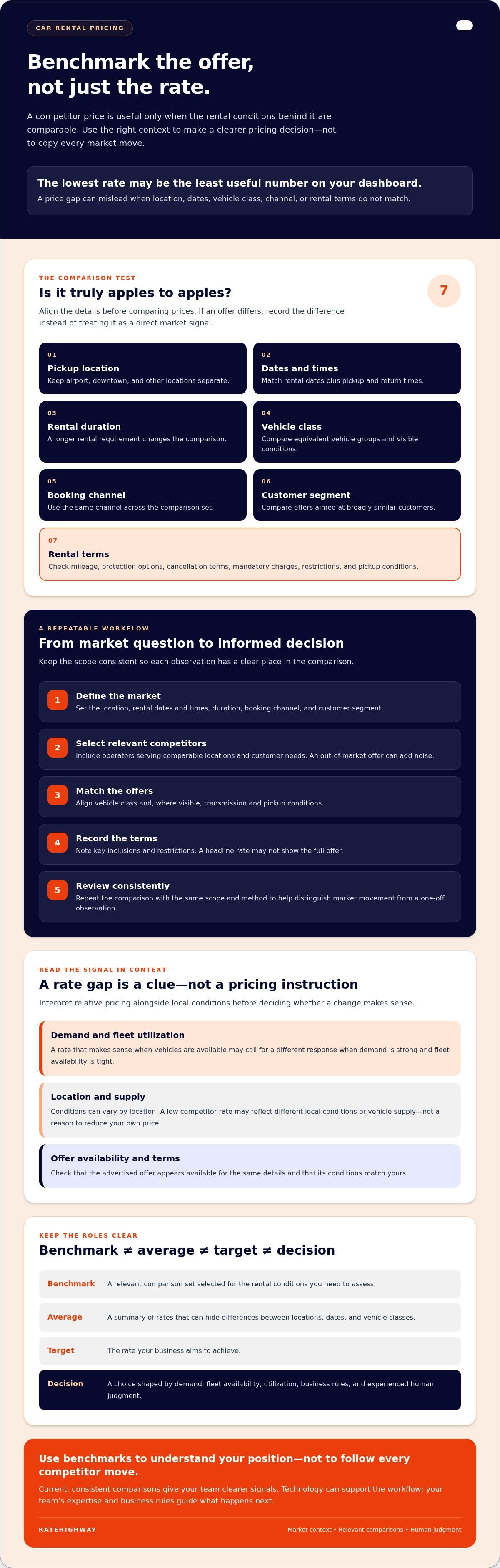
A benchmark is different from an average, a target price, or a pricing decision. An average summarizes a group of rates, but can conceal differences between locations, dates, or vehicle classes. A benchmark uses a comparison set selected for relevance. A target is the rate your business aims to achieve; the final pricing decision also considers demand, fleet availability, utilization, and business rules. Each has a distinct role.
What makes a car rental price a useful benchmark?
Start by defining your competitive set and the rental conditions you need to compare. Match the pickup location, dates and times, vehicle class, booking channel, rental duration, and key terms. Then check whether the advertised offer appears available for those details and whether its conditions match yours.
For example, two economy-car offers may look comparable, but one could require a longer rental or be available only through a particular booking channel. Those rates aren’t a clean comparison. Record the difference instead of treating the lower advertised price as a direct market signal.
Why benchmarking matters to fleet and revenue decisions
Relative pricing is only one part of the picture. A rate that makes sense when vehicles are available may call for a different response when demand is strong and fleet availability is tight. Likewise, a low competitor rate may reflect different local conditions or vehicle supply, not a reason to reduce your own price.
Broad market averages can blur these distinctions. Conditions at one location may differ from those elsewhere, even for the same dates and vehicle class. Benchmarks are most useful when interpreted alongside local demand and utilization, rather than treated as a universal answer.
Make benchmarking a recurring input to revenue management, not a one-time exercise. Market conditions change, so teams need current comparisons to spot meaningful shifts and reassess their position. Market intelligence from RateIndex market intelligence can help provide that view. The benchmark informs the decision; your team’s expertise and business rules determine what to do next.
How to build an apples-to-apples car rental price comparison
A useful comparison starts before you collect rates. Define the question the data should answer, then keep the scope consistent so every offer has a clear place in the comparison. This five-step workflow makes car rental price benchmarking more repeatable and easier to act on:
- Define the market. Set the pickup location, rental dates, pickup and return times, rental duration, booking channel, and customer segment. Keep airport, downtown, and other pickup locations separate.
- Select competitors. Include operators serving comparable locations and customer needs. A competitor outside the relevant market can add noise rather than useful perspective.
- Match the offers. Align vehicle class and, where visible, transmission and pickup conditions. Don’t treat different vehicle groups or rental requirements as direct equivalents.
- Record the terms. Note mileage, protection options, cancellation terms, mandatory charges, and restrictions. The Federal Trade Commission’s guide to car rental fees and charges explains why the headline rate may not show the full offer.
- Review consistently. Repeat the comparison using the same scope and recording method. A consistent history helps distinguish a market movement from a one-off observation.
Choose the right competitive set and comparison window
Choose competitors that serve the same pickup area and broadly similar customers. Keep airport rates separate from downtown rates, even when both locations serve the same city. Location context can affect the offer and its terms. Apply the same date window and booking channel across the comparison set. Review often enough to keep the view relevant as conditions change, without assuming one schedule works for every market.
Normalize rental terms before comparing rates
Check pickup and return dates and times, total rental duration, and vehicle group before comparing prices. Flag differences in mileage, protection options, cancellation conditions, or mandatory charges instead of treating the offers as equal. Keep channels separate if availability or terms differ. For example, a rate shown through one booking channel may have different cancellation conditions from a similar-looking rate elsewhere.
A simple tracking sheet can record the market and dates, competitor, channel, vehicle group, observed rate, availability, and terms. If you can’t make a clean match, add a note such as “different vehicle group” or “cancellation terms differ.” This keeps imperfect observations visible without letting them distort the comparison.
For repeated rate monitoring, tools such as RateMonitor Elite can support a consistent process. Your team still sets the comparison rules and reviews exceptions. To discuss how to structure a monitoring approach for your operation, contact RateHighway.
How to interpret benchmark gaps without blindly matching competitors
A rate gap is a signal to investigate, not an instruction to change your price. Before acting, confirm that the offers are comparable, check whether the competitor has vehicles available, and review your own fleet and local demand. A lower displayed rate might reflect a different rental duration, channel, or set of terms. It could also be a temporary market move.

This simple view helps separate an actionable comparison from a number that only looks relevant. For broader market context, the Federal Reserve Bank of St. Louis publishes a car rental price index. An industry-level trend can help frame market movement, but it can’t show whether a specific competitor has vehicles available at a particular location or whether your rate should change.
Read rate differences alongside utilization and demand
Consider fleet availability and expected demand at the location under review. If utilization is high and demand is strong, matching a lower competitor rate may not be the right move. If utilization is low, the gap may deserve closer attention, but the right response still depends on your objectives and operating rules. Local context matters: conditions at one branch can differ from those at another in the same wider market.
Use market movement to sharpen judgment, not replace it. A sudden change may be meaningful, or it may reflect a short-lived availability difference. Check whether a gap persists and whether your internal conditions support a response before changing a rate.
Account for length of rental and channel complexity
Compare rental durations carefully. Offers for different rental lengths may follow different pricing structures, so a daily rate alone can give a distorted view. Check channel-specific availability and terms too. A basic car rental rate scraper may capture a displayed price without enough context to confirm that the offer is bookable or equivalent. Keep those limitations visible in your review, and consult RateHighway’s published article on the dangers of a simple car rental rate scraper for a deeper look.
A practical workflow for using car rental price benchmarks
Benchmarks become valuable when they answer a clear question and lead to a documented decision. A repeatable process helps teams respond to changing market conditions without treating every competitor movement as a command to change rates.
- Define the question. Identify a location, rental period, or vehicle group that needs attention. For example, ask whether a rate gap at a particular branch during an upcoming rental period reflects a meaningful market shift.
- Gather comparable data. Use observations that match the relevant rental conditions and note exceptions, such as differences in channel or availability.
- Interpret the context. Check whether the gap could reflect demand, fleet availability, rental terms, channel differences, or a data mismatch. Review fleet utilization for the location and period before proposing a response.
- Make and record a decision. Document the action, the person or team responsible, and the reasoning. If the decision is to hold the rate, record why that makes sense too.
- Review the outcome and reassess. Revisit the observation as market conditions change. Note what has shifted and whether the original rationale still applies.
Turn a benchmark observation into a pricing question
A competitor’s lower rate is an observation, not a diagnosis. Ask what could explain the gap: Is the offer available through the same channel? Do its terms match? Does the competitor show availability while your fleet is more constrained? Does local utilization point to a different response? Record your assumptions and exceptions alongside the decision. That context gives the team a useful reference when the market moves again, rather than leaving a rate change without an explanation.
Use rate intelligence while keeping people in control
Continuous pricing depends on timely information, not only on periodic reviews that may miss market movement in between. RateIndex car rental market intelligence can support teams as they assess market conditions, while automation can make repeated monitoring more consistent. Data still needs direction: people set business rules, evaluate exceptions, and decide how insights fit local operating priorities. Technology supports experienced judgment; it doesn’t replace it.
A well-run car rental price benchmarking workflow connects a market signal to fleet context, a human decision, and a later review. If you’re considering how to structure that process for your operation, discuss your benchmarking needs with RateHighway.
Make car rental price benchmarking part of a balanced pricing strategy
Benchmarks are one instrument in the pricing cockpit, not the autopilot. They show how relevant offers compare, but a sound rate decision also reflects local demand, fleet utilization, availability, and the business rules that guide your operation. Car rental price benchmarking is more useful as an ongoing practice, with people responsible for interpreting the signals and deciding what action, if any, makes sense.
Build a repeatable, human-guided benchmarking practice
Assign clear ownership to the team members who select comparison markets, maintain matching rules, and review exceptions. Consistency matters: if the comparison set or terms change without being recorded, it becomes harder to tell whether a rate moved or the method did. Keep the rules stable enough for meaningful review, while allowing decisions to reflect local operating conditions.
Review outcomes over time. Consider whether a pricing decision still fits the demand and fleet picture, and record what has changed since the last review. The aim isn’t to prove that every adjustment worked or promise a particular revenue result. It’s to build a learning loop that helps the team make informed decisions and refine its judgment as conditions shift.
When rate intelligence software can help
Manual collection can become difficult to manage when teams need to track multiple competitors, locations, channels, and rental periods as market conditions move. RateIndex provides market intelligence for a broader view of the market, while RateMonitor Elite offers real-time rate shopping and automated pricing adjustments for operators. These tools can support continuity and consistency, but comparison rules, exceptions, and final decisions still need human guidance.
RateHighway’s Enhanced Intelligence® approach blends AI-driven automation with human oversight and configurable Pricing Plug-Ins to support pricing decisions. Technology can help organize information and surface insights, while experienced teams apply local knowledge and decide how to respond. Continuous monitoring supports timely review; it doesn’t mean reacting to every movement.
If you’re assessing how benchmarking could fit your pricing process, consider discussing your comparison needs with RateHighway. A practical conversation can help clarify what your team needs to monitor and where human review should guide the next decision.
Put Better Benchmarks to Work
Strong car rental price benchmarking starts with comparable offers, but the comparison is only the beginning. Match rental conditions before reading the gap, then weigh what you find against local demand, fleet utilization, and your operating rules. A competitor’s rate is a reference point, not an automatic pricing instruction.
Make the process continuous and consistent. Record the assumptions behind each comparison, review market movement, and keep people responsible for interpreting exceptions and decisions. That discipline gives your team a clearer view of when a rate difference deserves attention and when it doesn’t.
RateHighway specializes in technology for car rental operators. Its Enhanced Intelligence® approach combines AI-driven automation, configurable business rules, and human oversight to support informed pricing decisions, with people remaining firmly in control. To strengthen your benchmarking process, discuss your car rental benchmarking needs with the RateHighway team. Build a clearer market view, then let your team turn it into confident action.
Frequently Asked Questions
What is car rental price benchmarking?
Car rental price benchmarking is the structured comparison of relevant rental offers to understand how your rates sit in the market. It isn’t simply checking one competitor or copying the lowest displayed price. Operators define a competitive set, align rental conditions, and review rate differences alongside factors such as location, demand, and fleet availability. The result is a reference for decision-making, not a target rate or an automatic instruction to change prices.
How do you compare car rental prices fairly?
Compare offers with the same pickup location, dates and times, rental duration, vehicle class, and booking channel wherever possible. Check whether each offer appears available, then note mileage, protection options, cancellation terms, and mandatory charges when visible. If a detail doesn’t match or can’t be confirmed, flag it as an exception instead of treating the rates as equivalent. Consistent comparison rules make observations more useful over time.
How often should a car rental company benchmark its rates?
There isn’t one review schedule that suits every market. Benchmark often enough to keep comparisons relevant as demand, availability, and competitor offers change, with more attention to locations or rental periods facing active pricing questions. A one-time snapshot can miss movement, while repeated reviews using consistent criteria help distinguish lasting shifts from temporary differences. Set a process your team can maintain, and reassess it as operating conditions change.
Can a car rental company use competitor prices to set its own rates?
Yes, competitor prices can inform rate decisions, but they shouldn’t determine them on their own. First confirm that the competing offer matches your rental conditions and is available through a comparable channel. Then consider your own demand, fleet utilization, availability, and business rules. A lower competitor rate may be worth investigating, but it doesn’t automatically mean your rate should fall. Use the comparison as evidence for a decision, not as a substitute for judgment.
What factors should be included in a car rental price comparison?
Record the pickup location, dates and times, rental duration, booking channel, customer segment, vehicle class, and availability. Where visible, include transmission, pickup conditions, mileage, protection options, cancellation terms, and mandatory charges. These details help reveal whether two displayed rates represent similar offers. Keep unmatched terms or uncertain availability clear in your notes so your team can distinguish a strong comparison from an imperfect observation before using it to inform pricing.
Why do car rental prices differ by location and rental duration?
Prices can vary by location because each market has its own demand patterns, competitor set, and vehicle availability. Airport, downtown, and other pickup contexts may also involve different offer conditions, so check comparability before combining rates. Rental duration matters too: pricing structures can vary across trip lengths, which means a daily rate alone may not tell the whole story. Match location and duration before interpreting a gap.
Can automation make car rental price benchmarking more accurate?
Automation can support more consistent collection and review of rate information, especially when teams monitor multiple locations, competitors, and rental periods. It doesn’t make every comparison automatically accurate: results still depend on clear matching rules and careful handling of exceptions. RateHighway’s Enhanced Intelligence® approach combines AI-driven automation, business rules, and human oversight. Skilled teams remain responsible for guiding the process, interpreting context, and deciding how market insights should inform rates.
Curious to see RateMonitor in action? Reach out and book your demo now!