

What is a Car Rental Revenue Management System (RMS)?
A car rental revenue management system is the central nervous system of a modern rental operation. It isn't just a tool for checking competitor prices; it's a strategic engine designed to find the right price for the right vehicle at the right time. In 2026, the industry has moved beyond periodic updates. We've entered the era of continuous pricing. If you're still updating rates once a day or once a week, you're essentially flying blind while your competitors use high-velocity automation to capture every margin opportunity.
Unlike generic rate scrapers or messy spreadsheets, a true RMS integrates three core pillars to ensure your fleet remains profitable:
- Market Intelligence: Providing real-time data on competitor pricing and market shifts.
- Demand Forecasting: Predicting future booking patterns based on historical data and current utilization.
- Automated Execution: Instantly pushing optimized rates to all distribution channels through tools like RateMonitor Elite.
The Shift from Manual to Automated Pricing
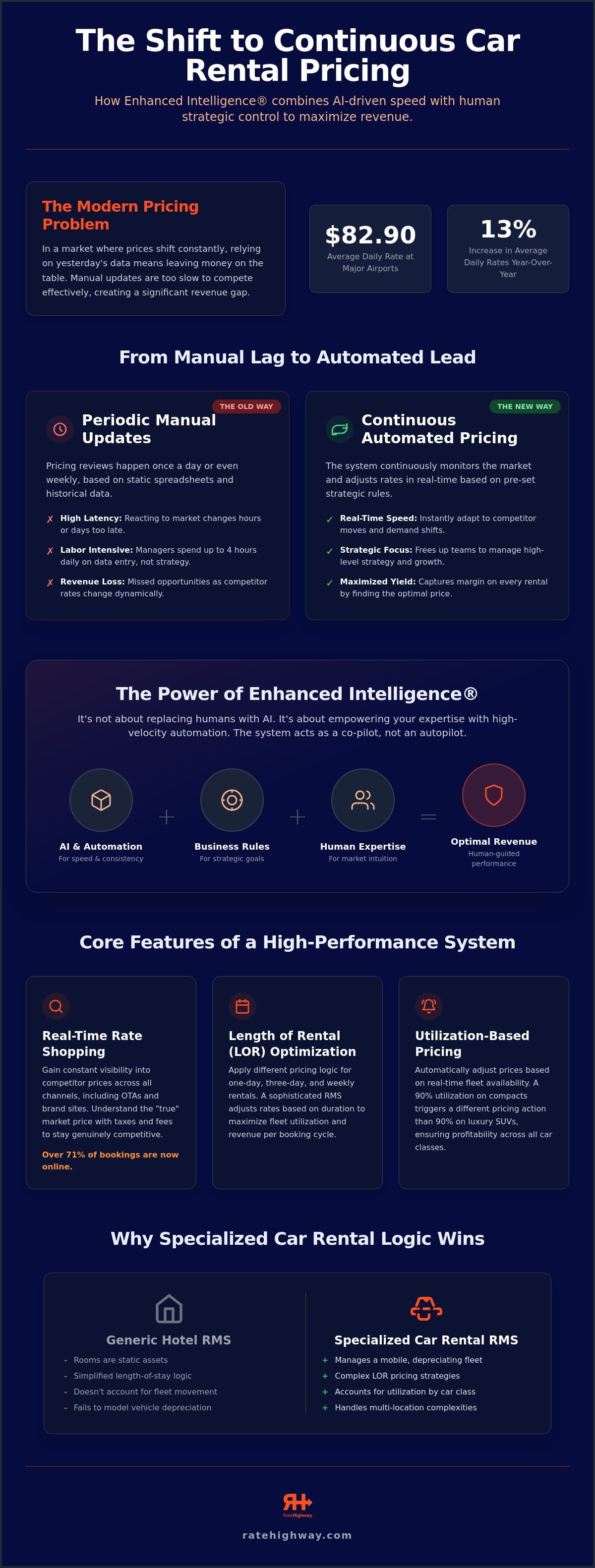
Manual data entry is the speed limit on your revenue growth. When a manager spends four hours a day manually typing rates into a system, they aren't managing strategy; they're acting as a data clerk. In a market where average daily rates have jumped 13% compared to last year, prices change fast. Stale rates are a liability that leads to lost revenue. Automation removes this bottleneck. It allows your team to set high-level business rules while the software handles the repetitive, granular adjustments. This shift moves your staff from the "engine room" to the "cockpit," where they can focus on long-term growth rather than daily survival.
Why Specialized Car Rental Logic Matters
You can't manage a car fleet like a hotel. Rooms don't move, but cars do. A car rental revenue management system must account for fleet utilization, vehicle depreciation, and varying lengths of rental. If a customer wants a seven-day rental, the pricing logic should be different than for a one-day rental, even for the same car class. Specialized tools like RateIndex understand these "tight turns" in the market. They recognize that a 90% utilization rate in a compact class requires a different pricing response than 90% utilization in luxury SUVs. A specialized RMS handles these complexities across multiple locations simultaneously, ensuring your pricing reflects the reality on the ground, not just a generic algorithm.
Key Features of a High-Performance Revenue System
A high-performance car rental revenue management system is defined by its ability to handle nuance. It isn't enough to just change prices. You need to change them for the right reasons. Modern systems must balance real-time market data with your specific operational needs, such as fleet size and current utilization. According to a landmark study on Key Features of a High-Performance Revenue System, integrating analytic models for capacity and pricing is what separates profitable operators from those just scraping by.
Real-time rate shopping is your first line of defense. In 2026, over 71% of car rental bookings happen online. This means you need constant visibility into OTAs, brand sites, and broker channels. However, seeing the base price isn't enough. You need to understand the "true" market price, including fees and taxes, to ensure your offer is actually competitive when the customer reaches the checkout page.
Length of Rental (LOR) optimization is another critical feature where car rental logic differs from hotels. A three-day rental has a different cost structure and impact on your fleet than a seven-day booking. A sophisticated car rental revenue management system adjusts rates based on the duration of the stay. This prevents you from overpricing short-term needs or leaving money on the table during high-demand weekly cycles.
Channel-specific pricing allows you to protect your margins. OTAs often take significant commissions, while direct bookings on your own website are more profitable. A smart system lets you set different rates for different platforms. This ensures you're always maximizing your yield, regardless of where the customer finds you. If you want to see how these features look in practice, you can speak with a specialist about your specific fleet needs.
Market Intelligence and RateIndex
Data is the fuel for your revenue engine. Without accurate visibility, your pricing is just guesswork. RateIndex provides this foundation by tracking competitor movements across every major distribution point. It filters out the noise and shows you where the market is actually moving. This allows you to react with confidence rather than following every minor price fluctuation. It's about seeing the "tight turns" in the market before they happen, allowing you to adjust your strategy before your utilization drops.
Configurable Pricing Plug-Ins
Generic logic fails because every market is different. What works at a busy airport location won't work at a suburban branch. Configurable plug-ins allow you to apply business rules that reflect your local expertise. You might choose a "Follow Leader" strategy when a major brand drops rates, or an "Aggressive Utilization" rule when your lot is full and you need to move cars fast. These rules ensure the automation stays within the boundaries you define, keeping you in total control of the strategy.
Enhanced Intelligence®: Why the "Human in the Loop" Wins
Artificial intelligence is often marketed as a "black box" that can run your business on autopilot. In the car rental industry, this approach is a liability. A fully autonomous system doesn't know if a local festival was just canceled, if a hail storm damaged 20% of your fleet, or if a competitor is dumping rates to clear inventory. Relying on a car rental revenue management system that lacks human oversight can lead to "pricing hallucinations," where the software makes decisions based on data patterns that don't reflect reality.
We believe in a different approach. Enhanced Intelligence® is the synergy between high-velocity data and human intuition. In this model, the revenue manager is the pilot, and the RMS is the high-tech navigation system. The software processes thousands of data points and suggests the best routes, but the pilot remains in total control of the destination. This partnership allows you to move faster than the competition without losing the strategic nuance that only an experienced operator possesses.
Automation should handle the 90% of routine, repetitive tasks that eat up your day. This leaves the remaining 10%—the high-stakes, strategic decisions—for your human experts. By focusing on these exceptions, your team can provide the "sanity check" that prevents a race-to-the-bottom pricing war or missed opportunities during unexpected market shifts.
Speed Without Loss of Control
The goal of a modern car rental revenue management system is to provide speed without sacrificing safety. Automated guardrails are essential. These business rules act as a safety net, ensuring that even when the AI suggests a radical price change, it stays within the boundaries you've established. If a sudden fleet anomaly occurs, you have the power to override the system instantly. This flexibility ensures your pricing always aligns with your current operational capacity and long-term brand goals.
Managing by Exception
Reviewing 1,000 price changes manually is impossible, but reviewing the five most significant market shifts is easy. Managing by exception allows the system to flag only the data points that require your attention. Instead of drowning in spreadsheets, managers receive alerts when utilization hits a specific threshold or a competitor makes a bold move. This approach significantly reduces burnout and improves decision quality. Your team stays fresh and focused on growth, while the software ensures that no routine margin opportunity ever slips through the cracks.
Evaluation Checklist: How to Buy an RMS in 2026
Selecting a car rental revenue management system is a high-stakes decision that impacts every part of your operation. You aren't just buying software; you're choosing a strategic partner. In 2026, the market is too volatile for systems that rely on yesterday's data or disconnected spreadsheets. If your rate shopper isn't pulling real-time information, you're reacting to a market that has already moved. You need a tool that fits your current fleet but also scales as you grow.
Use this checklist to evaluate potential providers and ensure they can handle the "tight turns" of the rental industry:
- CRS and PMS Connectivity: The system must communicate seamlessly with your existing fleet management and booking software. If they don't talk to each other, you'll end up with manual workarounds.
- Data Latency: Verify if rate shopping happens in real-time or on a delayed schedule. In a high-speed market, "stale" data is a liability.
- Scalability: Ensure the platform can handle 500 or more vehicles across 10 or more locations without a drop in performance.
- Reporting Depth: Look for dashboards that offer actionable insights. You need to know which car classes are underperforming and why, not just see a list of raw numbers.
- Implementation Support: A reliable partner helps you set up your initial strategy and business rules. They shouldn't just hand you a login and walk away.
-
Integration and Connectivity
A seamless link between your rate engine and your booking portal is essential. Without it, you'll face data discrepancies that lead to overbookings or missed revenue. An API-first architecture is now a requirement for modern operators. It allows different systems to share data instantly, ensuring your pricing is always based on the latest utilization levels. For example, RateMonitor Elite integrates directly with major car rental platforms. This ensures that your optimized rates are pushed out to all channels the moment a decision is made, keeping you ahead of competitors who are still updating manually.
The ROI of Automation
The cost of a new car rental revenue management system is an investment in your bottom line. Most operators find that the cost is easily covered by a 1% to 2% increase in fleet utilization. When you factor in the lift in Revenue Per Day (RPD) and the hundreds of hours saved for your team, the return on investment becomes clear. Automation doesn't just save time; it captures revenue that manual processes simply can't reach because they can't move fast enough. If you're ready to see how these tools can work for your specific fleet, contact our team for a consultation.
Conclusion: Taking the Wheel of Your Revenue Strategy
The car rental industry has reached a turning point. In a market where online bookings account for over 71% of revenue, speed is your most valuable asset. Relying on manual updates or generic software is no longer a sustainable strategy for growing fleets. A specialized car rental revenue management system is the only way to keep pace with competitors who are already utilizing continuous pricing models. It's the difference between reacting to the market and actively shaping your own profitability.
We've explored the necessity of the "human in the loop." While the allure of fully autonomous AI is strong, the reality of the rental business requires more nuance than a "black box" can provide. Enhanced Intelligence® provides the stability you need to navigate market volatility. It combines the raw processing power of automation with the strategic oversight of your most experienced team members. This approach doesn't just protect your margins; it empowers your staff to focus on high-level growth rather than repetitive data entry.
As you evaluate your options for 2026, look beyond the marketing buzzwords. Focus on operational control and specialized industry logic. You need a system that understands how length-of-rental impacts your fleet and how utilization should dictate your next price move. Choosing a partner that values your local knowledge ensures that your technology works for you, not the other way around. Profitability in this industry isn't about the most complex algorithm; it's about having the right data at the right time to make a confident decision.
Ready to Automate Your Growth?
Capturing every opportunity requires a tool that can spot shifts before they happen. Tools like DemandShift are designed to help you identify and act on those missed revenue windows. At RateHighway, we bring a 23-year track record of supporting independent and franchise brands through every market cycle. We understand the specific challenges you face because we've spent over two decades solving them alongside operators like you.
If you're ready to see how our technology can transform your operations, the next step is simple. We invite you to book a personalized demo. We'll show you how your own data looks inside our system and help you visualize a future where your pricing is as fast and precise as the market demands. Schedule your demo today and take back the wheel of your revenue strategy.
Mastering the Fast-Paced Rental Market
Winning in 2026 requires more than just reactive adjustments. It demands a proactive stance where your technology acts as a strategic co-pilot. By now, it's clear that a successful car rental revenue management system must offer more than raw data. It needs to provide the specialized pricing logic that understands the unique pressures of fleet utilization and length-of-rental dynamics.
You've seen how the Enhanced Intelligence® approach keeps you in control while automation handles high-velocity market shifts. This balance ensures your strategy stays grounded in real-world practicality while moving at the speed of modern competition. With over 23 years of specialized experience, we've refined our tools to help you handle the industry's tightest turns with confidence. Don't let manual processes or opaque AI systems hold your growth back. It's time to equip your team with the precision they need to maximize every booking.
Optimize your fleet revenue with a RateMonitor Elite demo
Your journey toward smarter, data-driven pricing starts here.
Frequently Asked Questions
What is the difference between a rate scraper and a revenue management system?
A rate scraper is a basic tool that only collects competitor data, but a car rental revenue management system is a strategic engine that analyzes that data to execute price changes. While a scraper shows you what others are doing, an RMS uses your fleet utilization and business rules to push optimized rates directly to your distribution channels. It moves you from simply watching the market to actively leading it.
Does my fleet need to be a certain size to benefit from an RMS?
Operators with 200 or more vehicles see the most significant impact from an RMS. At this scale, managing pricing across multiple locations and car classes becomes too complex for manual entry. The system helps maintain consistent profitability by automating routine tasks that would otherwise overwhelm a small team, allowing you to scale your operations without a proportional increase in administrative costs.
Can I still manually change my prices if I use an automated system?
You have full authority to manually change your prices at any time. We position our technology as a co-pilot that enhances your existing expertise rather than replacing it. If you know about a local event or a sudden fleet issue, you can override automated suggestions instantly. This ensures your pricing always reflects the reality on the ground, even when market data shifts unexpectedly.
How long does it take to implement a system like RateMonitor Elite?
Setting up RateMonitor Elite usually takes a few weeks to ensure a seamless connection with your current systems. Our team handles the heavy lifting of integration with your CRS and PMS. We also help you configure your initial business rules so you can start seeing a return on your investment as quickly as possible, ensuring the transition is smooth and professional.
Will an RMS help me manage my pricing on OTAs like Expedia and Booking.com?
Yes, the system manages your pricing across all major OTAs, including Expedia and Booking.com. This ensures your rates are consistent and competitive across every platform. You can also set specific rules to protect your margins on high-commission channels while encouraging more profitable direct bookings on your own website. This multi-channel approach is essential for a modern car rental revenue management system.
How does the system handle pricing for different lengths of rental (LOR)?
The system handles Length of Rental by applying different pricing logic to short-term and long-term bookings. It understands that a three-day rental and a seven-day rental impact your fleet utilization differently. By adjusting rates based on duration, the system ensures you don't leave money on the table during high-demand weekly cycles and prevents you from overpricing short-term needs.
What is Enhanced Intelligence and why is it better than standard AI?
Enhanced Intelligence® is the synergy of AI speed and human strategic oversight. Standard AI often operates as a "black box" that can make errors during unforeseen market events. Our approach ensures that the software supports your decisions, allowing you to use high-velocity data without losing the nuance of human intuition. It provides the speed of automation with the safety of human control.
Curious to see RateMonitor in action? Reach out and book your demo now!